Saturday, January 4, 2014

ON THE BANKS OF THE AUGLAIZE (Part Two)

Over the years my family and our neighbors would manage to tame the hard yellow clay on which our little row of undistinguished, new and modern, modified A-frame homes had been built—all by the same contractor—and would find ways to make them distinct from one another. But when we first moved to Oakwood Hills, on the opposite bank of the Auglaize River, that row of five new houses looked gut-wrenchingly stark.
When we first moved in the little row of houses looked 
gut-wrenchingly stark.
Oakwood Hills was a misnomer when it came to our immediate neighborhood. Not so, however, in talking about what was colloquially known as “Kelley’s Woods” just down the road. My mother, Reba Mae, had made it abundantly clear that if she was moving out of the handsome hundred-year-old home on stately West Auglaize street, which she had worked so hard over the past three years to refurbish, it would only be to reside in Kelley’s Woods, with its beautiful oaks, maples and hickories, its broad, shade-grass yards that rolled like a green carpet down to the river, its narrow streets that wound among the trees and followed the bends in the river.
They say "close only counts
in horseshoes," and Whitie
was always adept at that game. 
But there’s an old Ohio saying to the effect that “close only counts in horseshoes” and Whitie, my dad, had always been an able horseshoe player. So for him, I guess, being on the outside edge of the woods was “pretty near as good” as being in it...maybe even better because you didn’t have “all those leaves to rake and to clean out of the spoutings.” Besides, the house we were moving to “was a steal”—only slightly more than what he had gotten out of the house on West Auglaize, “and a lot cheaper to heat and maintain than that big old barn,” where he was damned if he’d spend another winter.
The house on Kelley Drive as it looked in the early sixties, when we first
moved in.
Thirty years later, Whitie would be rudely reminded just how “not pretty near as good” living on the edge of the woods was compared to living in it, during a lively debate about whether the now generously populated area should be incorporated into “the city” or not. Lots of people like Whitie, who lived just beyond Kelley’s Woods, were now faced with the cost of updating their aging septic tank and leach bed systems and the town was holding out the carrot of incorporation into the city sewage system and free sidewalks in exchange for fresh property taxes for the municipal coffers. But the folks in the woods weren’t having any: Putting in sewer lines and sidewalks would mean cutting down trees or severing their roots in order to widen the streets and lay piping. After Whitie had delivered an impassioned argument in favor of city sewage over the high cost of new leach beds and septic tanks, one of the neighbors from the “real” Oakwood Hills stood, and, hands folded and pressed to her heart, said, “But what you don’t understand is that we love the woods and don’t want to see it damaged.
Thirty years later it was a different place, with a character of its own.
We’re tree people!”
These words were like holding a red cape up in front of an enraged bull, and Whitie retorted, “Yeah, you’re tree people all right...Like a bunch o’ goddamn monkeys swingin’ from the trees!”
As is the case with a lot of excellent salesmen, when Whitie heard a convincing spiel from another good salesman, he tended to forget it was a pitch and was perfectly capable of letting himself be talked into...well, whatever he wanted to be talked into. And he evidently wanted to be talked into that house on Kelley Drive because he appeared to have forgotten the age-old rule of thumb in purchase and sale: that whatever you want to buy will always, in the view of the purchase and sale agent, be “worth a great deal more” than whatever it is that you want to sell. In short, whatever you’re buying will be “all the rage” and whatever you’re selling “nobody will want”. So his argument for selling quickly and taking a loss on the house Reba Mae so loved, and paying substantially more than what he’d gotten out of it for a house that she didn’t, was precisely that of the real estate agent. “Nobody wants those big old houses any more. Too hard to heat, too expensive to maintain, higher taxes than out in Oakwood Hills that’s outside the city limits...No, I’m telling you, Reba, we got out just in time! The guy says in another year or so you won’t be able to give away one of those places on West Auglaize Street.”
It was the modernism of the postwar era: Old was bad. New and modern was the trend. Out with the old, in with the new. So we moved.
Reba Mae eventually made her peace with the modern, built-in, all-electric kitchen and latest Formica counter-tops, and I compensated my sadness at leaving the old house behind by plunging into my new and much wilder surroundings. Today the land behind the house where my parents would live for over forty years is full of nice middle-class houses and new streets. But back then, there was a wide swath of open field that we kids started referring to as “the mud flats”.
Unlike the field that lay across the road in front of our house, which each year was sown with corn, beans or wheat, the one behind it was, like our yard, mostly made of hard yellow clay. A kind of slick gray in the rainy season and a yellowish erosion-cracked surface in the summer, it didn’t seem to be good for much of anything but construction. But in the meantime, it would serve as a vast battlefield in which we “played war”.
We played war with an eclectic collection of toy weaponry.
When I say we, I’m referring to my little brother Jim and me, along with the kids from the other houses along the edge of the flats who ranged from my age to my brother’s, a difference of 5 years. And sometimes when we wanted to pitch really major battles, we would also bring in my cousins, Newlands all, from across the way on Barbara Lane and from nearby Glynwood Road.  Depending on the season, we dug deep foxholes and narrow trenches or built snow forts. Sides picked and battle lines drawn, we would sometimes exchange fire with each other, making use of an eclectic collection of toy weaponry that we all brought to the table. And when we tired of arguing about who had killed whom and who hadn’t, battle lines were crossed and hand-to-hand combat ensued, in which we would wrestle each other to the muddy ground and settle matters no holds barred, or lob “hand grenades” made of packed snow or brittle dirt clods to see how many troops we could bean on the other side. And it never failed: Someone always ran home whimpering and clutching a war wound, after which mothers were called and reiterative warnings were issued to us about how that sort of thing was “a good way to get your eye knocked out.”
Back then, still, a gully ran through the middle of the flats, which, in the dry season was just another trench to do battle from. But in early winter and early spring, when first the rains and then the thaw came, it turned into a gushing stream that ran to a little creek on the edge of the woods that was a tributary of the Auglaize. It was that stream that I followed through the woods on my first river incursions from “this side of the world”. Nothing at all like the old, well-kept, traditional backyards on the south bank above the dam, the little stream cut through a strip of tangled woods on the north side, a no-man’s-land that didn’t form part of any of the yards in Kelley’s Woods, and no one ever bothered us when we played there.
I seldom went there with the other kids, though, saving and savoring it for myself, going alone, or sometimes with our dog, a dachshund called Corky, who, despite his short legs, liked nothing better than chasing after the rabbits, squirrels, muskrats and raccoons that abounded there. Except when the water was low in summer, that section of the Auglaize flowed fast and formed a little set of rapids just behind the town’s sewage disposal plant—visible on the other side through the trees—before broadening out and growing deeper further downstream. The disposal plant was an ugly, industrial, brick building with large concrete settling tanks built on embankments and resembling ramparts, and with a high chain-link fence all around it, topped by several strands of barbed wire.
Sometimes when dusk would find me still exploring the woods there by the river, I would see the high yellow lights that surrounded the entire plant come on, casting an eerie glow in the evening river haze. Seeing the place like that, I might imagine it to be a Nazi prison and myself to be an American spy working for the French Resistance, assigned the mission of creeping across the river, setting charges to blow out a section of wall and so facilitating an Allied prison break. When these imagined dramas unfolded in my mind, I was sure to come home wet to my knees or waist, shoes squishing. But when my mother asked how I’d managed to get soaking wet, I could never reveal the truth to her because my mission had to remain a State secret.
A section of the sewage disposal plant. In the backgound, a glimpse of 
the old forgotten cemetery and the tangled woods beyond that fed 
our Huck Finn fantasies. (Photo: Branden Furgeson/Multimedia)
It wasn’t long before I figured out that the land just across the river from there belonged to the father of a schoolmate of mine. His name was Dave, and although we’d been classmates since kindergarten, we’d never been close enough friends to visit each other’s houses. Now, however, the river was to become the link that would bind us. We were both avid readers and I finally had someone with whom to share the Huck Finn fantasies that I’d brought with me from my days on West Auglaize Street.
Ironically, Dave lived on West Auglaize, but further out toward the County Fairgrounds and the west edge of town. Although the place fronted on that main city street, the backyard sprawled into a small piece of rich black farmland, perhaps a couple of acres, on which his banker father kept a truck patch and had a couple of outbuildings including a big white barn, complete with hay mow. It was a fascinating place because behind the plowed field that Dave’s dad cultivated, bordered by the gravel service road that ran from Auglaize Street to the disposal plant, there was an old and long forgotten cemetery that bristled with tombstones from the earliest times of our town, and from even before, when it was a mere settlement, a white enclave in what had only very recently been the council house of the Shawnee Nation. Some of the stones were so old and eroded by the elements that they were barely legible. Many were from the early to mid-eighteen hundreds, a few, only, from the early twentieth century.
On the other edge of Dave’s father’s land, which ran behind the cemetery, the lot gave onto a delightfully unkempt piece of woodland that fell steeply away from the field and cemetery. It tumbled down to a scrub-forest bottom-land that the Auglaize flooded at certain times of the year, so low down by the river that when you turned and looked back through the penumbral woodland light you could see the spiky silhouettes of the headstones at the back of the graveyard that seemed to stand on the crest of a cliff. The odd river-bottom woods, a venue that teetered between enchanted and haunted, was to become, for the next couple of years, a secret playground that Dave and I shared, a place where we acted out our Huck Finn fantasies. There we built a camouflaged shanty from the dead branches that littered the forest floor, a place to keep secret possessions, like the corncob pipes that we fashioned ourselves and the pouches of tobacco that we pilfered from our fathers or from wherever else we could find it—shaken from butts in ashtrays, scraped from the bottoms of discarded pipe tobacco tins all of which we fleshed out with dried corn silk—and old metal cigar tubes in which we kept dry our kitchen matches, with which to make a small fire of twigs on the river bank and sit by it to smoke our pipes.
This was the sort of raft we had in mind when we set out to build one,
but the one we 'crafted' out of scavenged timber was a scary ride with
our feet always in a couple of inches of water. Still, it floated!
Eventually too, we undertook the task of building a river raft, which turned out to be no mean feat. Neither of us was a very able carpenter and despite having thoroughly read all the theory of “life on the Mississippi”, we had zero experience. But after several failed attempts, we finally were able to securely tie together enough scavenged timber to create a raft that would sort of float and that was big enough for both of us to stand on. It was a little unstable and scary to ride. We had to make sure one of us stood at the prow and the other at the stern (which were indistinguishable from each other) and once aboard we were always standing in an inch or two of water, but with great effort and with each of us armed with a pole long enough to reach the river bottom and push, we actually could navigate, after a fashion, on “our river”.
After the spring floods there was never any shortage of timber to 
scavenge along the Auglaize. (Delphos Herald Photo)
We kept our eminently homemade vessel in a little cove close to the disposal plant. We recalled a scene from Huckleberry Finn in which Huck hides his raft by mooring it in a cove and covering it with green branches so that it blends into the undergrowth. We did the same, every time we finished using ours, which made going out for a spin on the Auglaize a complicated affair in which we spent a lot of time and effort improving our camouflage skills and rendering our dock and raft invisible to prying eyes.
Right along there too, we used the shallow waters of the rapids to set up communications between my side of the river and Dave’s. We floated and then jammed a couple of big logs the river had dragged over the dam and downstream to create a makeshift bridge. This was really for me, so that I didn’t have to wear gumboots or get my feet wet wading, since our adventures were always on Dave’s side of the river and he never crossed over to my bank.
Swift-racing waters of the Auglaize during the thaw. 
(Photo courtesy of Linda Knerr)
Our rafting days were short-lived, however. With the first snow of that year, we stowed away the raft in its hiding place and forgot about it until the spring thaw. When the thaw came, it was with heavy rains on frozen ground that immediately caused the area’s rivers and creeks to rise above their banks and foster flash-flooding. When I remembered the raft and went to look for it, the river was running so high and fast that it was unrecognizable. It was swift-racing cold coffee and cream topped by frothy white foam and had spilled knee deep into the woods. There was no question of crossing to Dave’s side. Any attempt to do so would have spelled instant drowning. An optimist, I thought, “Maybe our moorings held and the raft’s down there, tied under all this water. And when the flooding is over, there it’ll be.” But when the waters subsided that spring and allowed me to hike through the muddy, ravaged-looking bottom land along the river banks, I eventually found our raft, or what was left of it, mangled and broken against the tree trunks, never to sail again.
Photo courtesy of Linda Knerr
It was after this that my river crossings to Dave’s became a little less frequent and I started also spending time with my brother and my neighbors, Joe and Greg, upstream by the dam, fishing. For a little river, the Auglaize offered a wide range of fishing possibilities. Huge carp, sheephead (sometimes called freshwater drum), marble and yellow-belly catfish, sunfish and rock bass, were among the ones we caught regularly. Unfortunately, bottom-feeders like the catfish and carp had to be thrown back no matter how big they were because in those pre-EPA days, the river water was polluted by local industries upstream that hadn’t yet made effluent treatment part of their agenda and didn’t seem to care what they dumped into everyone’s river, but we could sometimes talk our mothers into pan-frying the others that we filleted. Another species that was plentiful was the crawdad (known elsewhere as freshwater crayfish). So plentiful, in fact, that if you planned to keep what you caught you had to take along a bucket, because if you tried to use a stringer, when you pulled your catch out of the water at the end of the day, all that were left on it were the fish’s heads, the rest having served as a ‘seafood’ smorgasbord for these voracious crustaceans. These we also caught, having discovered early on that their tail meat was excellent for bait when we were short of nightcrawlers or minnows (which we caught along the riverbank in seine buckets when schools were there sunning themselves in the warm water on summer mornings).
We seldom met up with adults. It was a boys’ world in general. But the ones with whom we did cross paths on summer mornings, when our own fathers were stuck in their jobs somewhere, formed part of Auglaize lore. One such man we knew only as ‘Doc’, and only because we’d heard it through the grapevine, because none of us was ever brave enough to approach him. To me there was a pirate-like quality about him. Slim as a sapling and obviously wiry, he wore tight-fitting bone-color jeans, now mottled gray with wear, tucked into well-worn laced boots. His shirt was often open two buttons down to reveal his rock-hard chest or sometimes simply tied shut at his waist. He wore a wide belt with a big buckle and when he turned his back towards us we could see the large, sharp, wood-hilted kitchen knife that he carried tucked unsheathed under the leather of that belt. A red bandana kerchief was always tied at his throat and he wore a faded and sullied broad-billed fishing cap on his head. His face was hardened, weathered and ruddy and he wore a bushy, reddish moustache that drooped to his jawbone on either side of his mouth, but that was insufficient to completely cover the botched corrective surgery he’d had at some point on the cleft in his upper lip, which gave him a sardonic half-grinning, half-snarling air.
'Doc' always fished from the bridge, or in the  dry season,
from the dam.
This guy, we realized, was a pro: He fished to eat and to feed a family. He fascinated me, made me wonder about his life, where he lived. Indeed, how he lived. He always fished from the bridge, or, in the dry season, from the crest of the dam, and used a gunny sack to carry home his catch. His patience was boundless, tempered by the bottle of Gallo or Thunderbird wine that always accompanied him and by the smokes he carried rolled in his sleeve.
The days when the turtles were out and he managed to snag two or three, he’d make an early day of it, heading home with his sack heavy over his right shoulder, his rod and tackle in his left hand. When, from down below on the rocks beyond the dam, where we fished, we saw him haul up a big round-shelled gray mud turtle or a helmet-shaped snapper, we would watch with bated breath while, his back turned to us, “Doc” would draw the turtle’s head from its shell and slipping the big knife from his belt, slice it free from the body in one slick move. Then he’d toss the head into the water and string the turtle up by a leg from the bridge rail or from the metal structure of the floodgate to let it bleed out. Sometimes I would later walk across the bridge or the damn to see where “Doc” had been fishing, and those days, it looked like a murder scene.
(To be continued)                             


Wednesday, December 25, 2013

THAT PERFECT CHRISTMAS


I’ve been told I have a good memory. Actually, I’d qualify that statement and say I have a good memory for stories from the distant past. I’m hopeless at memorizing poetry, lyrics, passages from books, quotes, etc.—a dangerous thing for a newsman and non-fiction writer, which is why I’ve always had to take abundant notes and frequently look things up to check facts.
But I even amaze myself, sometimes, at how I can trigger a memory from twenty, thirty, forty, fifty or more years ago, and it will come back to me, not as a story, but as a special brand of video clip, a sort of dream-clip, if you will, in which not only the images are there, but also the sounds, smells and the exact feelings and mindset with which I experienced those scenes at the time. In fact, I can actually “time-travel” to that era, and experience those past times exactly as they were, or at least as they were for me, before the world changed and became the new state of mind that it is today. (I sometimes wonder if this isn’t precisely how the elderly eventually get trapped in their own past, in a sometimes blissful, sometimes anxious state, much like a dream that can suddenly turn nightmare, and that others describe as “dementia”, when observed from the outside).
Actually, I can remember certain scenes vividly as far back as when I was three or a little before. That’s why yesterday, on Christmas Eve, as I was trying to recall the first Christmas that sticks in my mind, I was at first a little surprised to find that it wasn’t until I was five that this holiday, so special to Christian-reared children, managed to make a lasting impression on me. But after I gave it some thought, I realized why: Because it was, quite simply, a uniquely perfect Christmas.
Back then, “The Christmas Season” began for me in November, when, Sagittarian-winter-child that I was, I already started longing for snow, and driving my mother crazy asking her, every time the thermometer dipped to near freezing “if she thought it would snow...No? But it could, right? I mean, it could, couldn’t it, please, please, please, couldn’t it?” Thanksgiving, my birthday in early December, and Christmas proper all blended together in one joyous season that I wished would never end.
The first thing to whet my seasonal appetite were the Christmas catalogs from major mail order houses like Penney’s, Sears, Spiegel and others that would start arriving  in November and that were filled with pictures of toys and ornaments and lots of other things to spark the fantasies of a five-year-old. I pored over them, filling my greedy eyes and mind, and wanted everything! I couldn’t understand why, if  Santa Claus was a god-like elf who could do god-like things, like flying all around the world making deliveries to every good little boy and girl in a single night, he was incapable of bringing me precisely what I was wishing for. But my mother made it abundantly clear that Santa wasn’t made of money and had millions of kids like me to please around the world and that it was a terrible thing to be an ingrate. I had to be grateful for whatever Saint Nick brought. Besides, I should be thinking more about the birth of the Baby Jesus than about what I was getting for Christmas. It was His birthday, not mine.


But then again, it was pretty darn close to my birthday, now, wasn’t it, coming only a couple of weeks afterward? So the Little Lord Jesus and I kind of shared a season. As if to celebrate that fact, this particular year my Grandma Myrt made a special request to DJ Cliff Willis at the local AM radio station in Lima, Ohio. My mother sat me right next to the radio in the kitchen, with a cup of hot cocoa with marshmallows melting on its creamy surface, so I would be there to hear when Cliff said: “Mrs. Myrtle Weber of Wapakoneta has asked us to play a special request for her grandson, Danny, who is five years old today. And here it is, ‘Christmas Dragnet’.” For some reason, I loved that story (recorded for Capitol Records on a script by comic genius Stan Freberg), which was a spoof on a noir genre TV detective show starring Jack Web and Harry Morgan, in which the strait-lace Joe Friday is investigating a guy called “Grudge” who doesn’t believe in Santa Claus (nor, he says, does he believe in Columbus, Cleveland, Cincinnati, or the Easter Bunny... “What about Toledo?” he’s asked. “Toledo...uuuh...I still haven’t made up my mind about Toledo”).
Needless to say, I was amazed at my grandmother’s clout. She had actually made the radio talk to me. 
This particular year, however, I was indeed reminded of the birth of the Christ Child, because we had a birth of our own. Just a month earlier, in mid-November, my brand new brother was born. Dad, who was nicknamed “Whitie” because of his blond hair, wanted to call him Rusty, because he was born with a shock of bright red fuss on his head. (Luckily, Reba Mae talked him out of that because when “Rusty’s” baby hair fell out, what came in to replace it was even blonder than Whitie’s). Now, you’d have thought that having an eccentric name like Reba Mae herself, my mother would have been less whimsical in naming us. But no. Her preference over Whitie’s “Rusty” was “Dennis James”. Why? Because she thought Dennis James, the sports announcer and later game show host, who at the time was the face of Old Gold cigarettes on TV, looked “like such a nice fellow.” My sister, Darla, she had named after Darla Hood, the child actress from the Our Gang children’s comedy movies. And me she called Danny, because she had always loved the song, “Danny Boy”. So Dennis James it was (regardless of the fact that the original Dennis James was actually born Demie James Sposa). And since Denny and Danny sounded so much alike, the poor kid would go through childhood with an “indoor” name and an “outdoor” name—Jim or Jimmy at home and Dennis at school.
A special gift that year, Jimmy!
Anyway, I was thrilled with this novelty. I mean, I’d have time later to tease the poor little guy to exasperation and to fight with him all the time when we got a bit older, as brothers are wont to do. But this year, this perfect Christmas, he seemed like another gift for me, a little brother all my own. He seemed to be a part of the Christmas miracle. My mother had gone away for a few days, and while she was out, picked me up a kid brother.
So, this year, when she sat us down on the couch to read us The Night before Christmas, Darla was sitting on the floor facing Reba Mae, I was sitting on the couch on one side of her, and little brother Jimmy was lying bundled up on a blanket on the other side of her sucking on a pacifier. My sister and I knew this poem from other years and knew when the funny parts were coming—especially our favorite one. I wanted to tell my new brother, “Listen, Jimmy, listen, here it comes!” And then Reba Mae read it: “...Away to the window I flew like a flash / Tore open the shutters / And threw up the sash!” At which point Darla and I made gagging, puking sounds and were swept away in gales of giggling at how clever we were. Threw up the sash! How funny was that? Jimmy, for his part, was unimpressed, oblivious in fact, except for a pruney frown that crinkled his ruddy little brow, at all the noise we were making when he was so obviously trying to catch forty winks.
Fredric March as Scrooge
We were one of the first families in town to have a TV set, and it was a magical world that it offered at Christmas time. This was the year of the première television production of the classic Charles Dickens story, A Christmas Carol, with Fredric March playing Scrooge and Basil Rathbone playing the ghost of his late business partner, Jacob Marley, who comes back to haunt Scrooge and convince him to change his ways or face the eternity of the damned, as he has had to do. With the special effects of today, kids now would probably find that old black and white film quaint if not downright laughable, but we were enthralled, and every bit as terrified as March’s Scrooge at the prospect of spending Christmas Eve in the company of four frightening specters. And then too, there was the tragicomic humor of comedian Red Skelton in his Christmas special, in which Freddy the Freeloader (the first homeless character to star in a nationwide broadcast), in a take-off on an O. Henry short story, is trying to find a warm place to spend a lonely Christmas Eve. He decides jail is his best bet, but “in the holiday spirit”, can’t find a single cop who’ll arrest him. (The sketch has a “happy ending” though: Freddy gets ninety days for vagrancy and thus has a “warm room” and three squares a day until spring). And also, the Perry Como Christmas Special, starring that famous crooner who was so relaxed you kind of wondered how he didn’t doze off and fall from the high stool he sat on to sing.
Red Skelton as Freddy the Freeloader
Christmas Eve dinner was at my Grandma and Grandpa Newland’s, cattycorner across the street from us, where we got together with all of our cousins, aunts and uncles on the Newland side. And Christmas Day lunch was at my Grandma and Grandpa Weber’s on the other side of town with the myriad members of the clan on that side of the family. Two very different affairs, but both veritable feasts with every kind of homemade dish and dessert imaginable, plus traditional cookies and candies: festive frosted sugar cookies, chocolate, vanilla and peanut butter fudge, snow-white-creamy-sugary-to-die-from divinity...
But in between there was the delight of Christmas morning and seeing what wonderful packages Santa had left under the tree for us, and it was so hard to wait until Whitie and Reba Mae decided it was time to get up—especially after their fitful night of resting in accordance with Jimmy’s feeding times.
This year, however, 1954, was, as I say, particularly special. Whitie seemed to know it too that year. With a newborn baby, Reba Mae wouldn’t be going to Candlelight Service at the First Methodist Church this year, but Whitie decided to go anyway, when the Christmas Eve family festivities were over. And although it was way past my bedtime, I decided to tag along with him and Darla. The old church across from the courthouse was dazzling inside. It was the first time I had ever seen it at night and it was decked out in boughs of cedar, ribbons and a multitude of candles. Everyone was full of season’s cheer including the minister. The choir sang “Oh Holy Night” and when they got to the climactic line that goes, “Fall on your knees / Oh hear the angel voices...” I could feel myself break out in gooseflesh.
Later, while—as Whitie used to say—“the preacher missed a few good places to stop,” I dozed off leaning against my dad’s arm, which he put around me when he realized I’d conked out. It was a comfort to be there, safe in the church on Christmas Eve, with the power of lots of people all thinking good thoughts, my father’s arm around me, the scent of his pinstriped wool suit, mixing with his cologne and the sweet bite of the filterless cigarettes he smoked. It was safe, warm, like the best place in the world I could possibly be. I was, quite literally, “in a good place.”
The next year would be different. Whitie would have the first in a series of nervous breakdowns that extended over the course of three decades. His chronic manic depression would virtually become a sixth member of our family and would change his life and ours forever. For now, however, Christmas, Eve, 1954, I was happier than I’d ever been, trusted and believed in, well, everything, and couldn’t have asked for anything more.


Sunday, December 15, 2013

ON THE BANKS OF THE AUGLAIZE: PART ONE


I have long loved the title of Norman Maclean’s 1976 autobiographical novella, A River Runs Through It, which Robert Redford turned into a stunning 1992 film, starring Brad Pitt and Craig Sheffer. In fact, I’ve envied him that title and wished it were mine, because it so aptly describes my home town. Different river, different state, different landscape, different era, a different kind of fishing and hiking, but a lot of shared sentiments about the importance and symbolism of flowing water in the life of a young man.
The three bridges in our town were a lot like
 the Steel girder one shown in this WPA photo
The Ohio county that I grew up in and the main street in Wapakoneta, my home town, were named after “my” river, the “mighty Auglaize”. It runs right through the middle of town, parallel to the main (Auglaize) street, which is why our tiny little town needs three main bridges (the Blackhoof Street Bridge, the Hamilton Road Bridge and the Harrison Street Bridge), all of which have since been rebuilt as concrete abutment bridges but which, when I was growing up, were the typical steel girder bridges built in the 1930s under the Roosevelt administration’s famous WPA employment program.  That same program, to get the nation’s laid-off laborers back to work and to promote progress following the crippling Great Depression, was also responsible for the building of our Post Office (still headquarters for the town’s mail today) and the public swimming pool (a welcome and delightful addition to the summers of generations of the town’s youth since then). 
Although some local historians have sought to convince people that the name Auglaize comes from the Ottawa or Shawnee dialects (perhaps because of some conservative Midwestern prejudice against all things Gallic) and that it means “fallen timbers”, it is almost certainly of French origin.  Besides, I recently read on a Shawnee Nation webpage that our Native American precursors in the region called the river Kathinakithiipi, so I figure that particular Auglaize-origin myth is pretty well busted.  The linguistic structure is most probably built on the French words eau (water) and glaise (as in terre glaise, meaning clay), which, if you observe the coffee-and-cream color of the river when it runs high and fast in the spring, makes a lot of sense. But there’s still another theory among Ohio historians that claims the name is a bastardization of the French words eau and glace, and means frozen waters. If you’d ever seen the Auglaize in the harsh winters of my youth—every “elder generation” of Ohioans posits that there were never any winters as cold and snowy as their winters, and we used to roll our eyes when our parents and grandparents said it but, by golly, global warming might just be proving right every one of those successive generations since the dawn of the Industrial Age—that theory would also make sense to you.
Until we were forced to study Ohio History in junior high, however, for most of us kids, Auglaize was a name that seemed as American as  John Wayne and apple pie, because of its familiarity to us—our river, our main street, our county, all Auglaize.  Why, even the first line of our Alma Mater anthem contained a reference to it: “There’s a high school in Ohio / On the banks of the Auglaize / And to her we each say I owe / Thee a heartfelt song of praise...”
When I first proudly spoke of the Auglaize to Virginia, my exchange student girlfriend-and-wife-to-be, back when we were both 18 years old, she observed it dubiously from the Hamilton Road Bridge, then looked at me with a wry smile and said, “You call this a river? A stream maybe, a trickle...but a river? Hardly!”
The River Plate, so broad you can't see the other side.
But then, you have to understand, she’s a Buenos Aires girl, a porteña, who grew up on the vast estuary of the River Plate, into which the great rivers of South America all pour their flow, a vast expanse of lion-colored water so wide you can’t see the other side,  25 miles across to Uruguay at its narrowest point, so enormous that the first Spanish explorers marked it on their maritime charts as Mar Dulce (literally, freshwater sea), a muddy giant that stains the Atlantic a tawny yellow for miles on end where it belches into the ocean surf. So I suppose she can be forgiven such blasphemy, since she comes from the banks of the widest and most voluminous river of all. But, frankly, we usually wouldn’t put up with such impudence, even from somebody who lived on the broad Ohio or the mile-wide Mississippi, because the Auglaize has had its moments in the limelight of Ohio history (as I’ve mentioned here before) and is something of an oddity in a region where the natural flow seems to tend south.

The mighty Auglaize
Indeed, the Auglaize does flow south through our town, but that’s the only place that it does. It springs to the surface near Harrod, Ohio, south of the industrial city of Lima and north of the Indian Lake Reservoir, flows south through Wapakoneta—almost as if it had purposely made that little detour just so that we wouldn’t be left a dry and riverless venue with no place to reflect our lights at night or to mirror our autumn sunsets—before describing a sharp bend and heading due north, over a hundred miles to its confluence with the Maumee, which carries its contribution of water and silt into Great Lake Erie. And it was precisely at that confluence that General “Mad Anthony” Wayne built Fort Defiance in 1794 (where the modern-day town of Defiance, Ohio, still stands), as a last defence against a Native American confederation in the Northwest Indian War, which ended in the nearby Battle of Fallen Timbers that same year.
Map by Karl Musser
http://en.wikipedia.org/wiki/File:Maumeerivermap.png
The name of the fort near the mouth of the Auglaize was to prove prescient.  It was derived from a statement by Charles Scott, the leader of a detachment of Kentucky militiamen supporting General Wayne in the region, who said, “I defy the English, Indians, and all the devils of hell to take it.” The fortress would prove important not only in the Northwest Indian War, but also in defeating the Native confederation that, in the early years of the nineteenth century, first fought U.S. troops and militia in Tecumseh’s War and then joined forces with the British against former colonists in the War of 1812 (in the course of which Chief Tecumseh was to be mortally wounded, the aboriginal confederation crushed and disbanded and the British defeated forever in their lost American colonies).
Fort Defiance,as depicted by Hermann Wiebe 
For me, however, as a pre-school child, the Auglaize was simply what I pictured in my mind when I heard the word “river”. Specifically, when I was very small, what that word brought to mind was the Blackhoof Street Bridge that we crossed from our home on the north side of town to get to “downtown”, as well as the view from the municipal parking lot “behind town”, where my mother would park by the flood wall, facing the river, and leave me in the car, telling me to “be good and stay in the car”, while she ran some errands. She always promised to “be right back”, but time is relative and to my four or five-year-old mind it would have seemed like forever, had I not been fascinated by the river as it flowed south then west past the back of town and under the bridge. I would stand or kneel on the front seat of our ’49 Ford and watch it, observing the flow, the birds, the backs of the houses and the sway of the weeping willows on the other side, and the time seemed to go a lot faster.
But the Auglaize didn’t really capture my heart and my imagination until we moved to the west side of town the year I turned nine. That was the year,in the huge, hundred-year-old house to which we moved on West Auglaize Street, that, on the urging of my older and highly literate sister, Darla, I started slowly but surely making my way through Mark Twain’s The Adventures of Tom Sawyer and then through The Adventures of Huckleberry Finn. Tom was “a winner”, a wiseguy, a trickster and con artist, and although I envied him his forward extroverted personality, his rougish character and his ability to pull off one scam after another, he wasn’t the kind of boy I could really identify with. Huck, however, was something else again. Anything Huck did was out of a sense of curiosity, desperation, self-preservation or pure adventure. He seemed right up my alley and I immediately became a fan. He had the great Mississippi and its tributaries as his path to destiny. So I too needed a river, and small though it was, the Auglaize was elected.

Our house on the south side of West Auglaize Street
At first, my relationship with it was timid. But the itch was there. We lived on the south side of West Auglaize Street and when I looked across the street at the rambling old houses on the north side, I couldn’t help feeling a twinge of envy, because I knew that their backyards stretched down to the tree-lined south bank of the river. Some of them, like the spinster sisters who lived with their aging father directly across from our house, had large gardens that thrived in the dark bottom-land soil, and if I craned my neck a little, I could sometimes catch a glimpse of one of the sun-bonnetted, long-aproned sisters out there hoeing up weeds or picking tomatoes, sweetcorn and beans.
Still, I now didn’t have far to go to enjoy the river myself. A long block east to the corner and another long block north and I was at the Hamilton Street Bridge that spanned the river and its flood dam. There, I could slither down the bank to the river’s edge and watch, when the water was high enough, how it brimmed over the dam and foamed under the bridge.
As I say, I started out shyly that first summer, on my way to the city pool, which was just across the bridge. At first, I’d just slip down and watch the water a while, sitting on the bank on the civilized upper side of the dam, where it still crested the spillway until a few weeks of summer drought stopped the flow and where people’s large, manicured backyards blended with the river’s edge. Then later, I started visiting the lower side of the dam, where a gallery of scrub and hardwood forest followed the gently curving Auglaize behind the much broader backyards west of Hamilton Road, many of which had long supported big gardens and truck patches behind homes that had witnessed the turn of the century and some a goodly part of the nineteenth century before it.
That gallery of trees and undergrowth broadened out a little further along and became a full-fledged woods, which I wouldn’t venture to know until later on. For now I mainly just skipped stones on the surface or heaved them into the deeper pools in the middle to hear them plunk, while thinking of scenes from Twain’s adventure stories and vicariously wishing I could at least become a lesser Huck Finn on this lesser river. I got to know the calm of the river in summer, the fiery scarlets and yellows of the folliage that reflected in its surface like sacred stained glass in the fall, its hard-frozen marble green surface in the winter and its terrifying white-water rage during the spring flood season. But it wasn’t until three years had passed—and my father decided that it was, again, time to move—that I really made the Auglaize mine.
That was the year (the year at the end of which I would turn twelve) that we moved out of the rambling old house on Auglaize Street—that both my mother and I loved—almost literally, straight across the river to a brand new, characterless house like four others to either side of it, which would be my parents’ home until they both passed away four decades later.
To be continued...

Monday, November 18, 2013

GRAND LAKE SAINT MARYS


The beach at Grand Lake Saint Marys
When I was a kid, if Reba Mae (Mom) talked about going “to the lake”—she was the only one who would, since Whitie (Dad) very seldom initiated conversations that had to do with going anywhere—she wasn’t talking about Lake Manistee, Michigan, where we sometimes went for a week in summer. Nor was she talking about Indian Lake, twenty or so miles southeast—where a number of people in town had weekend cottages or condos (that weren’t called condos back then) in what was rather creatively termed “the boatel”. No, if she were to say that it’d be “a nice day to go over to the lake”, we all knew that she was talking about Saint Marys.
That’s what we called it, just Saint Marys...when we didn’t refer to it simply as “the lake”. That was enough, even though that was really the name of the town, less than half an hour from home, where the lake was, or at least where it began, because it sprawled all the way over and past, to the outer city limits of the next town, Celina, as well. But for us, Saint Marys was the lake, or essentially the town you drove through to get to the lake. Well, unless you happened to be going to an ‘away’ football game, because the Saint Marys Roughriders and the Wapakoneta Redskins were rivals in the high school football league. Bitter rivals, in fact, much more so than with most other teams in the league. By our generation it would have been hard to know why, but some of our grandparents and great-grandparents still knew exactly what that rivalry was all about.
It seems that when Auglaize County was gerrymandered out of parts of the old Allen and Mercer Counties in 1848, a great controversy arose over whether Saint Marys or Wapakoneta should be the county seat. Saint Marys claimed it was the older of the two settlements and felt it should be given the honor for that reason. Indeed, it had been the county seat of Mercer County before the new boundaries made it part of Auglaize and the center of Mercer County’s government was moved to Celina. But the arrival of white settlers in the two towns actually took place within a decade of each other from the 1820s to the 1830s, with Saint Marys being officially founded in 1823 and Wapakoneta in 1833.

Chief Blackhoof (1740-1831)
in a portrait by Charles
Bird King (1785-1862)
Wapakoneta argued that it was a more central location for the seat of county government. And besides, if it was a question of seniority, there was the fact that Wapakoneta had been an important settlement for Native American tribes long before the whites ever came to the area. In fact, it had been the council house of the Shawnee nation. The Shawnee had taken over the area from the Ottawa in the late 1700s and in the first decade of the nineteenth century there were hundreds of Shawnee, Mingo and Seneca natives living on the banks of the Auglaize River at Wapakoneta (the place of the white bones in the language of the Shawnee, I’m told), including none other than Blackhoof, chief over all Shawnee in the Ohio Territory. Seen in that way, Wapakoneta was a very big deal among the area’s natives, and thus too in relations between the whites and the Indians. Within three decades, however, white settlers would be building their town at the sight of this prominent Shawnee village, after the US government breached its treaties with the Indians and drove them west of the Mississippi—but not before the death of Blackhoof at what would later be the village of St. Johns, a few miles away. It was Blackhoof who, after fiercely resisting white expansion prior to the War of 1812, would come to the conclusion that the Shawnee should adapt to European ways in order to avoid being wiped out, because, like it or not, the whites were here to stay. It was probably only his newfound allegiance to the white man that kept his people from being robbed of their legacy on the Auglaize sooner rather than later.

Auglaize County Couthouse as it appears today,
without "the Copper Lady" on top. 
Anyway, once the two towns became full-fledged white settlements, there was a referendum to see which would be the county seat and Wapakoneta won. Saint Marys, however, cried fraud. Legend has it that one of the ballot boxes from a particularly populous area favorable to Saint Marys disappeared for a while and then mysteriously turned up again after the count was finished—a sort of nineteenth century “hanging chad” controversy, if you will. Almost too petty to believe, but nonetheless part of the urban legend of Wapak Past, a grade school teacher of mine (whose vehicle for getting to work when she first started teaching had been a horse and buggy, and who had also been my mother’s teacher in one of several one-room country school houses where Reba Mae was educated prior to her high school days in town), once told us that when construction of the second and still existing Auglaize County Courthouse was completed in late 1894, the finishing touch was to be a statue of Lady Liberty, holding high her light—an adornment that would become known as “The Copper Lady” and which today forms part of the Auglaize County Courthouse Museum. And this schoolteacher/chronicler added that when that emblematic detail was hoisted into place, the Wapakoneta city fathers of the day made sure that it was positioned ever so slightly askew, so that The Copper Lady, for all the years that she stood there before being replaced with a simple light, would be looking askance at Saint Marys.
So for a long time, Saint Marys couldn’t get over having had the county seat “stolen from it” and Wapakoneta couldn’t get over “being dubbed a cheat”, and that’s how a kind of muted enmity remained between the two towns for years to come (and seeped through history onto the football field long after anybody could recall what the original fight had been about). That was neither here nor there, however, when it came to the lake, which, at least in our family, we sort of considered “our lake”.
A sprawling 13,500-acre lake, hand-dug by 1700 immigrants.

Officially named Grand Lake in the US Geographical Survey, it is known locally as Grand Lake Saint Marys—a moniker that has stirred no little jealously and debate between the lake-front cities of Saint Marys and Celina—and that’s even the name posted on Ohio road signs, including those on Interstate 75 and US 33, despite the Federal government’s refusal to add the Saint Marys suffix to official maps. At one time, it was the largest man-made lake in the United States—or as some West-Central Ohioans will boast, “in the world.” And it remains, even today, the largest inland lake in Ohio...if also one of the shallowest with an average depth of six or seven feet. It was hand-excavated over a period of eight years in the 1830s and ‘40s by some seventeen hundred German and Irish immigrants who were paid ‘handsomely’ for their trouble: thirty cents a day plus a jigger of whisky to ward off malaria.  
Saint Marys wasn’t always a merely recreational lake, however. It began with a practical purpose: to be a so-called “feeder lake” for the Miami and Erie Canal. Now, in Ohio, when we talk about “Miami”, it’s not America’s most tropical and most Latino city, located a stone's throw from Cuba, that we mean, but rather, the Miami Valley of the Ohio Territory and the river that made it. And it is that Miami that the name of the canal refers to.
Ohio was a wild and remote territory in the early 1800s when it first achieved statehood. Despite having become part of the fledgling United States, which enjoyed certain sophistication in the long-standing former eastern colonies, there were few roads in Ohio and the ones there were turned to quagmires in the rain and snow or were bone-crushing corduroy roads built using some of the thousands of trees felled to clear the sylvan land for farming. Not only luxuries but many of the basics of civilized life were denied to the early settlers of the Ohio interior, cut off as they were by the Appalachian Mountains from the Atlantic ports and by distance and difficult terrain from major freshwater ports on the Ohio River in the south and Great Lake Erie in the north. A solution supported, then, by a number of visionary politicians—including George Washington, prior to his death in 1799—was the construction of a national system of canals.
The first, highly successful one of these was New York’s Erie Canal, which started operating in 1825—and which is still functioning today, if on a much reduced scale from its nineteenth-century days of glory, when it first connected Atlantic Ports to the Great Lakes and handled tens of thousands of shipments a year.  Being as we were from a canal county ourselves, if far removed from that great canal system in New York, it was only logical that we should be taught the Erie Canal Song in primary school music classes. And even today, I can’t hear the words “Erie Canal” without that folk tune’s coming to mind:
“I’ve got a mule, her name is Sal,
Fifteen years on the Erie Canal.
She’s a good ol’ mule and a good ol’ gal,
Fifteen years on the Erie Canal.
She tows those barges every day,
Filled with corn and coal and hay,
And she knows every inch of the way,
From Albany to Buffalo...”
Horses, like this replica in St. Marys Memorial Park, mules,
or oxen pulled barges like the restored one in this picture,
walking on towpaths beside the canal.
(Photo:Jade Phoenix Pence used under license from Creative Commons -
That song aptly describes how the canal barges worked. Without any means of locomotion of their own, they were pulled the entire length of their run by horses, mules, donkeys or oxen, which walked along so-called towpaths that ran exactly parallel to the man-made canal.
The new state of Ohio, then, decided to follow New York’s lead. And that wasn’t the only connection between the two projects, since, once a second stage of Ohio’s own Erie canal system was built in the north, it would literally connect the Ohio River with New York City by linking the two canal systems via Lake Erie, which meant that Ohio would no longer be isolated from the civilized American east. 
Excavation for the Miami and Erie Canal in Cincinnati.
But the problems that had to be overcome in building Ohio’s Miami and Erie Canal were vastly greater than those of New York’s Erie Canal—which ran roughly parallel to the Hudson River that fed it—and it had to scale much greater heights to those on the other canal’s run.  New York’s direct access to Atlantic ports, its much larger population (and thus trade) and the lesser elevations that its canal had to deal with were all factors in its continuing success throughout the 1800s and on into the twentieth century. And these obstacles are clearly what kept Ohio’s Miami and Erie from ever being the great success that New York’s Erie Canal was, and what led to its lingering demise through the latter part of the nineteenth century and to its being abandoned completely in the early part of the twentieth, once the “iron horse” had reached Ohio, swiftly and firmly establishing rail transport as a highly feasible and practical reality in the state.  
Lock 13 at Memorial Park in St. Marys, one of over 100
canal locks installed between the Ohio River and Lake Erie
from the 1830s to the 1840s.
(Photo:Jade Phoenix Pence used under license from Creative Commons -
Be that as it may, at great expense to the infant state—mostly financed by selling tracts of land on either side of the canal—and with a monumental engineering effort that remains astonishing even today, the Miami and Erie eventually ran more than 300 miles between Cincinnati on the Ohio River and Toledo on Lake Erie. Its operation depended on a sophisticated system of locks to negotiate the almost 400-foot climb above the level of Lake Erie and the more than 500-foot rise above the Ohio River. Its complete construction took two decades (1825 to 1845), at a cost of about 8 million dollars: This too is pretty amazing, since, if economists are to be believed (something I frequently have my doubts about), that amount translates into only about 250 million dollars in current terms for public works that included not only digging the canal and making the towpaths but also constructing over 100 canal locks, a score of aqueducts and a string of feeder canals to get water from reservoirs like Grand Lake Saint Marys (as well as others like Lake Loramie and Indian Lake) into the canal.
Barges could measure 14 feet wide and up to 90 feet long.
(Barge art from www.cincinnativiews.net)
Quite a lot grander than the sorry ditch that bears testimony to its passing in places where traces of it can still be found—beyond the token runs that have been restored as monuments or for the tourist trade—in its heyday, “Deep Cut”, as the Miami and Erie was sometimes known, was a minimum of four feet deep and 40 feet wide with a ten-foot-wide towpath beside it, and carried barges 14 feet wide and up to 90 feet long in both directions, bearing passengers and every kind of cargo imaginable along its route. Early Ohio industries and businesses grew up along its banks and became the hubs of towns that would flourish from the trade that it afforded them before the days of rail transport.
The east shore of Grand Lake in the 1890s. Note the oil derrick
in the right-hand background.
(Photo from the George Neargarder Collection)
While the use of the Miami and Erie Canal waned toward the turn of the century, Grand Lake added another first to its “world’s largest artificial lake” status—one clearly of dubious merit to environmentalists. I know this will sound like an Ohioan’s ridiculous “stretcher”, but I swear it’s true. Grand Lake Saint Marys was the site of the world’s first off-shore oil wells. (I’ll pause for a moment to allow the skeptics among you to get their guffaws and “get-the-hell-outa-heres” under control)...  It was during the Ohio oil rush, which sparked the growth of such nearby industrial cities as Lima or Findlay, that, in about 1891, the world’s first offshore drilling rig was set up in the lake, quickly followed by others. The wells were drilled from platforms set on pylons sunk into the lake bed and were developed by local oilmen (Bryson, Riley and Banker’s Oil, among others) who were in fierce competition in the Lima area with John D. Rockefeller’s Standard Oil. The first saltwater offshore drilling wouldn’t follow until half a decade later, in California. The derricks and platforms were, of course, long gone from Grand Lake by the time I first saw it, after it was declared an Ohio State Park in the year of my birth.
For us, however, all of this rich history was only connected to the obscure memory of some fleeting mention our grandparents might have made of Grand Lake’s working past as a key element in operations on the Miami and Erie Canal. To our minds, the sprawling 13,500-acre lake, with its adjacent state park was a glistening gem on the otherwise unbroken surface of the surrounding farmland. It was where family picnics were followed by swimming and horseplay with my cousins in the ever-murky waters, or walks along its grassy, tree-lined shores. It was an exciting place where wealthier families kept their motorboats and canvas awning-topped pontoons moored in the marina during the summer months, and where there were sometimes events in peak season, like speedboat races or fishing competitions.
In the fall months when the leaves were turning and cast their autumnal spell, when Canadian geese gathered and garrisoned briefly to forage and feed before flying south for the winter, it was where, as grown-up teens, we might take our girlfriends to walk hand in hand along the water and steal kisses behind the trees. And in those much colder winters of a less frightening past, the shallow lake froze over and attracted ice fishermen, or pensive adolescents like myself who found the stark black and white landscape of the Ohio snow belt a soothing atmosphere in which to contemplate life and the brilliant, romantic futures we fancied for ourselves.
It was there too that I fell in love. It was in the dead of Ohio winter that Virginia arrived in our town. She was our first Youth For Understanding exchange student. She was from Buenos Aires, Argentina, and she would be staying with us until graduation in the spring. It was my senior year and the first day that I saw her in Spanish class, I was bowled over.
Usually pathologically shy, I put aside my hang-ups when I heard there would be a welcome party for her. She was staying with the family of a girl with whom I had been friends since grade school. I boldly asked Jeannie (my friend) if she would be driving Virginia to the party. When she said she would, I begged her to make up any excuse not to and said I’d volunteer to stand in for her.
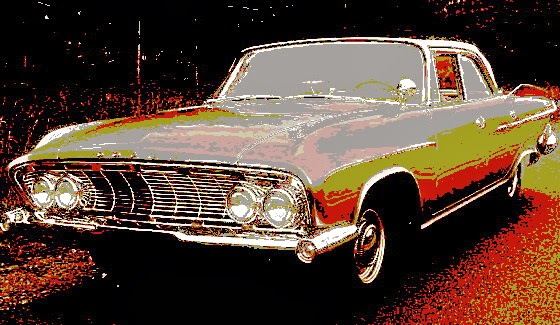
The party was being held at the Moulton Gun Club, a stark, white building in the middle of the countryside about halfway between Wapakoneta and Saint Marys, where my grandfather often went to shoot skeet. Late that afternoon, I picked Virginia up at Jeannie’s house in my sleek, waxed and polished, ’61 Dodge Pioneer. I was proud of my car. I had worked since I was twelve and was now eighteen and doing well for myself as a professional musician, musical instrument salesman and private percussion teacher, besides going to high school. This was the second car I had owned in as many years, and a real step up from the rust-laced ’57 Dodge Royal that I had previously purchased for fifty bucks when I was barely sixteen. So I felt flattered when I held open the passenger-side door for her to get in and she said, “What a beautiful car!”
 
I was proud of my '61 Dodge
For a while, that was pretty much the extent of our conversation. We both felt shy and couldn’t think what to say. She was so beautiful that I felt awkward and unworthy. It was a leisurely drive on two-lane country roads and I was trying desperately to think of something to ask her about her country or herself that wouldn’t make me sound like a stupid jerk from the outset, but my mind was a blank. Suddenly, she broke the ice.
She said, “Would it bother you if I smoked?”
In response, I smiled, reached into the inside pocket of the winter coat I was wearing, and took out my Philip Morris Multi-filters in their classy plastic box, thumbed open the lid one-handed and shook a cigarette part way out, offering it to her. “Here,” I said, “have one of mine.” I handed her my fashionable, grown-up, Ronson gas lighter and watched out of the corner of my eye as she lit up. It seemed to me that I had never seen a more beautiful or sophisticated profile and I knew right then that I was in love. I lit a smoke for myself and pulled open the ashtray on the dash between us.
Virginia, a few years later at Grand Lake

For a few seconds we smoked in silence. But then we started to talk and now the words came easier. The first thing she said was that her accent embarrassed her. I said that she hardly had one, that her English was excellent, “kind of British,” and that, anyway, I thought her Spanish accent was charming.
We had started out with plenty of time to get to the gun club. It was winter and the sun was already setting, but, on the spur of the moment, I decided to show my exotic guest some local color. So I drove a few miles out of our way and took her to see Grand Lake Saint Marys. I told her a little of its history, that it was the “world’s largest man-made lake.” She was duly impressed.
It was a stunning winter evening so I parked near the shelter house, and we took a walk along the now frosty shore in the abandoned state park grounds, where picnickers, water skiers, boating enthusiasts, anglers and beach-goers thronged in summer. It was freezing cold and daylight was fading fast, the sun now a creamy ember-orange glint on a snow-clouded horizon beyond the lake. But we strolled there in the dusk for a time and watched the last light of an incredibly beautiful Midwestern winter day reflected on the breeze-ruffled surface of the water that was frozen along the edges. When we got back into the car to go to the gun club for the welcome party, it was as if we already had a tacit understanding between us. We liked each other…a lot.