This little
bragging rights quiz was posted by Facebook friend and fellow Wapakonetan, Chris
Glass. Okay, Chris, I'm game!
The idea is to
see how many of these queries you can "heart". Typical of me, however,
I can't resist some clarifying comments:
Been
married ❤️
Been,
and still am, going on 52 years.
(Hold the applause).
Been
engaged ❤️
I suppose you
could call it that. No ring or anything. But for a couple of years I lived
halfway—well, let’s say, a quarter of the way—across the world from my future
wife, Virginia, and only visited her once, for a month, in Buenos Aires, my
first time out of the country. We had met when she was the first Youth for
Understanding exchange student at Wapakoneta Senior High from which we both
graduated that same year, 1968, that I sold my car, bought a ticket and flew
down to South America to see her.
 |
| With Virginia in the Paraná Delta, age 19. |
In fact, that
was my first time anywhere further from
Wapakoneta than Lake Superior or Niagara Falls—although once before that, I did have an inaugural half-hour joy ride
on a Lake Central prop passenger plane. It was a promotional flight to
advertise the opening of the then-new Lima (Ohio) Airport, which was supposed
to offer limited regular commercial services to Cleveland, Chicago and a few
other big cities, back when Lima was still a small but important industrial
town. Obviously, the rust belt that started a decade later changed all that.
Well, so, I won
it, the little Lake Central adventure, for being the top seller of a cookbook,
published in twelve installments, with a special hard-cover binder to which
purchasers added each new monthly section until they had a full set. It was
distributed through the local newsstand, whose owner, Russ McLean, every now
and then, had one of these moonlighting assignments for any newsboy, like myself,
with the ambition to take it on.
And then, after
that—after my exciting, life-changing roundtrip to Buenos Aires, not after my
half-hour of newsboy fame on Lake Central (they also gave me a coin-changer for
my weekly newspaper collections and a cheap Wiley Coyote-style Acme imitation
of a Kodak Brownie Star Flash camera)—I was more than halfway across the US
from her. She was studying at Bowling Green University in Ohio and the Army
posted me in LA. So, for nearly an additional year, I only got to see her on a
handful of long weekends, most of which were spent making my way, first, from
Fayetteville (North Carolina), and then, from Norfolk (Virginia)—my two
postings prior to LA—and finally, from California to Ohio via military standby.
But in those three years, I never dated anyone else, so, yeah, engaged I guess
you could call it, as in “taken”, not available.
Enough was
enough, and eventually I worked up the courage to ask her to make the insane
decision to give up a university scholarship and come out to LA and marry me,
when I was a Spec-4 soldier making a hundred eighty dollars a month. If my dear
cousin Dee-Dee were here, she would say—as she did at one of my book-signing
events in our mutual home town— “Tell them how
you proposed.” The answer (of which I’m not particularly proud) is, “Drunk,
from a phone booth, from the Army base in the Port of LA, forgetting entirely
that there was a four-hour time difference, and with her whispering urgently the
whole time that her roommate was sleeping and that she’d talk to me later, and
no, she wasn’t going to answer me that minute, and that, indeed, she was going
to be hanging up now!”
Still, when I
stepped out of the phone booth, I turned to a buddy who was waiting there, and
who had encouraged me to call her, and said, “Well, Dave, I’m getting married…I
think.”
Been
divorced
Like I said, no.
Till death do us part. That’s what we vowed to a nice lady called Judge Olivera
who married us at the LA County Court House. (We were No. 13 in the matrimonial
line-up that morning).
Been
to Disney World❤️
Yes, but only
because I traveled to Florida with my two oldest Argentine nephews, who were
fifteen and sixteen at the time, and wondered what sort of uncle I would be if
I refused, on ethical and aesthetical grounds, to take them to "the
happiest place on earth." I swear, it was utter torture for me, and
shockingly expensive, but I thought, "Okay Tío Dan, take one for the team." I was so proud of Federico,
the younger of the two, when, after several hours of hoofing through the “the
most outrageous place on earth,” he turned to me and said, “Tío, this place is all about money!”
I washed the
bitter taste out of my mouth by chartering a fishing trip with them out of Key
West. That was a great day! Fede even
hooked himself a pelican—an accident, actually: he was pulling out a
yellowtail, the pelican made a grab for it, got the hook instead—and Fede flew
the squawking bird around like a kite for a short spell until the skipper
hopped down on deck, reeled it in and unhooked it from my nephew’s rig before
setting the big bird free to go flapping away, wiser for the experience.
Skipped
school ❤️
Oh, hell yes, every chance I got. So many of
us used to skip school to hang out and shoot pool at the local Brunswick Bar
that the city finally named one of the owners, tough-guy Ike Schnell, to be the
ad hoc truant officer. What that
meant was that when we punks showed up at a suspicious hour of the day, Ike
would say, “Hey, don’t you have school to go to?” And before you could answer,
he’d say, “Get your ass outa here.”
Been
to Canada ❤️
Yes, a number of
times. In fact, there was a time I wanted to live there. Both Virginia and I
loved the city of Toronto. So instead of flying from Buenos Aires to New York
and then to Dayton when we were back home on a visit, we would fly to Toronto,
spend a few days vacationing there, and then fly across the “puddle” to
Cleveland and make our way home to Wapakoneta from there.
Once, when my
younger brother Dennis was managing a Camelot Records branch in Flint,
Michigan, we flew into Detroit instead, and then rode down with him on I-75 to
Wapakoneta for Thanksgiving. And still another time, autumn, not winter, we
rented a car and drove down from Toronto.
 |
| With Virginia in Toronto, 1979 |
We had a great
trip there at Christmas time in 1979, when we also traveled with my
brother-in-law, Miguel. A Buenos Aires boy born and bred, he found snow fascinating,
and Toronto didn’t disappoint, sparkling like a gem in a blanket of white and twinkling
with colorful Christmas cheer. We also spent a few days in the snowy Christmas
enchantment of New York, as well as in Washington DC.
Then, in
Wapakoneta for Christmas, we decided to do a winter road-trip and, in
neighboring New Bremen, bought a six-year old Chevy Caprice for six hundred
seventy-five dollars, because it was cheaper than renting a car, and toured six
states, along the way getting snowed in at Colonial Williamsburg, which turned
out to be a magical experience, because the power was down and the entire
seventeenth-century town was lit by candle and lantern light that night.
On the way back
we spent another few days in wintry Toronto, and none of us was really anxious
to leave. A few years later, I was tapping my contacts in the Canadian Embassy
in Buenos Aires to probe the possibilities of my getting a job with a Canadian
paper—ideally the Toronto Star—and
was told the chances were good if I first acquired a working knowledge of
French as well as my native English and fluent Spanish. I found a teacher and
started studying French, but then…I don’t know. Life happened, and Toronto
didn’t.
Rode
in an ambulance❤️
This happened
rather recently—2018. It was a really stupid freak accident. I slipped on the ice
right outside my door in Patagonia, and instead of just doing a prat fall like
any other normal human being, I rather dramatically fell from a height of about
seven feet into my patio, landed on my back on a rock and broke a rib.
I didn’t know it was broken. I mean, sure, it
hurt like hell, but I figured once I caught my breath, I’d be okay. I wasn’t.
By an hour later, I knew something was amiss because I could hear the two parts
of the broken bone click when I moved a certain way. So I had my wife drive me
into town to the hospital.
The emergency
room doctor examined me and, with her thumb and index digits, let her fingers
do the walking down the back of my ribcage until she found the broken one—she
knew right away because I about went through the ceiling when she came to it.
She sent me for an X-ray and confirmed her suspicion that the rib was broken.
“Not much you
can do for a broken rib,” she told me, “except make no physical efforts
whatsoever for six weeks, and get a lot of rest.”
It was winter
and living where I live in the Andes, winter means firewood.
“Can I chop
firewood,” I asked, rather obtusely, I admit.
“No…physical…effort!”
she said again emphatically. So clearly I was going to need help from a
neighbor to provide for our needs, which I’m never comfortable with.
I probably
should have mentioned to her that, at the time, I was taking blood thinners.
But I didn’t, even though I noticed she was closely examining the quickly spreading
hematoma on my back and side.
Long story
short, throughout the next day, I felt progressively worse. Above all, I was
exhausted, but I just put it down to the fall. That evening, I stood up from my
armchair in the living room and immediately felt dizzy, and then got tunnel
vision in which the tunnel was quickly closing like the aperture on a camera. I
thought to myself, “So this is what they mean when they talk about ‘blacking
out’.”
I managed to get
to the sofa and lie down, telling my wife I wasn’t feeling well and that if I
didn’t feel better soon, I was going to ask her to drive me to the hospital
again. But I never made it off the couch. I drifted in and out of consciousness
and, at some point, which I sincerely don’t recall, I told Virginia to call for
an ambulance.
How on earth the
two emergency folks who answered the call—one of whom, the most veteran of the
two, was a thirty-something woman who couldn’t have weighed more than a hundred
ten pounds soaking wet—managed to carry my two hundred fifty-pound humanity the
thirty yards up a steep hill to the closest place they were able to park their
ambulance, I have no idea. But somehow they did, and I will be eternally
grateful for their effort.
Gladder still
that they kept me alive while we were in the ambulance because, by that time, I
had a liter and a half of blood accumulated in my damaged lung and at least
another half-liter pooling in the hematoma on my back. I faded in and out of
consciousness all the way to town, a twelve-mile trip, and while the woman
drove, the male attendant kept talking to me and calling my name to keep me
from slipping away. At one point, I heard him say, “Better hit the lights and
step on it, because I’m having trouble finding a pulse.”
That was about
when I felt an enormous exhaustion and thought to myself, “This is a lot easier
than I thought. You just fall asleep and…let go.”
So yes, I’ve had
an ambulance ride—although I don’t recall much of it.
Been
to Hawaii
I haven’t been.
I read Hawaii by James A.
Michener when I was fifteen, and back then, as I was reading, I thought it
would be a cool place to visit. But after I’d read nine hundred pages or so, I
kind of began to think I knew enough about it for a lifetime.
My little
brother Dennis went there on his honeymoon the second time he got married. The
pictures he brought back were absolutely gorgeous. And I have a childhood
friend who moved there some years ago. It looks like he lives in paradise and
he seems quite happy there. But oddly enough, in all the places I’ve been and
everything I’ve seen, Hawaii has never been on the list of Next Places I Want
To Go. Not even, in fact, on my Bucket List, most of the items on which are
either in the continental United States or, even more pressingly, in the vast
expanses of Patagonia, where I make my home, and which it would be hard to ever
know completely.
Been
to Las Vegas
Oh, Vegas...
Well, Vegas ended up being another one of those misencounters between Whitie
(my dad) and me. And it’s just one more of those things I’ve had to feel guilty
about ever since.
Virginia and I
were back on a visit to Wapakoneta. Whitie, who was severely bipolar for most
of his life, was on a manic high. I had issues from childhood with his
bipolarity, since, as a kid, I had a lot of trouble separating the man from the
pathology. To me, his lows were always personal, and, I felt, somehow my fault,
because when he was like that, he seemed to find it exceedingly hard to love
me. And when he was on a high, I always had the feeling it was an act, that he
was reeling me in, making me feel everything was going to be okay, just so he
could dash my feelings on the rocks again when he plummeted back into the black
depths that seemed inevitable.
In other words,
in our dicey father and son relationship, I was always about me, never about
the hell Whitie was living through.
So, there came a
time, from my rebellious teens on, when I not only quit striving to please him
and to attract his affection, but also did pretty much everything I could to displease him. Much of the time, that
habit kind of carried over into young-manhood.
Whitie and I
really didn’t have the same taste at all in what we considered something cool
(or ‘neat’, as he would say) to do.
For instance, he
hated anything to do with camping and trekking—both of which I loved doing—since,
he said, “I spent four goddamn years camping and trekking in World War II and
don’t know why I should ever want to do it again.”
Meanwhile, some
of his ideal outings made me break out in a rash. Like the time he insisted we
just had to drive over to Fort Wayne,
Indiana for supper at this place where, according to him, “The food is good,
and cheap, and they’ve got this
organ. You’re a musician, Dan, you’ll love
this.”
“An organ?”
“Yeah, but not
just any organ. This one’s unique.
Only one like it in the world and
it’s right over here in Fort Wayne.”
“What’s so
special about it?” I asked suspiciously.
“Well, for one
thing, it has one of the most beautifully lacquered finishes of any instrument
ever made. It’s got…hey, Reba, how many coats of lacquer did that organ in Fort
Wayne have on it? Reba? Reba? Anyway, it’s got like, I don’t know, twenty or
thirty coats of lacquer on it and, I swear, Dan, I shines like a damn jewel.”
“Are we talking about
a pipe organ?” I ask dubiously.
“How the hell
should I know? No, electric I think. But you’ve got to see it. You won’t regret
it.”
Let him talk me
into that one. And did regret it, as
we ate greasy burgers and greasier fries, drank tepid beer and watched a coiffed
and sequined Fun-Machine artist play “Alley Cat” and other greatest hits on the
most garish organ I’ve ever seen, perched on an elevated turntable in the
middle of the eatery, which looked, for all the world, like a barely converted
warehouse.
So anyway, when
Whitie wanted to go to Vegas with us, I put my foot down. Vegas, I told him,
would probably be one after the last on the list of places I would ever want to
visit. Besides, who had the money to spend on five or six days in Vegas—the flight
out, the hotel, meals…
No, he told me,
all of that was really cheap because they wanted you to spend your dough in the
casino. But still, I countered, why should I want to spend any money on going to Vegas when I hated casinos and taking money
out of my pocket and putting it in the mob’s, or didn’t he know that the house
always wins?
“You don’t have
to gamble, Dan. Hell, there are all
kinds of great shows. Hell, Wayne Newton lives
out there. And all the other big names perform nightly.”
I was adamant. He looked dejected and said, “I just thought
maybe we could do something fun together. How ‘bout this. I’ll pay for it.”
When he said
that, I should have realized how important it was to him, because I think the
last time I’d heard the words, “I’ll pay for it,” from Whitie’s lips, I was
fourteen and had to have an emergency appendectomy. Still, I stood firm. Told
him to go with Mom if he felt like it, but that I had no interest.
He was
disappointed and his disappointment showed for the rest of the visit. As with
so many other unresolved things between Whitie and me, it’s one of those I wish
I could do over. Forget about the constant rivalry between us and just say yes! I’m sure we’d have had a ball.
So no,
regrettably, never been to Vegas.
Been
to Texas❤️
Yes. Just once. El
Paso. A horror story. It was in the eighties. I was feeling stuck in my job. I
was looking for a way to go back home to the States from Argentina, and I
reached out to the company that owned sixty percent of the newspaper where I
was editor.
The CEO was very
amiable but said there was nothing for me at headquarters in Charleston at the
time, but had I ever thought about electronic journalism.
I said, no, that
I was a writer and editor. I was a newspaper man, period. I liked hard news and
commentary. Yes, he said, but the future was electronic news media and as a
young, experienced guy, I might want to sink my teeth into it early.
 |
| Electronic journalism? I was a writer! |
They had a TV
station out in El Paso that needed to revamp its news department. It needed
better writing, better ideas, somebody who gave a damn about investigative
reporting. And they needed somebody with my language skills who could connect
with both the white and Hispanic communities. Why didn’t I just let him fly
Virginia and me out there to talk to the station chief before I decided.
The station
chief wined us and dined us at what he considered El Paso’s best Texas
steakhouse and filled me in. He wasn’t happy with his TV news section. The
reasons were the ones the group CEO had outlined earlier. He told me he’d have
“his guy” at the station show me around the next day.
It didn’t take
me long to realize that this guy was not only an experienced newsman, but a
fellow with a sound career in, and understanding of local TV. He showed me
around El Paso and the TV station—where I felt at a complete loss. He had a
keen insight into how being a border town affected places like El Paso. He was
a guy who had clearly overcome a retiring nature in order to become an
effective newsman. I got him and he got me.
That evening,
over cocktails with our wives, he said, “So Dan, what exactly is the job that
the boss is offering you?”
I said, “Well,
I’m not exactly sure, but it sounds like he wants me to head the news team.”
The guy slowly
nodded, gazing frankly at me, and said, “So, essentially, my job.”
“Geez,” I said, “I don’t think so. I mean, if
that were his plan, why the hell would he have you, of all people,
showing me around?”
“You clearly
don’t know the boss,” he said. “He can be one twisted sonuvabitch.”
The die was cast
right then, and if it hadn’t been, it was the next day when the boss told me
the salary he was offering, which was exactly a third of what I was getting as
a managing editor at the paper in Buenos Aires.
Visited
Mexico
Like I say,
close—El Paso, just across the creek. Well, and Senator Wash, California, just
a half-hour from the Yuma-Mexico border crossing. Speaking of which…
Seen
the Grand Canyon in person
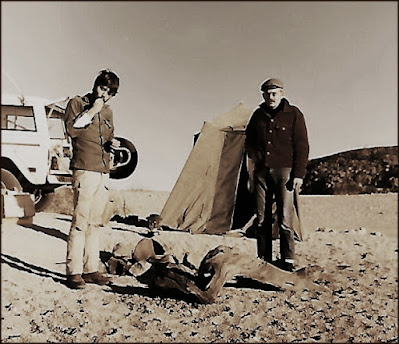 |
| With Army Buddy Dave Zeiss at Senator Wash, 1971 |
No, and I’d like
to. I did camp for a few days once with a couple of Army buddies at Senator Wash,
California, about half an hour from Yuma. Harsh, rough and absolutely beautiful
desert terrain and rocky chocolate brown foothills in the distance.Back then, I’m
talking 1971, it was a desolate place where there were mostly aquatic birds,
kangaroo rats, lizards, rattlesnakes, coyotes and wild burros—a legacy of
nineteenth century amateur miners. We didn’t see another human soul the whole
time we were there. I understand that, nowadays, it’s kind of a camping
hotspot. But that’s about as close to
the Grand Canyon as I ever got. Which isn’t all that close.
Flown
in a helicopter.
No. But once
during Basic Combat Training at Fort Bragg, North Carolina, the training
sergeant got the whole company together to listen to a recruiting spiel by a
chief warrant officer helicopter pilot. The guy was really a great salesman,
and by the time he was done, I was feeling really gung-ho about maybe just
reneging on my enlistment contract for the Army Bands and, instead, becoming a
chopper pilot.
The more I thought about it, the more I liked
the idea. And, I figured it might be something
Whitie could be proud of me for in my life. Especially since he was always
trying to get me to think about the future and he didn’t think wanting to be a
musician and a writer qualified. Having a helicopter pilot’s license when I got
out of service seemed like a pretty good tool to have—one that could get me a
high-paying commercial aviation job, or a respected post with lifelong benefits
flying a police chopper until early retirement.
My mind was
almost made up when I drew courier duty for the duty sergeant the next night.
My boss that night was a very veteran combat infantry sergeant. He had a chest
full of combat ribbons, so many that his medals made the other DI’s look like
rookies by comparison. Despite that, he was only a buck sergeant, which didn’t
make sense, until I heard from another drill sergeant that the guy had been an
E-7, got busted two ranks and did jail time for twice punching out superiors.
But he was too good at what he did to give him a dishonorable.
Obviously, he
looked older than his years. I’d been his courier before. That other time, we
started talking, which was odd. DI’s didn’t usually talk to maggots. But I’ve
always been a good listener. He told me he didn’t believe in the Vietnam War,
an admission that, coming from him, I found shocking. I asked how many tours
he’d done there.
“Four,” he said,
“which is why I don’t believe in it.” When he saw the unspoken question on my
face, he said. “So why’d I go four times, right? Because I’m a combat
infantryman. It’s what I do. It’s all
I know and I’m damn good at it, and Nam’s the only war I got right now. And I sure as hell would rather be there than
here trying to train you maggots.”
Taking advantage
of the intimacy of the moment, I said I’d heard the talk by the helicopter
pilot and was thinking about signing up for warrant officer pilot training
after Basic.
He looked at me
as if I’d just spit in his coffee cup, and said, “Are you out of your goddamn
mind, trainee? The life expectancy of a chopper pilot in Nam is about
seven-feckin’-minutes. Or why do you think they’re here trying to recruit you
friggin’ idiots? You can take down a chopper with an M-16. I have taken down an enemy chopper with an
M-16. Knock out the tail rotor and they drop outa the damn sky like damn lead
balloons. And you can bet your ass that as soon as they pin those WO-1 bars on
you, you’ll be off to Nam to fly combat missions.”
“So,” I thought,
“maybe Whitie’ll have to find something else
to be proud of me for.”
Been
on a ferry boat❤️
Been on a lot of
ferry boats—down on Chesapeake Bay, on the Main in Frankfurt and on the
Bodensee out of Konstanz in Germany, from the mainland to Chiloé in Chile, all
through the Delta out of Tigre in Argentina, and a number of other ferries in
different parts of the world. But there are two I remember particularly well.
 |
Reba Mae, Grandma Allice, Whitie, my sister
Darla and me on the City of Petoskey, 1953. |
The first was
when I was maybe four years old. It was on one of our summer vacation trips
from Ohio to Michigan’s Upper Peninsula. We usually went with Whitie’s parents,
Grandpa Murel and Grandma Alice, and a couple of days out of the always
fleeting week we spent in what were then the wilds of the UP, we did some
sightseeing that usually included a trip to the Sleeping Bear Sand Dunes and to
Traverse City.
I don’t know
why, but that year we also decided to board a ferry, christened City of Petoskey, that took us on a
cruise through the Straits of Mackinac between Lake Michigan and Lake Huron.
I don’t recall a
lot about the trip, except that it was a clear, clean summer day, the navy blue
of the deep water contrasting with the azure sky. I remember standing on the
deck of the vessel in the lake breeze, holding my Grandma Alice’s hand and
watching an old gent with the most beautiful long white hair, who was leaning
over the railing right below us and holding up pieces of stale bread that the
lake gulls gently and deftly took from his fingers as they flew past.
It was one of
the most magical moments of my infancy.
The other one
was when I was stationed with the Seventy-Second Army Band in LA. We had a
stage band gig on Catalina Island. The Port of LA was right outside the back
door of our barracks and rehearsal hall, so it was just a little drive in our
Army bus down the road to the terminal for the San Pedro Ferry. On a rare clear
day in LA, we could sort of make out the profile of Catalina straight out from
the upstairs window of the barracks. It was a twenty-six-mile voyage that took
an hour or so aboard the ferry. There was a little bar on the upper deck, and
some us had our morning coffee—others their morning beer—up there to while away
the time.
It was a warm,
dry, beautiful California day and this was a gig we could actually enjoy. We
were playing for a star-studded garden party at the fabled Wrigley Mansion—a
solid, sumptuous home, the true
foundation of which was chewing gum. We’d have been a lot more comfortable in
shirtsleeves than in our dress blues, but it was fun anyway and the hosts laid
on a wonderful luncheon buffet for us.
When we were
done with the gig, we were done for the day, so except for trying to maintain
the decorum befitting our uniforms, we could relax on the way back. Typical of
the Old Man, our chief warrant officer commander and band conductor, Mr.
Truitt, he was nowhere to be seen. When it came to enlisted men, he always made
it clear he wanted to be “familiar but not friendly” with us, so at times like
this, he made sure we didn’t see him and he didn’t see us.
Our first
sergeant was a World War II and Korea vet, Master Sergeant Nate Riddick. He and
I hit it off from the start. I was the Old Man’s clerk as well as a band
member, so Sergeant Riddick and I worked together on a daily basis. But on this
trip, we bonded more than ever before.
 |
| Master Sgt. Nate Riddick |
We were the
first ones in the topside bar on the way back before other band members started
drifting in. The bartender was a Vietnam vet and this was his first job since
getting out of service. He seemed to like it. “What can I get for you, Top?” he
said when Nate took a stool, and then added, “It’s on me.” Riddick thanked him
and asked for a seven-seven, then the barman turned to me and said, “How ‘bout
you, soldier? Don’t be shy, it’s on me.” So I asked for a vodka-tonic.
I guess the guy
saw Riddick’s Vietnam Service Ribbon and recognized a brother in arms. He
seemed to see me as an extension of the Master Sergeant since I had bellied up
to the bar with him, so neither of us paid for a drink the whole trip back. And
when he mixed them for us, he was generous with the hooch. Every time the master
sergeant reached for his wallet, the barman raised a staying hand and said,
“Your money’s no good here, Top.” He and Riddick traded war stories and both
Nate and I plied him with tales of eccentric musicians we’d known and worked
with. Meanwhile, he plied us with booze. The barman was also something of an
amateur comedian and kept us, and the other guys who drifted up, in stitches
for the entire voyage.
By the time we
docked in San Pedro, the top sergeant and I had pretty much drunk our weight in
free cocktails. I turned to him as I stepped onto the pier and said, “Hey
Nate,” first time I’d addressed him by his given name, “is this a floating
dock.”
He laughed and
said, “Sure as hell feels like it, but it looks like concrete to me.”
“Then I think I
drank myself legless,” I said.
From then on, I
only called him Top or Sergeant Riddick if we were in front of the other men or
if the Old Man was around. But when we were working alone together in the
office, I always called him Nate, even though he referred to me as Newland. He
was to become like a surrogate father to me for the rest of the year I spent in
LA, always keeping me on the straight and narrow and offering me wise advice. And
though I never saw him again, he often comes to mind still today.
I recently found
out that he lived to be ninety-two, and, in 2013, passed away in Carson,
California, where he had made his home since 1967.
Sang
in the rain❤️
Sure, hasn’t
everybody?
Been
to California❤️
As I mentioned
above, I lived in LA for a year, and that’s where I got married, so although
they were impoverished times, there were also some very happy ones there.
We didn’t have a
dime to spare, but we made the most of our newlywed status and were constantly
looking for little ways to celebrate. Walks and impromptu picnics on Cabrillo
Beach near the harbor or in Averill Park, up the hill from the port off of
Walker Street. An occasional sweet treat from the Pilatus Italian bakery, or a
delicious pizza from Nuncio’s—Nuncio himself would answer the phone and after
you placed your order, he would always say, “She’s a-ready ten-a minutes.” An
infrequent perusal on the Wines of the World basket in the local supermarket,
where, if you were lucky, you might find a decent chianti or liebfraumilch for less than a dollar.
 |
| Just married, LA, 1971 |
Even our
“wedding reception” was as fun as we could make it. Our witnesses, Spec-5
Branin Smith and his wife Shelley, took us out to Shakey’s Pizza after the
brief courthouse ceremony, and we all stayed there enjoying a prolonged
luncheon of thin-crust pepperoni pizza, drinking dark beer, and watching the
old silent comedy movies that they displayed on the wall.
I had found us a
small house in the backyard of a bigger house, both owned by an Italian
fishmonger called Migliaccio. I could barely afford it, but it was dirt cheap
by LA standards and a fairly cozy, quiet place, straight up a long steep hill
from my base, Fort MacArthur. But then another of the owner’s sisters moved
over from Italy, and he insisted we vacate that place and go to another rental
property that he owned, which he rented to us slightly cheaper in compensation.
It was the
downstairs of a two-apartment house. The upstairs, accessible by a steep ladder
staircase, was occupied by a hard-of-hearing retired Sergeant Major, who listened
to his radio and TV full-blast, and his blind old dog from which he was
inseparable. The house shared a yard with the home of another of Migliaccio’s
sisters, her husband and three kids.
It was a much
livelier place than the first one and gave onto an alley instead of a street.
The owner’s sister was wont to play opera loud enough for the whole
neighborhood to hear, and if the lyric theater happened to include a duet, the
couple was almost certain to break into song themselves, in a sort of experiment
in operatic karaoke.
They also had a
habit once a week or so of pounding on our door and hollering for us to “shut-a
da windows”. A warning that was followed by the husband, bare-chested and
wearing only thongs and colorful boxers, hosing down the entire house from top
to bottom, often while still singing his part in the opera over his shoulder to
his lovely wife, who, leaning out the back window of their place, answered in
kind, and in her best, if far less than successful, imitation of Renata Tebaldi.
But in its
defense, the apartment was clean and sunny, and we were still celebrating our
honeymoon.
Been
to New York❤️
New York had
been a dream of mine throughout my early days as a jazz musician. I promised
myself back in Wapakoneta that I would one day live in New York City, where I
would be both a successful studio musician and a bestselling author. But the
first time I actually went there was with an Army buddy from the Army Element
of the Navy School of Music in Little Creek, Virginia.
His name was Paul and he was utterly and
completely out of place in the Army. He was an accomplished pipe organist,
choir director and musicologist with a doctorate in liturgical music. He was so
brilliant that he’d achieved his doctorate and graduated definitively while he
was still young enough (barely) to be drafted, when he no longer had a student
deferment.
A balding,
pear-shaped, civilized, urbane and intellectually mature man of twenty-six, I
can’t imagine the hell that Basic Combat Training must have been for him, but
he’d enlisted, like I had, in the Army music program and, against all military
odds, made it to this music school assignment. A band posting was out of the
question—military music doesn’t include pipe organ and he had no talent for or
interest in jazz, so making him a piano-player in an Army stage band was out of
the question as well. But the Navy commander in charge of the school recognized
talent when he saw it and got Paul assigned, for the duration of his three-year
tour, to the institution, where he was promoted and given a teaching position.
We became
friends early on. And it was Paul, who was from the New York area and couldn’t
believe I’d never been there, who drove me up to the city one weekend and gave
me a tour of “his” Big Apple—the Church of the Heavenly Rest (which he
humorously referred to as “the celestial snooze”—another thing he told me was that
New Yorkers often refer to the two-tiers of the George Washington Bridge as
“George and Martha”: George is on top)— Union Seminary, where he had studied
sacred music, St. John the Divine Cathedral, and many other points of interest
throughout Manhattan that I’d only ever seen in the movies.
I would visit
New York a number of times after that—when I was a correspondent for ABC Radio
News, when I went to negotiate a reprint contract with Forbes Magazine for a business publication I worked for in Buenos
Aires, when I stayed for a few days with my friend and colleague Claudio
Remeseira and his wife Marcia at their place in Harlem, when I was there with
my wife and brother-in-law on vacation in 1979, and with Virginia another time
following a special issue presentation I made for the Buenos Aires magazine I
worked for at the IMF Annual Meeting in Washington. But I will always be
grateful to Paul for that first glimpse of one of the most fascinating cities
on earth.
Played
in band/school color guard/ orchestra ❤️
 |
| With fellow WHS drummers Jane Siferd and Mike Krebs |
Band became
pretty much my life throughout high school. Not only at school but beyond as
well, since it was through band and my two high school band directors that I
first started giving percussion lessons, first was introduced to the area’s
professional music community, joined the American Federation of Musicians,
started playing nightclub and country club gigs and landed a part-time job in a
music store.
As a high school
upperclassman, I lettered in band and served as head drummer, band president,
student conductor and director of the pep band that played at basketball games.
My senior year, I acted as the band director’s assistant arranger for the music
we played in the football halftime shows. I competed solo and with the band at
annual Contest, headed the percussion section two years in All-Area Band and,
in the summer of my junior year, won one of two scholarships to a two-week
Summer Music Clinic for gifted young musicians from all over the state, held at
Ohio University in Athens. I was also both a student and a marching and
percussion instructor for the younger kids at summer Band Camp my last two
years in high school
 |
| Directing the WHS Pep Band |
Yes, I couldn’t
have played more in the band if I’d tried.
Sang
in the school/church choir ❤️
I enjoyed
choir—or chorus, as it was called in school—but I only did it prior to high
school, because there, I was entirely too busy already with band. The first
choir I was in was the Children’s Choir at what was then the First Methodist
Church in Wapakoneta. I later graduated to the Youth Choir, but by the time I
was old enough to be in the main Chancel Choir, I was no longer attending
church—having, to Whitie’s chagrin, flatly refused to go any more after I
turned fifteen.
At school I was
in chorus during junior high—our director was Mary Lee Lament, who had, earlier
in life, been a member of a very famous professional choir, Fred Waring and the
Pennsylvanians.
I would make
only one more appearance as a clear but far less than outstanding tenor, when
my Army buddy Paul, whom I mentioned earlier, landed a weekend gig directing
the choir and playing the organ at a well-to-do church in neighboring Virginia
Beach. The choir was light on tenors and he asked me to sit in. I balked at
first, but I owed him so many favors I couldn’t say no, since he’d always been
generous to a fault. It was a lively group, he was a great director, and in the
end, it turned out to be fun while it lasted.
Sang
karaoke
Never had the
opportunity and can’t think how drunk I’d have to be to want to sit in a bar
listening to other drunks sing out of tune and out of time all night. That
said, when I was fourteen, I was in a kid band called The Trees, and sang
backup from the drum kit along with rhythm guitar player and childhood friend
Steve Combs. Our front man was Dave Emerson and the truth is, he’s the only one
who really knew how to sing like a pro.
Laughed
so much you cried and peed
Shed a tear or
two, but hey, even if I had done the
other thing, I’d plead the Fifth…or perhaps it would have been after a fifth.
Caught a
snowflake on your tongue❤️
Not only have I
caught a snowflake on my tongue, but have also, as a boy, been hit in the face
with and ice-ball and been taken down and had my face rubbed in the snow by
three older boys.
Had/Have/Having
children
No. We got
married at twenty-one (Virginia and I are the same age) and decided
definitively by twenty-three that we didn’t want to have children. We were from
the sixties culture when we still understood that humans were destroying their
own environment and when we still got that there was a certain carrying
capacity, which, when overtaken, would start creating problems that we wouldn’t
be able to solve.
The main issue
that we understood clearly then was overpopulation. (Indeed, the world
population in 1960 was three billion and today, just six decades later, it’s
eight billion, so the science wasn’t wrong about that). And in our youthful,
intellectual seriousness, we figured that there were millions of children
worldwide or even right around the corner who didn’t have homes. If we wanted
children, there were plenty to go around without our making more.
Then we got
older and wiser, and decided that, actually, the best reason for not having
kids was that the two of us were having enough trouble just bringing up
ourselves, without ruining some other poor human being’s life by messing up
their childhood as well.
That said, if
I’d ever had a child, I’d have wanted a little girl, who would have been the
smartest, most self-aware, most self-confident and most spoiled little girl in
the world. And when she got old enough to be interested in boys—if, indeed, she
was interested in boys—then I’d have
made every boy’s life who got near her a living hell, until I was sure he was
the love of her life, and deserved to be.
Had a pet(s) ❤️❤️❤️❤️
Over the years,
my wife and I have had many pets—dozens, in fact. In the twenty years that we
lived in Buenos Aires, we started out in our two-room efficiency apartment with
two cats (Capusát and Sweetpea), who gave birth to a third (Oliver), and moved
with us to our second, much larger apartment that had a lovely terrace balcony.
There, we added Maxwell, Rocky and Blueboy. By the time we moved to a house
with a full terrace Oliver was the eldest and he and the others moved with us.
There we added Chester (who died quite young of a heart ailment) and Rudy, a
strange, autistic cat who’d had such terrible experiences with humans that he
lived in a tree, and barely survived with the food a neighbor tossed up to him.
Food, water and our other cats eventually coaxed him down and he became part of
the family as well.

But things only escalated
from there. We were always finding a dog or a cat that needed a loving home,
and there always seemed to be room at the table for another one. Every one was
different, each with his or her own personality and with their own tragic
stories. Out of all the animals we’ve had, only one was born at home. The rest
were all strays and animals urgently in need of rescue. The most we ever had at
one time were seven dogs and seven cats. Now we only have three dogs, Simbad,
Calypso and Anteia, and six cats, Clemens, Nina, Emma, Josefina, Roxy Anne, and
Anabella.
This won’t be
the last time I mention them, I’m sure, because, whether still here or gone,
each has touched our lives in a different way, but always making us the better
for it.
Been sledding on
a big hill❤️
Born in winter,
it was about my favorite season as a kid. And from the time I was old enough to
have a sled—a beautiful Radio Flyer that I got for Christmas when I was about
six—I was always in search of the highest hills I could find to use as sledding
runs, which wasn’t easy since the land in our town is barely hilly. To my
father’s fury, because of the ruts it made in the yard beneath, down the embankment
in front of our big old house on West Auglaize. Down the low slopes of Harmon
Field, our main city park. Down the icy dip in our road on Kelley Drive. Down
the banks of neighbors’ backyards along the Auglaize River. Wherever there was
the slightest incline in our snowy west central Ohio winter, my Radio Flyer and
I were there.
Rode on a
motorcycle ❤️
When I was about
fourteen going on fifteen, I got a job as an usher and janitor in the Wapa
Theater, our local movie house. There, I made friends with a boy nearly two
years older than I who was the projectionist. His name was Howard, but
everybody called him “Herbie”. It was funny. Everybody you talked to liked
Herbie. What wasn’t to like? He was a really good guy. Do anything for you. But
he didn’t really have a lot of friends, people he hung out with. He was,
basically, a loner.
Despite that,
Herbie was ubiquitous. He was the yearbook photographer at school, the manager
for a couple of the sports teams. He was always on the fringes but never really
a direct part of anything that was going on.
I think it was
that eccentricity of Herbie’s that made me like him. Since we worked together at
the movie theater and were often the last ones there—him busying himself with
maintaining the arc-light projectors, making them ready for the next night’s show,
me cleaning up the theater, and then both of us changing the marquee together
whenever the movies changed—we talked a lot. It was something neither of us did
very often with other people. Not, at least, about what bothered us or what our
dreams were, or which girls we had crushes on but who hadn’t the slightest
inkling we were alive.
So anyway, at
some point that year or so we worked together, Herbie surprised everybody by
acquiring a barely used Honda Superhawk 305 motorcycle. It was black and silver
and killer-sleek, and suddenly, Herbie had a brand new loner-cool mystique.
For several
months, when he wasn’t giving a lift to any girl adventurous enough to hop on,
I cruised around on the back of Herbie’s bike with him every chance I got and
couldn’t wait to have the age and the money to get one myself…that is, until we
laid it down on the ice once and he flew one way and I the other, while the
heavy Superhawk, luckily, found a path of its own.
Suddenly, Herbie
had a Fury and then a Mustang, and I kind of forgot about motorcycles forever.
But it was fun while it lasted.
Been to a
drive-in movie ❤️
Loved the
drive-in. We went fairly often with Whitie and Reba Mae when my sister Darla and
I were still small. But when my little brother came along five years after me,
it was too much trouble for my parents to go with Darla and me and a baby, so
the habit kind of petered out.
It was fun, but
the concession stand wasn’t part of our outing, though Darla and I both begged
and whined for it to be. Instead, my mother would take pressed ham sandwiches,
a big bag of homemade popcorn and “some nice apples”, as she said. If we were
thirsty, there was a Thermos of “nice Kool-Aid”, because, Whitie let us know,
he wasn’t about to pay “the goddamn outrageous prices” they demanded in the
concession stand.
Depending on
what was showing, we went to the Midway, halfway between Wapakoneta and nearby
Saint Marys, or we drove a little further and went to the Sharon or the Gloria
in Lima, Ohio, north of us fifteen miles.
But I never
really knew how much fun the drive-in could be until high school, when some of
us got driver’s licenses and cars of our own—‘nough said.
Rode an elephant
or camel
No. Never been
to Asia or Africa. A camel did spit
on me at the zoo once though.
Rode a Horse ❤️
I mean, rode is misleading. Bounced around like
a sack of potatoes on a horse is more like it. As a little kid I always wanted
to go on the pony ride at the fair. In the Army, during Basic Training, I found
out that Ft. Bragg had some stables and, on Sundays, if a trainee was willing
to go after chapel and shovel manure for a few hours, he would be rewarded by
allowing him to exercise a horse or two for another couple of hours.
There were a lot
worse things you were called upon to do than shovel manure in Basic Training,
so it seemed like a nice outing. I did it a couple of Sundays during my
eight-week cycle.
Longest horse
trek I ever did was in the Patagonian province of Chubut, nearly five hours
into the mountains and three hours back. It was an incredible adventure, but it’s
a long story that’ll have to wait for another day.
Been on TV ❤️
Several times as
a newsman guest on national stations in Buenos Aires back when I was a
newspaper editor. I was also called on once, while I was a radio correspondent
for ABC in Buenos Aires, to do a TV broadcast because they didn’t have a
television correspondent available. That time, as in the cases of the guest
spots, I was like a deer in headlights, my mouth almost too dry to speak. In
every case, everyone seemed pleased with my performance, but you sure as hell
couldn’t have told it by me.
Stayed in the
hospital ❤️
Had an emergency
appendectomy when I was fourteen and fell impossibly in love with a young nurse
called Miss Weir. She was the one who gently did the preliminary preparations
on me for surgery.
I lost one of my
socks somehow in the emergency room. After the operation, I found the missing
sock on my hospital nightstand. It had a note safety-pinned to it. I think it
read something like: “Found this sock in the emergency room. Think it’s yours.
If not, please advise the nurse’s station.” It was signed, Nurse Weir, and she’d
drawn a pretty little daisy with a smiling face next to her name. I think I
kept it in my sock drawer until I graduated high school.
Been in a few
other times. Once in my fifties when I severed a tendon in my foot and needed
surgery. Another time when a bout of chronic arrhythmia landed me in the ICU
for a few hours. The last time in 2018 when I was in for a week after the
accident I described earlier.
But the only
other time that stands out, was when I was seventeen, was already a working
nightclub musician, and had to have an upper and lower GI series done because I
was having stomach problems.
Part of the
testing was particularly humiliating. I was taken to an exam room full of
complicated equipment. A very pretty young technician, assisted by an equally
pretty younger technician, first flipped me over onto my stomach on a table. I
was wearing a hospital gown that, from the rear, left little to the
imagination. I kept reaching back and trying to cover up, but there simply wasn’t
enough gown to go round. The pretty technician patted my shoulder and said, “Don’t
worry, honey, I’m gonna have to get in there anyway.”
Very soon, she
kept that promise, priming me with some lubricant on her gloved finger and then
replacing the finger with a slender hose that she slipped in pretty much as far
as it would go. Then she opened the valve on a large pouch of thick white
liquid that she allowed to drain into me until I felt like bursting.
While this was
going on, she said, “You look so familiar. Do we know each other from
somewhere?”
“No,” I said
laconically, and inside my head I was screaming, “Geezus! Tell me she doesn’t know me!”
Then she leaned
close, put her hand on my shoulder and said, “Okay, I’m gonna take this out
now, and you’re gonna have to hold all that liquid I put in you, okay? Don’t
let it go.”
Easier said than
done. I almost lost it when she pulled the hose out. Then she strapped me down
and said, “Okay, now we’ll take some pictures.” With a remote control, from a
safe distance, she maneuvered the hydraulic table this way and that, snapping
X-rays from this angle and that for what seemed like forever while I made such
an effort to hold onto the liquid that sweat beaded on my forehead. Finally,
after flipping me so I was almost standing on my head, with the gown up around
my waist for the final portraits, she said, “Okay, all done. See, that wasn’t
so bad, was it.”
“No,” I thought,
just the most humiliating experience of my life. “Okay, honey, there’s a toilet
right over there behind the curtain. You can go get rid of that stuff now.”
It was as I rushed
over to the curtain, pinching my cheeks together to make sure I made it, then
took a seat and let go of the liquid in a noisy torrent, that I heard the
technician said, “Hey! Now I know
where I know you from. You’re the drummer with the jazz trio that plays at the
Wayside. Hey, you guys are really good. My boyfriend and I go to hear you all
the time! Next time, I’ll say hi!”
Donated blood or
plasma
Can’t. I’ve had hepatitis
twice. Long story. I've gotten blood though. Two transfusions after almost bleeding out.
Gotten a
piercing
Can’t imagine
what I could possibly want pierced. Certainly nothing normally invisible to the
passing eye. Maybe a single earlobe. If, that is, I could find a very specific
earring that I always thought would be cool—a large gold hoop with a big green
parrot perched in it. It’s that or nothing. Driven a stick
shift vehicle ❤️
All the time.
Ever since I’ve lived in South America, I haven’t driven anything else:
three-speed on the column, a French dash-mounted four-speed, four on the floor
and five on the floor. Currently, a five on the floor with high and low four by
four.
Got a speeding
ticket ❤️
Once, in the
middle of nowhere, on the outskirts of a Patagonian town called Picún Lefú. It’s
in the middle of the high desert. Nothing around for miles. The town surrounds
a hydroelectric project. As I’m coming up on it, I see a sign reading “Urbanized
Zone 40 kph”. That’s like 25 mph! I’m on a highway where I haven’t seen ten
cars in the last hour and I’m easily doing 70 mph, or about 112 kph.
Seeing the sign, I think how ridiculous it is
because, as far as I can see, there’s nothing out here but scrub brush, coarse
volcanic sand and the occasional bird of prey. But signs are a rarity in
Patagonia so I don’t brake, but I do take my foot off the gas and am letting
the car slow naturally, when I come out of a long curve and, up ahead, I see a
provincial patrolman pointing a radar gun at me.
His partner
waves me over. They tell me I was doing 70 kph in a 40 zone and write me up.
They tell me I can pay it at the police station a click off the main road. I
take the ticket and say, “Fine.” Then I add, “You know, there are studies that
show that policemen who have to use these radar guns all day often wind up
getting cancer.”
Gave him
something to think about.
Gotten stitches
or staples ❤️
Yep. I have an
appendix scar with stitch marks, one on the side of my right foot where they
repaired my severed tendon, and one high up on the right side of my thorax
where they put in a drain to empty out the blood that accumulated there after I
punctured my lung.
Traveled
alone ❤️
For the last
twenty-odd years, all the time. Ever since we moved to the mountains in
Patagonia in 1994, my wife and I, as I say, have hosted a large number of cats
and dogs in our home, which really is their
home. We don’t have anyone we can or want to leave them with in order to go
away for any length of time, nor is it safe to leave a cabin in the woods alone
very long either. Too many things that can go wrong.
So we never
travel together. One or the other of us is always at home.
Been
zip lining
Never saw a zip
line I would have trusted to hold my weight without snapping. And don’t tell me
they’re made to hold a lot more than a big man’s weight because there’s no way
to prove that until you find yourself in the middle of it.
Shot a gun❤️
My father, a guy
who earned four bronze stars in combat during World War II, was bitterly
against having guns in the house. This was probably for the best since he
suffered from prolonged manic lows in which he was considered potentially
suicidal.
But I spent a
lot of time with my maternal grandfather in the great outdoors, and he was a
hunter. So there was pretty much nothing I wanted more than a gun of my own
when I was growing up.
I finally got
one on the sly from a friend when I was fifteen. Bought it for ten dollars,
since he’d gotten a new semi-automatic .22 for Christmas. It was a single-shot,
bolt-action .22-caliber. I kept it hidden in my closet and had to sneak it into
and out of the house, but every chance I got, I was down by the Auglaize River
plinking away at cans and rusted out oil drums and all sorts of other junk that
littered the shallows. I did a little hunting with friends in high school but
was always more interested in being a good shot than in actually killing
anything.
In the Army, the
years of plinking away with my single-shot .22 paid off.
On the shooting
range, during Basic Training, the captain came up behind me while we were
practicing. I was in the prone position at the time and there were a hundred
and ninety-nine other M-16s rattling away around me, so the officer rapped on
my helmet with a stick he was carrying to get my attention. When I saw it was
him, I sprang up and snapped to.
“Captain, sir!”
I said according to protocol.
“At ease,
trainee. Do you always shoot left-handed?”
“Yessir, I’m a
southpaw, sir.”
“You’re gonna
burn hell outa your face that way with the brass ejecting right.”
“Yessir,” I
said. He was right. A small blister had already formed just beneath my
cheekbone and I’d had to learn not to flinch every time a capsule was ejected.
“You like bein’
burnt, trainee?”
“Nossir!”
“So lemme see ya
shoot right-handed.”
“Sir?”
“Right-handed.
Ya know left from right, don’t you?”
“Yessir.”
“So get your ass
down there and shoot right-handed for me.”
I did as I was
told, emptying a clip without hitting a single target.
“Awright,” he
said. “Switch to left again.” I reloaded and, on his signal, emptied the
twenty-round mag one shot at a time in slow, deliberate rhythm. Every shot was
a kill.
“Damn, trainee,”
he said, “I think we finally found something you can do. Put a piece of tape
over that cheek and carry on.”
On qualifying toward
the end of the cycle, I shot the highest score in the battalion and was given a
three-day pass, as well as an Expert Marksman’s badge for the M-16. The
training taught me that an assault weapon “isn’t your daddy’s shotgun” and that
it is designed for one thing and one thing only—killing people as quickly and
effectively as possible.
Although I still
own a few guns today, I have long been an advocate of sensible gun control, and
knowing what I know about AR-type weapons—of which the M-16 is the granddaddy of
them all—I don’t think they have any business being in civilian hands or
anywhere else but on the battlefield.
Been to another
country❤️
 |
| On the Bodensee |
This could be my
longest story yet, but I’ll save the details for some other time. But thanks to
the Army, for Virginia and me, my last fourteen months in the Army and our
second year of marriage was, for the most part, an almost bohemian existence
in which, except when I was on duty, we lived as if we were two people on an
extended honeymoon. When we weren’t on tour with the Thirtieth Army Band in
Germany and France, I was free on compensatory time that we spent traveling on
our own. Daytrips all over Germany visiting museums and castles, staying in
quaint gasthausen and enjoying a meal
and a beer in taverns that had been taverns for hundreds of years. Taking
weekend trips to Paris and staying on the bohemian Left Bank. Making longer
journeys to Switzerland, Italy, Monaco and the Mosel wine valley, to Bavaria
and Austria, and all like two veteran travelers with all the time in the world.
In South
America, both my work and pleasure have led me to explore some of the vast
regions of Argentina and to travel to Chile, Uruguay, Paraguay and the
Tri-Frontier of the northeast. And there’s still so much more I’d love to see.
But as I never
tire of saying, every time I go back to my home town of Wapakoneta, I find
something new or some memory of old to write about. And although I’ve traveled
to many different foreign lands, some of the most breathtaking sights I’ve ever
seen are within easy walking distance of my Patagonia home.


