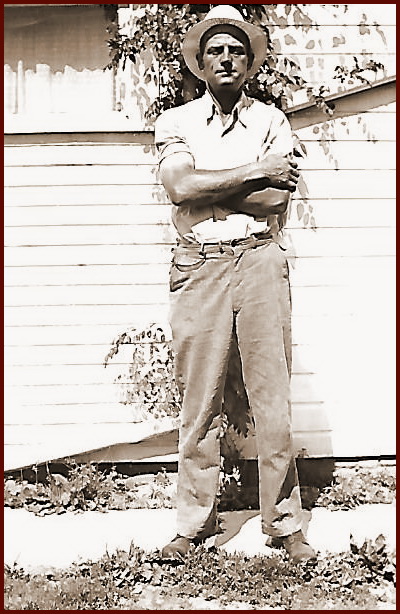
I’ve been an orphan since July 22nd, 2003. I was going on
fifty-three when it happened. I guess a lot of people wouldn’t call that being
orphaned. But consider for a moment that many people are never prepared for losing their parents, no matter when it happens
in life.
 |
| Reba Mae - 1941 - aged 18 |
I think sometimes for expats it can be particularly bad because you don’t
get to see your parents often. In my case, once a year if I was lucky and a
couple of times it was several years between reunions. Not only does that generate
a lot of regrets, but it also means that you tend to freeze your loved ones in
time. In your mind they never age. But then they do. And then they die.
I have friends my own age (which I’d rather not talk about) who still
have one or both of their parents. If their parents are still well and happy,
which some of them apparently are, I admit that I envy my friends that
blessing. If mine were alive today, my father would be ninety-seven and my
mother ninety-six. People actually live to be that age nowadays, some of them
quite well.
My mother Reba Mae died the same year as my father Whitie did. They were
both eighty. Reba Mae was the last to go. Whitie preceded her by six months. I
can’t be sure, but I think that might have been a kind of pact they had. I
mean, they had been together for sixty years. And from the time he was in his
sixties, Whitie was always saying that he hoped he went before she did, because
he “didn’t know what he’d do without her.”
Hearing that, a stranger might say, “Aw, isn’t that sweet?” But, believe
me, that wasn’t the kind of romantic thing Whitie might say just to be sweet.
He really didn’t have a romantic bone in his body. At least none where anyone
could see it. Example: One year for
Christmas, he got her a lightweight aluminum snow shovel and put it under the
tree with a red bow on it. To be fair, that same year he also got her a pretty
tweed coat with a Russian black squirrel collar. But...you know.
 |
Lennox School on the Hardin Pike 1933-34 - one of
the one-room
schools Reba Mae attended. That's her, the
one with the banana
curls just in front of and to the right of
the teacher. She was 10.
(Courtesy of WDN and the Linda Knerr
Collection)
|
Clearly, although Whitie did have a funny sense of humor, whenever his
perennial depression let it shine through the clouds for a moment, the snow
shovel wasn’t a prank. It was like, “Okay, what’s Reba been wanting? A new coat
and, oh yeah, a lightweight snow shovel!”
When my sister Darla, who was about eleven or twelve at the time—and
quite precocious—pointed out that a snow shovel for your wife was about the
most thoughtless gift she could imagine, Whitie countered that he didn’t see
why. She’d been wanting an aluminum one for years. He knew because he’d had to
listen to her bitch about how damned heavy the coal shovel was when it was full
of snow. So, he indicated, buying her the shovel she wanted seemed to him to
show that he was thinking of her.
“Besides, don’t you think the coat I got her’s pretty snazzy?” he wanted
to know, “I sure do. That’s a genuine Russian black squirrel collar on it too.”
So no, his talk of wanting to die before she did wasn’t a sweet nothing.
It was pragmatic, practical, because when he said he “didn’t know what he’d do
without her,” he actually meant that if she weren’t there to tell him where it
was, he literally wouldn’t be able to find his ass with both hands.
I’ve written a lot about Whitie over the past few years since his death.
Anyone who has read any of those musings knows that my relationship with my father
was, to say the least, conflictive. But that doesn’t mean I didn’t love him. On
the contrary, perhaps I loved him more than was good for me and struggled with
his apparent lack of empathy for me and with never seeming to be able to
achieve any perceptible level of approval from him.
 |
Reba Mae, her older brother Gene and their little brother
Kenny. Country kids.
|
His importance to me, nevertheless, should be clear from the fact that,
although this is supposed to be a story about my mother, I’ve spent a not small
part of the first paragraphs of it talking about my father. But that’s not an
error. It’s a given, because the all-pervasiveness of his influence on my
mother’s life, let alone mine, would be difficult to overstate.
Suffice it to say that his death—and his dying which drew out
agonizingly over the course of several years—proved highly traumatic for me.
Much more so than I could have imagined, since throughout much of his life and
mine, I’d heard him talk a lot about wanting to die, and hearing his successive
therapists opine that he was indeed suicidal when at the lowest levels of his
half-century struggle with manic depression (or bi-polar disorder as it is
described today).
Perhaps this was because his way of facing the inevitable demonstrated,
beyond a shadow of a doubt, what I had always suspected. Even when his doctors
claimed he was suicidal. Namely, that as a suicide, Whitie was a phony. That he
didn’t survive long years of combat during World War II because he had a death
wish. That when he came face to face with death, when it grabbed him by the
throat and sought to choke the life out of him, he latched on and choked it
right back, even though he knew it was futile, that he was hopelessly
out-gunned. So it was that, when he was diagnosed with lung cancer, although they
told him they figured he’d be dead in six months, he fought it for four years.
The symbiosis between my parents was palpable to me as a child. Not so
much when I was small, but surely by the time I reached my pre-teen years.
Despite being the good and loving parent that she was, no one had to tell me by
that time that Whitie was Reba Mae’s favorite “child”. Although “favorite” is
perhaps not the right term. He was the “child” who most required her help and who
most fully absorbed her attention. To my siblings and to me, Reba Mae set the
tone for our relationship with her by saying, “I’m not worried about you. I
know you’ll always do the right thing and make the right choices, ones that’ll
make you proud of yourselves and make your father and me proud of you too.”
Now, we all handled that crushing responsibility in our own way. It was
probably toughest for Darla, because she worked hard at being the model
daughter, the straight-A student, the best musician, the best she could be, in
fact, in every extracurricular endeavor, a popular girl in school as well—a
leader. She made it look so easy. But when we became adults she once admitted
to me that it had been almost overwhelmingly hard.
Our little brother Dennis James (or Jim as we called him at home) seemed
to have the healthiest attitude. It was like, “Great! It’s all up to me so I’ll
do whatever I want.” And boy, did he ever!
He literally did it his way practically from the time he was a very little boy.
And yet, a lot of the erroneous choices he made, and that lonely feeling of
performing on the high-wire without a net, haunted him and caused him great
suffering later in life.
For my part, I just mostly muddled through in every respect except my
music and my writing. Those were areas where I was in my element, if badgered
by self-doubt all the same. Because I took my mother’s demand for commitment
and self-governance dead seriously, I was doing that high-wire act from the
outset, and always with the nagging feeling that I was screwing it up. That I
would, ultimately, fall from grace, and let everybody down. Those self-doubts
and constant misgivings turned me into a fiercely independent and often
secretive and taciturn teen—a stage when one of my favorite pop songs was Simon
and Garfunkel’s “I Am a Rock (I am an island)”. If I was screwing up, I was
doing it in private and without asking for help from anybody.
This was the exact opposite of how I had been as a little boy, when I
drove my mother nuts with my worrying about every little thing and constantly
asking her if I was making a mistake, being bad, endangering my health,
sinning, and so on. She had trouble recognizing me as a teenager. And although
I’d driven her to distraction as a worry-wart kid, she wouldn’t have minded
having that kid back again, I’m sure, from the time I was thirteen or so.
The month of May always brings back Reba Mae to me more than any other
time of the year. First there’s Mother’s Day, and then, a few days later, on
the sixteenth, her birthday. It’s a time when I try to remember her out of
context, as if she were nothing to me. In other words, without seeing her in
the reflection of my own passions and biases.
 |
Reba Mae (right) with her parents (left)
and siblings, Gene (rear), Ken and Marilyn
|
Although I’ve always been a storyteller, I think my mother’s death was
the first time that, in a flash, I could see a person’s life from start to
finish, and realize that each individual’s time on earth is just that—a story,
with a beginning, a middle and an end. In between, there might be rising
action, climax and denouement before the inevitable end. Or there might be an
anthology of short stories, a sort of life storybook, with a series of
beginnings and endings, comings and goings before the last page is written and
read. Or in some cases, a life will seemingly flat-line from beginning to end
and barely make a ripple. But in those cases, I always suspect there is some
underlying secret that no one else will ever know, but that piques, like
nothing else, the curiosity of writer types like myself.
Reba Mae was a very internal person. Her younger sister Marilyn once
described that as a trait of the Weber side of the family. What she actually said
was, “We Webers are all a bunch of tight-lipped krauts.” But in Reba Mae’s
case, I could sometimes see a glimmer of her rich inner world, into which she never
intentionally let anyone, and especially not Whitie. That was where she lived in
the quiet moments. It was her survival mode. Since although she sought to keep
it simple on the surface, she was a highly cerebral woman.
Given half a chance, Reba Mae could have been just about anything she
wanted to be. She was intelligent, creative, curious and witty. She was also
beautiful, a real knockout when she was young. But she was also almost
pathologically shy in her younger years, and under-confident throughout most of
her life.
Reba Mae's maternal and paternal families:
(Left rear) paternal grandparents Salome (Leninger)
and John Weber, followed
by her maternal grandfather
Job Cavinder, and by
her father Vern Weber.
(Middle row left to right) Maternal grandmother
Mary Landis Cavinder, holding Reba,and Reba's mother's
sisters, Edith, Flossie and Ruth. Kneeling, her mother's
brothers, Jesse and Ivan, who is holding
Reba's brother Gene.
|
Because she was so beautiful and intelligent, her shyness was often
mistaken for haughtiness. Nobody could understand why such a gorgeous and very
apparently smart woman would have anything to be under-confident about. So when
she lowered her head and walked by somebody like she hadn’t noticed them, some
people took offense and described her as “stuck up”. It wasn’t until they got
to know her a little that they realized her reluctance to engage was all about
not knowing why anybody would be interested in talking to her, so best not to make
them feel obliged to say hello if they didn’t want to.
 |
| Reba Mae's father, Vern Weber |
Reba Mae was the daughter of a tenant farmer. My grandfather, Vern
Weber, was the son of immigrants. His parents were Germans from the Alsace
Lorraine. My mother would sometimes reflect that it made her sad to think of
her grandmother, because the only thing she could remember was that her Grandma
Weber was an unhappy woman who never smiled.
They had a small farm of their own near the village of Glynwood in west
central Ohio. When Grandpa Vern first married my grandmother, Myrtle Cavinder, who
herself grew up on a farm near Jackson Center, he built them a bungalow on his
father’s property, figuring he would one day inherit the farm. Instead, when
his parents died, according to my mother, the farm went to a couple of old
bachelor uncles. It caused bad blood in the family and apparently had something
to do with Grandpa Vern’s sister, to whom he didn’t speak for twenty years or
more.
Long story short, my grandfather ended up working as a tenant farmer
within the farmland empire of another German immigrant, Charles Herbst. He
worked three different farms for Herbst in Shelby and Auglaize Counties before
eventually moving to the Auglaize County seat, Wapakoneta, my home town, once
my mother and her older brother Eugene reached high school age.
 |
| Egg money helped make ends meet. |
So, Reba Mae spent her childhood in the countryside. She grew up during
the Depression, so times were tough. But thanks to the fact that they lived on
farms, her family always had enough to eat. And between the thirty dollars a
month that Herbst paid for living expenses, the money my grandmother made
selling eggs and a small share of the crop harvest and dairy production, as
well as my grandfather’s skill as a small-game hunter, they managed to make
ends meet.
But until her family moved to town, Reba Mae never lived in a house with
electricity or running water. She attended the one-room schoolhouse nearest to
whichever farm they were living on and did her homework by the light of a coal-oil
lamp. School was always at least a mile away and she either walked it or rode
her Shetland pony. The homes she lived in always had an outhouse, a hand pump
in the kitchen sink and a woodstove for cooking and heating. The one modern
convenience was always a telephone, a wall-type device that featured a crank-operated
ringer box with a fixed mouthpiece and a detachable cone-shaped audio handset.
That life instilled my mother with an inherent love of animals and
nature in direct conflict with a distaste for any and all things “rustic”.
Although she deigned to live in a cabin at the Buckeye Rustic Resort on Lake
Manistee in Michigan for a week’s vacation once a year, that was the limit of
her stomach for life in the wild. While she was frugal and unassuming as an
adult, she wanted every comfort and modern convenience money could buy...including
a lightweight aluminum snow shovel.
(To be continued)