Showing posts with label Wapakoneta. Show all posts

Wednesday, October 22, 2025

I’M BACK…LITERALLY AND FIGURATIVELY

It’s a grey, breezy, Great Lakes-type of day in Cleveland today.

I arrived here day before yesterday. As per usual, I had first spent several days in Wapakoneta, my home town. I stayed in my little “home back home”, the Moonflower Inn, a tiny house with a miniature sitting room, a comfy bedroom with almost wall to wall king-size bed, kitchenette and bath. Perfect for a family of one (or two…if you are very intimate).

I flew in from Miami, where I’d spent a couple of days on business. My friend Mary Jo was waiting for me at the Dayton airport, and drove me the hour from Dayton to Wapak, where she handed me the key to her lovely van and told me I could use it until I went back to Argentina. Mary Jo’s the best.

We made a brief stop in Troy, Ohio, just north of Dayton, for supper—early for me, late for Troy—at a nice family restaurant. There, we both had the beef Manhattan—which the restaurant menu referred to as an “open-face beef sandwich”. It was Mary Jo and I who remembered the name “beef Manhattan”. And then I recalled that it was also, back in the day, sometimes called a “beef smear”.

It was absolutely delicious, and the first one that I, at least, had eaten in more than fifty years—thin-sliced lean beef, on a bed of bread and mashed potatoes, and the whole thing with clear beef gravy ladled over it. I’ve been on  a self-imposed diet for a few months and have shed thirty-five pounds or so. So, it wasn’t exactly what I should have been eating, but I justified it by virtue of the fact that it was now after seven in the evening, and I hadn’t eaten anything since a light breakfast at my hotel in Miami twelve hours earlier. I relished it and felt no pang of guilt. It was as much a pleasant memory as a meal.

How so? As soon as I shoveled the first heaping, dripping forkful into my trap, I immediately recalled all the old places where I used to enjoy this once common dish, back in the days before high-tech, the Internet and social media. The most indelible memories were of my teen years working in Lima, Ohio. From the time I could drive, I worked for a music store that was in the first block south of the Public Square on South Main Street. It was my first contact with other professional musicians and, at the time, seemed like a dream come true. I taught percussion there, and in free hours between students, sold musical instruments and all the stuff that goes with them—reeds, mouthpieces, drumsticks and mallets, mutes, capos, ligatures, guitar and bass strings, violin, viola, cello, and acoustic bass strings, horsehair bows and rosin, picks, bridges, pick-ups, valve oil, and so on and so forth. It was through my contacts there that I also started picking up nightclub gigs. Just a few at first, and then a busier and busier schedule. By my junior year, I almost didn’t have time for high school.

A week later, already up here in Cleveland, I would find myself in a cramped little Irish pub—owned by the also-proprietor of the barbershop next door, a guy called Sean Gormley—listening to an old blues-singer-guitarist called Austin. Like I say, Gormley’s Pub is little, peopled mostly by Rocky River regulars, so the performer is right there on the floor with you. Well, Austin and I fell into an easy conversation, he sipping tequila shooters and I quaffing Guinness Stout, about the old days in music. It was great to reminisce about those days when live music was everywhere, and we all lived off of making it.

Anyway, the music store in downtown Lima was a very human place to work, and my schedule always included ample time to have lunch or supper. And the beef Manhattan was often my meal of choice—abundant, reasonably priced, and absolutely delicious. When I worked until 9pm, my restaurant of choice was the one that operated on the second floor of Greg’s department store in downtown Lima. As a rural, smalltown boy, Lima was my Manhattan, so the meal seemed appropriate. Gregg’s had a really great beef Manhattan, and to me, the restaurant seemed like a really sophisticated, grown-up place. What wasn’t to like about a beef smear? Abundant, brown and delicious. Paradise on  a plate.

And it came to me with other memories I was making. I was already a grown-up kind of musician, doing jobs grown-up musicians did, making friends among grown-up pros. And I was working on my other dream. That of becoming a writer. I understood right away that if you were going to write, you needed to read—abundantly, broadly, eclectically and regularly. So, when my composition notebook didn’t accompany me to my solitary lunch or supper, whatever I was reading did.

And a lot of that, the literature that was helping mold my future as a writer, I was buying at another eatery I frequented. It was a large old pharmacy a couple of blocks from the music store on West Market Street, the east-west main drag of Lima. It was not only an old apothecary, where remedies were still prepared behind a tall counter by the druggist, but also had a great lunch counter and soda fountain, and a huge selection of paperback books. It was there that I acquired most of my first collections of Hemingway, Fitzgerald, Salinger, Steinbeck and Kerouac. With my beef Manhattans and vanilla phosphates, I delved into the Spanish Civil War, the decadent society of East Egg Long Island, the joys, passions and suicidal thoughts of sensitive, artistic people and child stars, life on Cannery Row and among the migrant workers in the Salinas Valley, and the beat generation and life-on-the-road.

Another favorite spot was tucked away in the basement of what was known back then as Cook Tower, but that had actually been re-christened Chase Tower by that time. It was also, at one time, called the First National Bank and Trust Building, and is now known as 43 Public Square. While that’s its official address, it also has another entrance at 121 High Street. The name of the city’s most iconic skyscraper changed with its tenants. It was first occupied by the Cook Publishing Company (hence, Cook Tower), and for many folks in Limaland, the name stuck no matter how many times it changed later. It remains a fourteen-storey historic piece of the Lima skyline, built when Whitie, my dad, was still a tiny tyke, growing up in the city’s South End.

Cook Tower opened in 1926. My grandfather, Murel Newland, then twenty-nine and the father of two, watched the progress as Cook Tower was being built on the other side of the square from the barbershop that he and his partner ran there.

I get the feeling that the café in the basement mostly worked with the office crowd in the building, because I was often the only customer there after banking hours. It was perfect for reading and writing. They had good black coffee, all you could drink for a quarter, and simple, hot, delicious blue-plate specials, including beef Manhattans—and fried chicken, and meatloaf and mashed potatoes, and BLT plates, and so on. A different special each day. It was there that I read, for the first of many times, J.D. Salinger’s For Esmé with Love and Squalor, and realized that it was, perhaps, one of the greatest short stories in contemporary American literature. On that evening, with my coffee and beef Manhattan, I dined on the poignant awareness that, while Papa Hemingway would always be my hero, I wanted to learn to write like Salinger. He was, quite simply, the most extraordinary and most eloquent writer I’d ever-in-my-young-life read—a perception that would be underscored tenfold when, a few months later, I acquired (at the same local pharmacy) his novella, Franny and Zooey.

All that with one mouthful of delicious beef Manhattan at a family restaurant in Troy.

So, amid memories and visits with old and new friends, I’ve come back to my native Ohio with yet another new book under my arm. It’s the fourth anthology of what might loosely be referred to as “essays”, but which I’ve always preferred to think of as “non-fiction short stories”. Despite making my living for fifty years with the written word—as a journalist, commentator, translator, editor and ghostwriter—it took me long enough to get around to finally getting my most creative and personal work out of my desk drawers and onto the printed page. But hey, better late than never. And, just like that, I’ve published four books in as many years.

The first one was about a fellow Wapakoneta native son, Jim Bowsher, a guy who could only be described as “unique” or “one of a kind”, and who created one of the most eccentric and interesting permanent art installations anywhere—his fabulous Rock Garden and its centerpiece, the Temple of Tolerance. That book was an intimate portrait of Jim, his crazy, weighty art, and his eccentric personality, but also included a magical road trip he and I shared, as well as the story of an unsolved murder from another age that has become an integral part of Wapakoneta folklore. That book is entitled The Rock Garden and Other Stories.

The second and third books—Visions of What Used To Be and From a Place Called Wapakoneta—are sequential collections of anecdotes of the people and places that were part of my childhood and youth in rural Midwest America in the nineteen-fifties and sixties. As such,  they also reflect the experiences of other Midwesterners from my generation and the one before it.

This new book, Other Worlds—Destinations on the Road of Life, is something different, a memoir of experiences lived and gathered in other parts of the US, and of the world. I loved writing it and love sharing it. And as always, it will be my pleasure to present it at a book-signing event in my own home town—on November 5th, from 6 to 8pm, at  the Riverside Art Center in downtown Wapakoneta. 

I love my home in Patagonia. I’ve been there for more than three decades. And, as a newspaperman and editor, spent another twenty years in Buenos Aires before that. But it’s always a pleasure to get back to my roots, to recall who I was and am, to walk the streets of my home town and those of the iconic Midwestern City of Cleveland, where I now have my stateside residence. To see old friends and to make new ones.

We expatriates live a strange reality. Always “leaving home” to go “back home”.

Confusing?

You have to have been there.


Tuesday, May 27, 2025

RECALLING REBA MAE

Reba Mae on her 50th wedding anniversary
 May is my mother Reba Mae’s month. Her birthday and Mother’s Day are within a few short days of each other. I began writing this on the eve of her birthday. The idea was to publish it on her day, May 16th. But as often happens with a piece like this, it took a lot more thought and effort than expected, when the idea first popped into my head.

She would have been one hundred two this year. And she would have been aghast. She was already wondering “how she’d gotten so damned old” when she was seventy. In July, it will be twenty-two years since her death. I’ve always wished she had decided to stay a little longer.

It’s not like she was vain, though. I mean regarding the age thing. On the contrary, she was self-conscious, even self-effacing. She thought of herself as “so big and ugly and awkward” and felt that small-boned, petite women like my wife were really fortunate. She said she always felt like “such a big, clumsy, German cow” around them. At social gatherings, which she was loath to attend, she sought to “stay out of the way,” and blend with the wallpaper, unless she could be of use in the kitchen, in which case she would withdraw to that safe haven and remain there for as long as possible.

Her shyness garnered her a reputation—in general but particularly in my father Whitie’s patently verbose family—as “tight-lipped”. As in, “a tight-lipped kraut,” coming as she did from the Weber-Lenninger clan. They were hardy rural folk who were more prone to action than to talk. They knew what they knew and the rest was “none of their damn business.” Despite that fact, if someone managed to coax her out of her self-conscious trance, they would be surprised to find a woman with a fun-loving, even zany bent, somebody highly articulate, with a sharp wit and often even sharper tongue.

Age 18.
Reba Mae was beautiful. I mean that literally. Not because she was my mother. I mean, I’m not being a dutiful son here, not like some guys I’ve known who would say their mother was beautiful even if she looked like Winston Churchill. I’m saying it as  someone who has always been able to deeply appreciate the artistic and aesthetic value of beautiful women. Usually not the ones widely touted as beautiful—certainly not the plastic Barbies—but the ones with a rare natural beauty, with uncommon traits, and the ones whose inner beauty forms an inseparable part of their outer attraction.

She was, I suppose, a clear product of the rural Ohio of her time. A mix of the German and Scots-Irish bloods that prevailed in the state back then, but, according to accounts from her mother’s family, with a dose of Native American blood to temper her European genes. She put her prominent cheekbones, thick, dark hair, and almond-shaped eyes down to that heritage. Those eyes were indescribable. On her driver’s license they figured as “grey”, But that doesn’t begin to describe their color, which I can best depict as “varied”. They changed with the light, and the conditions of the surroundings—sometimes grey, sometimes green, sometimes blue and sometimes almost violet.

Reba Mae and older brother
Gene (right) with Father and
mother (Vern and Myrtle), and 
two younger siblings, Ken and
Marilyn
That Native streak was said to come from Great-Grandpa Job Cavinder’s side of the family. Although proud of it, no one in the family that I know of has ever produced proof of our ties to the Indians, nor is anybody very sure of the tribal origin of our alleged predecessors. But the most plausible story concocted so far has pointed to the possibility that Job’s mother, “Zura” (called that because she hailed from Missouri), who was a Kennedy, may have been the daughter of a Native American mother and an Irish immigrant father.

Whatever the case may be, Reba Mae ascribed to that family theory and said it was the reason for the apparent “Indian traits” in her Aunt Ruth, her Uncle Jesse, her brother Gene, and even her own mix of Teutonic and supposedly Native features. Whatever the case might be, it was a winning combination.

As I say, Reba Mae was of rugged rural stock. Folks on both her father’s side and her mother’s farmed for a living. Her father was a first-generation American whose parents immigrated from Germany. As his daughter,  Reba Mae grew up in the rural Ohio of the nineteen-twenties and thirties, when there were few frills. Even fewer since she was raised on a series of three tenant farms that her father operated for a major local landholder, also of German descent, Charles Herbst.

Oddly enough—thanks to relatively advanced telecommunications in the two counties (Auglaize and Shelby) where the farms were located—her family always had a phone, but never had electricity or running water until they moved to town when she was a teen. The toilet was “out back”, water came from a well through a handpump in the kitchen, meals were cooked on a wood-burning range, baths were taken in a tub in the kitchen with water heated on the woodstove, and Reba Mae did her homework by the light of a coal oil lamp.

That spartan lifestyle made Reba Mae cringe at any suggestion of things “rustic” throughout her adult life. She coveted modern conveniences and if she was traveling, she wanted good hotels with comfortable beds and proper linen sheets. The word “camping” didn’t form part of her vocabulary. And she found nothing “charming” about the log cabins we stayed in when we vacationed on Michigan’s Upper Peninsula, where she was, of course, the only one who knew how to build a proper fire in the pot-bellied stove.

Despite that, she remained in intimate touch with nature, and made sure that her children developed a deep appreciation of their natural surroundings. She knew the names of every tree, plant and flower, and those of the many birds of rural Ohio, and she knew the traits and habits of a wide range of animals, both wild and domesticated.

Reba Mae (right of the teacher in the second row
from the top), with her class at the one-room
Lennox School in Auglaize County

Reba Mae was a good student and, like her mother, loved to read. She was an assiduous patron of the Auglaize County Library from the time she moved to town, and for her entire life after that. But she also frequently joined book clubs and loved to visit bookstores. In her latter years, she read upwards of fifty books annually.

Before she moved to town and enrolled in Wapakoneta’s Blume High School, she received her education at a series of one-room schoolhouses. These were typically sturdy red-brick buildings about the size of a small family home. Prior to the advent of regular school bus routes, schools went to the children rather than the children traveling to schools. With the proliferation of buses, bigger more centralized schools could be built and rural children could be bused to them. But from the nineteenth to the early twentieth centuries, the one-room schoolhouse was the solution for ensuring that rural children received basic, compulsory education.

Back then, there were about two hundred one-room schoolhouses in Auglaize County alone. The idea was for schoolkids to never be more than two miles away from one. Most kids made their way to class hiking cross-country or on horseback. Reba Mae was one of them, depending on the season, either walking with her older brother Gene, or riding her Shetland pony to school.

She loved school, and excelled in her studies. Today it almost seems incredible that anyone could get even a basic education in a school with a single classroom, where one teacher taught six to eight grades. But when Reba Mae entered Blume High School in town, her teachers and fellow students were amazed to find that she had no catching up to do. She was always grateful to the incredible rural schoolteachers she’d had, such as Miss Yvonne Cannon or Miss Jessie Rue Crawford, women who would still be teaching in Wapakoneta City Schools by the time Reba Mae’s own children were in grade school.

Reba Mae got saddled up young with a husband and family. Married at nineteen, her new husband off at war, she took on the task of saving for their future. She waitressed at first, taking a job at Lyman’s Restaurant—which would later become a self-service cafeteria—in downtown Wapakoneta. But she eventually got a better-paying job in the defense industry, working on the line at the Tank Depot in nearby Lima, Ohio, where the M3 Sherman tank, the M5 light tank, and the M26 Pershing tank were all being manufactured for use in World War II’s European Theater. 

It didn’t take long for her bosses to figure out that Reba Mae was smart, industrious and meticulous. And before she knew it they had promoted her to inspector. Very shortly, she was promoted again, this time to line supervisor. All very daunting for an inexperienced young woman who was barely twenty years old when she stopped being a simple line operator.

According to the journal she started keeping in her senior years, the responsibility of the supervisory post got to be too much for her. Especially the part of it that involved giving orders to her peers. Ever shy and self-critical, far from making her feel empowered, ordering her workmates around made her feel embarrassed and uncomfortable. She apparently asked to be put back on the line as a regular assembly worker but her request was refused. She was needed where she was and her bosses had every confidence in her.

So she quit, went home to her parents-in-law’s house, and tried to figure out what her next move would be. She had secretarial and bookkeeping skills. Perhaps she could find a job like that.


But before she even started her job-hunt, her immediate boss from the Tank Depot showed up at her door. She was sorely needed at the plant, he told her. She had to come back. Her country needed her, and so did the boys overseas. Besides, he told her, there was a new assignment waiting for her. He couldn’t tell her about it, except that it would mean more money and a higher position on the organizational chart. She would be briefed if she took the job, but the details were top secret until she decided.

Known as "the duck" this was the secret
amphibious craft Reba Mae was to work on for D-Day

He argued so convincingly that she said she would  take the job under one condition: that it didn’t involve giving orders to others. No, no, he told her. It wasn’t a supervisory job, but a key post in a top-secret project, in an isolated sector of the plant. According to her journal, however, two weeks after taking the post, she was already being placed in charge of specific production teams, something to do with weather-stripping and waterproofing. But it was too late to back out now. Reba Mae’s guiding rule was that, no matter how tough the going got, the worst thing you could be, once you’d made a commitment, was a quitter.

It is noteworthy that, even half a century after the war, Reba Mae refused to write in her journal about what the top secret project had entailed. She had taken an oath, had been sworn to secrecy, and for her, a secret was just that. If you had given your word not to reveal something, you died with whatever it was, and didn’t tell another soul. It didn’t matter that it had already come out in the post-war era that the super-secret project the Tank Depot had been working on was the building of advanced amphibious assault vehicles, specially designed for the D-Day landing. It might not be a secret anymore, but if it wasn’t, it was not Reba Mae who was going around blabbing about it. Loose lips sink ships, as they say. Her code was like that of the Mafia: two people could have a secret…as long as one of them was dead.

Reba Mae with Darla and Dan

From this sort of responsibility as a defense worker at a very tender age, when the war ended, she was out of a job. It was, “Thank you for your service, but the men will take over now.” But she took all of that sense of responsibility and put it into creating a home for her Army veteran husband and the three children that they would produce over the course of the next eight years.

Reba Mae was, obviously, a Taurus. Taurus, the bull. And she lived up to the name with her quiet bull-headedness. She was quietly stubborn and serenely passive-aggressive. And once she had made up her mind about something, there was no veering her off her path. The only one who could manipulate and control her was Whitie. And he did, consistently.

When we were still young enough to get too big for our britches, she was, like a lot of mothers of her time—obviously, she had been brought up that way as well—a great believer in the old adage, “spare the rod and spoil the child.” You always had fair warning, but when she picked up her yardstick, you knew she meant business and it was often too late to “fall on the mercy of the court.”

Our family (Whitie in the rear), Reba
Mae, Jim, Darla and Corky in the middle, 
Dan in the foreground
After a certain age, my older sister Darla had grown too smart to ever merit a whipping. My little brother Jim (Dennis to his friends) was just too cute and simpatico to spank. Eight years younger than Darla and five years younger than I, he was clearly, like a lot of youngest children, her favorite. He was, in fact, everybody’s favorite—a towheaded little guy that was a ringer (in looks and character) for the comic book personality Dennis the Menace, and whom my sister once described as “weighing thirty-five pounds for like four years.” So more often than not, his mischief (of which there was plenty) prompted laughter, while mine (as someone who was anything but cute—equally well-described by Darla as “never a child, always like a little old man”) tended to generate irritation. 

But as I say, at a certain age, when we got too old to cane and old enough to reason, her tactic changed. For me, it was when I grew taller than she was in about a year’s time, and when she once whacked me with the yardstick and it snapped in two. I laughed so hard that it infuriated her, and she grabbed her broom instead. And still, I laughed, so it was obvious I’d outgrown corporeal punishment—unless Whitie decided to dispense it.

I was always respectful (scared spitless) of Whitie’s temper. Darla once said she never was scared “except when he moved really quickly.” That’s a good description, because once Whitie started moving like greased lightning, it was too late to get out of his way. And he remained dangerous like that for most of his life. When he was seventy and I was forty-four, I once said, “Y’know Dad, I must be one of the very few forty-something men who aren’t very sure they could whip their old man of seventy.”

“Oh hell, Dan,” he said, “you’re a helluva lot stronger than I am.”

“Maybe,” I said, “but you’re faster, and you’re meaner.” 

Anyway, from that time on, Reba Mae developed a wonderfully passive-aggressive way of making us do what she wanted us to. Whenever we hinted that we might like to do something that sounded like fun but that could be construed as morally, socially, or ethically questionable, she never prohibited us from doing whatever it was, never yelled, never grounded us. Instead, she would say, “I know I never have to worry about you kids, because I know you’ll always do the right thing.”

But what was the right thing? Was everything that was fun the wrong thing? Ah, there was the rub. If we went to her, it wasn’t for advice, it was for approval. And she knew that, whatever iffy thing we were thinking of doing, we already knew what the right thing to do was.

With Jim, well, it didn’t take. That boy was so full of life, and so free of convention, that he was going to do whatever the hell he was going to do and consequences be damned. In short, he was the healthiest of us all with regard to living life on his own terms as a teen and youth.

But for me, as well as for Darla, that dictum of Reba Mae’s weighed on us like a battleship’s anchor. Our mother was the person we most respected in the world, and knowing that she was expecting us “to always do the right thing,” made every secret adventure either of us chose to realize a source of profound guilt that was almost equal in the balance to whatever fun we derived from it. And that guilt followed us right into adult life, so that, at the backs of our minds, we imagined Reba Mae looking on as we did whatever we were doing.

I’m sure that helped me, at least, to be a somewhat better person, since there was no ethical code higher than Reba Mae’s. But it didn’t help me to be freer, or to live life as it came without regard for the moral consequences of my actions. It put a self-activated bridle on me that reined me in whenever I sought to step out of bounds. It made me a highly responsible person, but played hell with my narcissistic dream of living the artist’s life.

Still, it wasn’t like she was imposing anything on me that she hadn’t imposed on herself. For the decade that I made a living as a professional musician, she used to always say that she just didn’t know where I got my musical talent. “It sure didn’t come from me,” she would say. But that wasn’t true.

The Andrews Sisters
Maybe she didn’t think I was listening when I was a little boy and she told me how much she loved the music of the swing era, and how she’d dreamed of being in a group like the Andrews Sisters, a trio of three saucy chicks singing in the coolest of harmonies. She had a huge collection of 78rpm records with every major swing band and singer of her time. And she indeed had a nice voice and a good ear.

But if she felt like singing along with her records or the radio, she always kept it to a quiet hum and a random lyric, because she was, rightfully, afraid of the derision of her children, or comments from Whitie like, “What the hell are you so happy about?”  To which she would answer, “I don’t know. Just stupid I guess.”

Over the course of the rest of her life, Reba Mae was a mother, restaurant manager, school cafeteria cook, insurance agency secretary, and law firm office manager. She had a good and artistic eye for home décor, and always dreamed of starting an interior decorating business of her own, but it was a dream that was never to come to fruition. It was that enormous amounts of her energy were taken up by a consistent labor of love. Taking care of Whitie.

For more than forty years after returning from that war, Whitie suffered from what was known back then as “manic depression”. Reba Mae was always there to try and rein him in when he hit impossible highs and to attempt to catch him when he fell to abysmal lows. But it was a tough way to live. When a member of the family has severe mental health issues, the whole family suffers from the illness. And that was certainly the case at our house. But it was Reba Mae who lived it every minute of every day.

She followed him through a series of psychiatrists and a series of hospitalizations over the course of decades. It created a kind of symbiosis that they were both powerless to break. It locked them into a small, dark, secret world that only the two of them could comprehend. A world that shut out others including their children. In the end, they came upon a psychiatrist who was willing to call what Whitie had “a chemical imbalance”, and to keep him in a drug-based state of mild but tolerable depression for the rest of his life. By then, the psychiatrist had prescribed a “happy pill” for Reba Mae as well.

Whitie and Reba Mae, sixty years together

When Whitie died at eighty, after a prolonged illness, it was at home, alone with Reba Mae. I’ve often wondered what their last words a to each other were. He had always warned her that she couldn’t die before he did, because he wouldn’t be able to get along without her. His death seemed to release her to finally give in to her fatigue of years and die herself. Shortly before she passed away, six months after my father’s passing,  Reba Mae told me that she wasn’t sure how to go on any longer. She said that she “had been Whitie” for so long that she no longer knew how to find Reba Mae.

After a few months of progressively crueler illness, she was released into my brother Jim’s care at a rest home. Her stay was quite brief. Darla and Jim were with her when she died. All she wanted to do was rest. When Jim, her favorite, her baby boy, tried to talk quietly with her on her death bed, her last words to him were, “Just leave me alone!”

Clearly, she was ready to move on.

She seldom comes to me in dreams anymore. When she does, she’s quiet and aloof. She has nothing to say to me. I moved far away, and she moved on.

I try not to dwell on these things. It seems like such a waste of a smart, creative spirit, and it breaks my heart.

But then I remember the good times. A sunny kitchen where I watched her bake and ice beautiful Christmas cookies. A road trip on which we all played My Father Owns A Grocery Store and ended up laughing until our sides hurt. She and Whitie dressed up in clothes like Roy Rogers and Dale Evans to go square-dancing with The Spinning Eights. Her cutting up with the girls at the sandwich and coffee shop she and my father owned together, or joshing good-naturedly with the men who came in to get their morning joe there. My mother and little-boy-me planting a garden together. Reba Mae pruning her roses. Everybody but Whitie working together to redecorate a big, beautiful house we once lived in on the main street in town. Reba Mae teaching me how to pitch a ball. Reba Mae, getting up at the crack of dawn on wintry Sunday mornings to cheerfully take me on my paper route when temperatures were just too low, and the snow just too deep for me to deliver my newspapers on my bike. Reba Mae surreptitiously slipping me her list for the liquor store whenever I was home because it embarrassed her to go in herself. She, Whitie, my wife and I driving down to Tennessee together for a weekend at Opry Land. Reba Mae and I shopping together, lunching together, having pie and coffee together. My mother and I sitting at the kitchen table, a pot of coffee between us, swapping stories about people and events in our small town, she, instilling in me my love of books, my love of storytelling, and my penchant for chronicling the past of personalities the rest of the world had never heard of.

I think about her almost every day. But never more than in May.


Saturday, August 31, 2024

TRAIN WHISTLES


I remember when I was about six, my first grade teacher, Miss Long, took us on a field trip. It wasn’t a distant one. Just from the Centennial Primary School to downtown Wapakoneta a few blocks away. I recall its being a bright blue day, crisp and cold, since we went first thing in the morning.

Wapakoneta train station, built in 1917

We gathered around the teacher like a gaggle of goslings, our breath visible in the morning air. We were on the cobbled platform of the old brick freight depot, on the west side of the Baltimore and Ohio rail line. I don’t know if, as usual, I wasn’t paying attention or what, but I remember asking myself what we were doing there, even if it was exciting and fun to be playing hooky from the classroom.

Then the teacher said, “All right, children, here comes the train.”

We heard the shrill whoop of a steam whistle in the distance, the tracks trembled, and then there was the chug-chug-chug of a steam locomotive, and more whoops of the whistle. We all squealed as the steam engine, pulling a freight formation behind it, hissed vapor that enveloped us on the platform. The train came to a stop at the depot and stood there huffing and sighing like some large, powerful animal that was taking a breather before chugging on. We could smell the coal burning hot in the fire box, and we could see the tender loaded with more mineral fuel behind the engine. Smoke, like our own breath, billowed into the clear morning air from the locomotive’s stack.

Reading Railroad #602 - Painting by Fred Schuster

We were too young to realize the historical significance of the event. We were witnessing the last stop of a steam locomotive in our town, and one of the last regularly scheduled steam freight services on the B&O line.

My home town of Wapakoneta is definitely a train town. Besides spurs that go to the site of the old stock yard and the now defunct cheese, canning, churn and handle factories, there is a main line that runs right through the center of town. When I was young there were still coal yards along the tracks.

When I was still a primary schooler, we lived for three years near a siding. It was at the end of our street, South Pine, on the east side of Wapakoneta. I had friends in the neighborhood who were as curious as I was. Both their mothers and mine had forbidden us to hang out on what was known as the “right of way”, a sort of grassy easement near the rail spur. They told us “dirty old bums” hung out there and, if we didn’t want our throats cut, we’d best steer clear.

Hobos riding the rails

Of course, we went anyway. We even had a treehouse down there. And the thought of its being a dangerous, threatening place, made it all the more attractive. We never saw any of the rail hobos our mothers told us about, but we did once discover unsavory evidence that someone had spent the night in our treehouse.

What we actually most liked to do was to pretend we were hobos, with just the clothes on our backs and riding the rails to exciting destinations. Occasionally, we would climb up into some boxcar left standing on the siding. We would pretend we were hiding out, being careful not to be seen by a railroad detective, made infamous by The Grit (a national newspaper targeting a rural readership), for tossing bums off of moving trains after beating the bejesus out of them.

There was only one time we did that with adult permission—although not that of the B&O Railroad. Centennial School was just down the alley from my house and the teacher took us all on a little hike down the road to the easement. It was for our primary school “Hobo Picnic”. It was a day when we all had to dress up, as best we could, like tiny rail bums and carry our lunch in a bandana tied to a stick over our shoulders. The teacher thought it would be more authentic if she took us down by the tracks, and, incredibly, she gave us all permission to climb up into a boxcar standing alone there on the rails.   It had been left with the doors wide open. It was empty except, at the far end, for a stack of still wet hides, probably, we figured, from the nearby stockyard. I still remember their raw, rank odor.

Old Wapak station in use prior to 1917
It was hard to live in Wapakoneta and not have trains in your blood. I mean, there were, and still are, townspeople irritated by the constant delays that having level-crossings all across town signifies. If you’re driving east-west from one end of town to the other, chances are good you’ll have to wait for a mile-long freight train to lumber through. But many of us who grew up in a train town found the passing of each rail convoy to be a satisfying if minor daily event. Many of us still love the click and the clank of wheels meeting the track, the jerking clunk of the couplings as the locomotive slows and accelerates, the rumble you can feel in your chest from the heavy formation rolling down the tracks, each loaded boxcar with a gross weight of a quarter-million pounds.

Another factor that made railroads special for us was that we lived just down the line from one of the world’s most renowned locomotive manufacturing operations, Baldwin Lima Hamilton. It wasn’t called that until it merged in 1951 with another famed locomotive-maker, the Baldwin Locomotive Works of Philadelphia. Before that, it had been known as the Lima Locomotive Works, named for its home base, the industrial city of Lima, Ohio, my father’s home town, located up the track fifteen miles north of Wapakoneta.

The Baldwin locomotive firm had been a railroading pioneer, founded in 1825. That was when locomotives were being built by hand, a time when there wasn’t even machinery to manufacture the huge cylinders that train engines required, and they had to be turned and bored by hand. The company was named for its founder, Matthias Baldwin, who was originally a talented gold and silversmith but with an obsessive interest in machinery and practical mechanics.

In the early days of his firm, Baldwin partnered with a talented machinist called David Mason. This was the beginning of the Baldwin Machine Company. But it didn’t become the Baldwin Locomotive Works until, after experimenting with steam-driven machinery for several years, Baldwin and Mason, in 1832, put together their first successful steam locomotive, which they called Old Ironsides, an engine they sold to a Philadelphia rail line that, until then, had been purchasing from a steam locomotive manufacturer in England.  

The Old Patagonian Express - La Trochita

I recall once, many years ago, waxing nationalistic on this subject, when I was watching a documentary in Argentina, where I live. It was about the Patagonian Trocha Angosta, a narrow-gauge train that once linked numerous remote destinations in the wilds of the Patagonian region—with a section of the rail link still operating today, but mostly as a tourist attraction, although some local residents still use it to get from point A to point B.

Once a thriving wild west frontier line, La Trochita, as it is fondly known—and better known to Americans as The Old Patagonian Express, since the 1979 best-selling travel book of the same title by Paul Theroux—employed a score of narrow-gauge steam engines, powered by coal from the Río Turbio mines of southern Patagonia back then, but today converted to fuel oil. Anyway, in this particular documentary, they explained that the little stretch of La Trochita that is still in operation is served by seven steam engines that are still operable. When asked about the make of the locomotives, a commentator said they were all Henschells and Baldwins, which he described as “English”.

Well now, at the time, I didn’t yet know that Henschell engines were German, but I sure as heck knew that Baldwins were American. And like a good native son from a Midwestern train town, I didn’t hesitate to get hold of the TV channel airing the program and give them a piece of my mind.

Baldwin's "Old Ironsides" - 1832

The Baldwin Locomotive Works struggled in the firm’s earliest years, living project to project for American railway companies. It went through especially difficult times following the panic of 1837, a US financial crisis that sparked a major depression that would stretch on into the mid-eighteen forties. For more than a decade after that, BLW would, to a large extent, live off of steam stock production for railways in the Southern states that were using the rails to an increasing degree to move their agricultural production.

The secession of states below the Mason-Dixon line over the burning question of American slavery practices seemed once again to spell hard times for the Philadelphia steam engine builder. But those concerns turned out to be short-lived. When the Civil War broke out, the Union military began moving troops, supplies and ordnance increasingly by rail, and steam engine production burgeoned as a result.

Baldwin would remain a powerful player in US railroading from then on, until the advent of diesel locomotives. Baldwin had difficulty making the transition from steam to diesel, which led to its post-World War II merger with the Lima Locomotive Works (by then known as Lima-Hamilton, after a previous merger with a machine-building firm based in Hamilton, Ohio).         

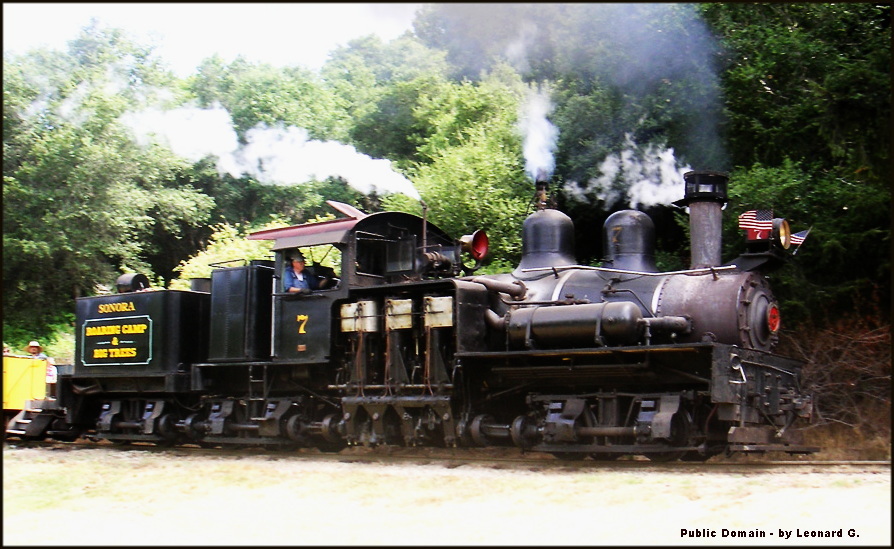
Lima Loco's Shay geared locomotive
Long before the merger with Baldwin, however, Lima Loco, as it was colloquially known, was already famous worldwide, for building some of the world’s finest steam locomotives. Founded in 1869, the firm was known, prior to 1878, as the Lima Machine Works.  But it was in that year that industrialist James Alley contracted Lima Machine to construct an innovative geared steam locomotive, specially designed by Ephraim Shay for the lumber industry.

The first Shay engine was completed in 1880 and became an instant hit throughout the US logging sector.  Over the next decade, Lima Loco would turn out some three hundred such steam engines. The Shay locomotives were low-speed, high-traction steam engines designed to pull heavy loads through mountainous terrain. But by the twentieth century, Lima Locomotive had largely covered that market, and was already turning to “super-power” steam technology.

Shay "Dixiana" logging train

This was a homegrown concept developed by Lima mechanical engineer William Woodward. His development concentrated on maximizing the locomotive’s prime capability—namely the generation and use of steam power. This so vastly increased the power and efficiency of Lima’s steam engines that the New York Central railway ended up buying more than three hundred of the Woodward-technology locomotives. While Lima’s production had earlier concentrated on pulling-capacity, the new locomotives of the nineteen-twenties were built for speed, and it was during that time, when my father was a boy growing up in that town, that Lima Loco became internationally renowned for building some of the world’s fastest steam engines. The maximum expression of this new breed of locomotive was the Berkshire 2-8-4, a powerful iron workhorse with a top speed of seventy miles per hour.

The Berkshire 2-8-4 super-power steam locomotive
In hindsight, the Lima Loco was, quintessentially, a steam locomotive builder, and it was superb at what it did. It was proud of that history and sought to hold onto to it, remaining ever loyal to steam. Seeing the writing on the wall, it was the new partner, Hamilton, that pushed to make the switch to diesel technology. Between 1949 (the year I was born) and 1951, Lima-Hamilton constructed just one hundred seventy-four diesels, making it the smallest diesel builder in the US.  Using Hamilton engine technology, more than three-quarters of the diesel locomotives that Lima-Hamilton built were thousand-horsepower switchers for use in America’s train yards. A rare few are apparently still in service today.

Lima Locomotive Works factory floor
But it was too little too late, and the 1951 merger with Baldwin could do nothing to save it. The firm simply couldn’t compete with big diesel-electric locomotive builders like Electro-Motive Diesel (EMD), Alco, and General Electric Infrastructure (GE). Sadly, in 1956, LBH closed its locomotive operations.

Despite this rich railroading history, what I remember most about growing up in a rural train town like Wapakoneta are the train whistles. Someplace in the back of my mind, from the time of my earliest years, I can still hear the shrill steam whistles. And from my early childhood, I can remember wanting to be at the tracks when the trains passed to see whether they were being pulled by a steam or diesel locomotive.

Lima Loco diesel, still operating freight runs in 2016

I was reminded of this when I was stationed in Germany for more than a year with the Army. I traveled a great deal by train at the time, and it wasn’t unusual then, in the early 1970s, for the German railroads to still use steam for switching and freight operations. It was exciting to see those heavy-breathing steam locomotives chug through, steaming, smoking and pulling with all their might.

But the most vivid memory I have of growing up in a train town is of the mourning doppler howl of the powerful diesels passing through, pulling seemingly never-ending formations of boxcars, flatcars and tankers. It always seemed especially poignant at night, lying in my bed in my parents’ home, and hearing it in the distance, as if in a dream. Or sitting after dark with my friend Mark on the roof of the shelter house in the park, smoking pilfered cigarettes and fantasizing about being on the lam, destination unknown. It was the background tune for our casual discussions of stories like Hemingway’s Nick Adams series or Jack Kerouac’s On the Road.

Now when I go back to Wapakoneta for visits, I stay in a tiny house known as the Moonflower Inn. One of the things I love about the place is that it is close enough to the tracks for me to hear the train whistles at night. It’s nostalgic yet comforting, like being back in my warm bed at my family home.

Indeed, wherever I travel, no matter how far, the sound of a diesel locomotive horn is always sure to carry me away, to take me back home to Wapakoneta.  


Friday, July 26, 2024

THIS IS WHERE I’VE BEEN…AND WHERE I WAS BORN

 Hopefully, some of you will have noticed that I’ve been missing in action for a while.  There’s a good reason for it. I’ve been putting the finishing touches on a new anthology of non-fiction stories (some people would call them memoir essays, but in the end, memoirs are just stories you don’t make up).

For anybody who’s not a regular reader of this blog, let me tell you what to the regular readers is already obvious. I’m from a small town in the US Midwest called Wapakoneta. Despite having been an expatriate former journalist living in South America for the past fifty years, I’ve written a great deal about the people, idiosyncrasies and history of Midwestern smalltown life. The stories I tell appeal (I’m told) to anyone brought up in smalltown America, and most especially to people of my own generation and the generation after. In other words, boomers and Gen Xers. But they are also apparently appealing to anyone interested in how folks lived before the Internet, before cellphones, before social media and even before television. Those are quite often the memories I relive and share with anyone willing to listen.

You needn’t remind me that, as I mention in one of the stories in this new book, I can write authoritatively about all of this because I am “older than dirt.” I cop to it and have even embraced it in my latest writing. Although I do recall what it felt like when I was one of the youngest foreign correspondents in Buenos Aires back in the seventies, and when I was the youngest general news editor in any newspaper in that city (which boasted a dozen daily and evening papers back then, plus a number of weeklies).

I guess nearly everyone would like to be young again. But as a writer, I’d only like to be young again if I were to know everything I know now. It’s not that I don’t still wrestle with doubts the way I always have. But my doubts now are experienced and educated doubts, not the scary existential and ignorance-based doubts of my youth as a guy who didn’t know nearly enough in jobs where you really had to know a lot.  

Anyway, mine, in general, is literature of broad appeal. But I also have specifically written a great deal about my town as sharing these common qualities of the Midwest, but also as being its unique Midwestern self. To start with, a town with a name no one will confuse with any other. Not a Springfield (there are thirty-five towns with that name in the US, plus the one on The Simpsons), a Lebanon (thirty-five), an Arlington (thirty-eight), a Centerville (thirty-eight), a Clinton (thirty-nine), a Franklin (forty-five), or a Washington (ninety-one), but Wapakoneta.

If you say you’re from Wapakoneta, some people might not know the name—"Wapaka-whosis?”—but surely no one will ask you “Which one?” And a lot more people know the name now than did when I was a kid growing up—even my ophthalmologist (a private pilot and aerospace buff) in Patagonia knows it—because Wapakoneta native son Neil Armstrong put us on the map. You would practically have to be a hermit, or never have opened a history book, not to know that Neil was the first person to ever set foot on the surface of the moon back in July of 1969. So, Moon Town is my town. Still, he’s not the only local boy (or girl) of certain widespread renown, even if he is indeed, and by far, the most famous.

But that’s not all that makes Wapakoneta unique. Like each person, each town has a story all its own. A story that usually includes beauty marks and ugly warts, proud moments and others you’d like to forget, moments of outright joy and contented happiness, and moments of tears and tragedy. 

In my latest book, A Place Called Wapakoneta, I strive to capture this essence. Sometimes the task is a little like trying to bottle lightning, but you go at it little by little, memory by memory, quirk by wonderful quirk in order to paint a portrait of a town and a story that you’ve never stopped loving, beauty marks, warts and all.

 This book could be loosely described as “a sequel” to my first two—The Rock Garden and Other Stories, and, Visions of What Used To Be—but is, by far, the biggest anthology yet. It contains a total of twenty-five non-fiction stories in a two hundred-fifty-page-plus book. And each story is accompanied by a related photo depicting the town and its history. The book also includes related portraits of other towns, specifically, Lima and Saint Marys, Ohio.

 The e-book and hard-cover editions are already on Amazon for pre-ordering (with deliveries scheduled for the first week of August). The paperback will go live on Amazon as of Sunday, July 28, the official launch date for this new book. 

https://www.amazon.com/stores/author/B003ZWKVEK

From a Place Called Wapakoneta will also be available for purchase at the Riverside Art Center in downtown Wapakoneta as of the first week of August. And I will be holding a book-signing event there in September. Check with the RAC for details.

I only hope all of you enjoy reading this book as much as I’ve enjoyed writing it, and that you too will feel the emotions and identification with it that I have in attempting, from my own point of view, to set part of my home town’s story down in order to share it with others, and to keep these memories alive after I’m gone. Because the only true history we have is the one those who lived it can share with us. The rest is pure revisionism.