Showing posts with label Lima OH. Show all posts

Saturday, August 31, 2024

TRAIN WHISTLES


I remember when I was about six, my first grade teacher, Miss Long, took us on a field trip. It wasn’t a distant one. Just from the Centennial Primary School to downtown Wapakoneta a few blocks away. I recall its being a bright blue day, crisp and cold, since we went first thing in the morning.

Wapakoneta train station, built in 1917

We gathered around the teacher like a gaggle of goslings, our breath visible in the morning air. We were on the cobbled platform of the old brick freight depot, on the west side of the Baltimore and Ohio rail line. I don’t know if, as usual, I wasn’t paying attention or what, but I remember asking myself what we were doing there, even if it was exciting and fun to be playing hooky from the classroom.

Then the teacher said, “All right, children, here comes the train.”

We heard the shrill whoop of a steam whistle in the distance, the tracks trembled, and then there was the chug-chug-chug of a steam locomotive, and more whoops of the whistle. We all squealed as the steam engine, pulling a freight formation behind it, hissed vapor that enveloped us on the platform. The train came to a stop at the depot and stood there huffing and sighing like some large, powerful animal that was taking a breather before chugging on. We could smell the coal burning hot in the fire box, and we could see the tender loaded with more mineral fuel behind the engine. Smoke, like our own breath, billowed into the clear morning air from the locomotive’s stack.

Reading Railroad #602 - Painting by Fred Schuster

We were too young to realize the historical significance of the event. We were witnessing the last stop of a steam locomotive in our town, and one of the last regularly scheduled steam freight services on the B&O line.

My home town of Wapakoneta is definitely a train town. Besides spurs that go to the site of the old stock yard and the now defunct cheese, canning, churn and handle factories, there is a main line that runs right through the center of town. When I was young there were still coal yards along the tracks.

When I was still a primary schooler, we lived for three years near a siding. It was at the end of our street, South Pine, on the east side of Wapakoneta. I had friends in the neighborhood who were as curious as I was. Both their mothers and mine had forbidden us to hang out on what was known as the “right of way”, a sort of grassy easement near the rail spur. They told us “dirty old bums” hung out there and, if we didn’t want our throats cut, we’d best steer clear.

Hobos riding the rails

Of course, we went anyway. We even had a treehouse down there. And the thought of its being a dangerous, threatening place, made it all the more attractive. We never saw any of the rail hobos our mothers told us about, but we did once discover unsavory evidence that someone had spent the night in our treehouse.

What we actually most liked to do was to pretend we were hobos, with just the clothes on our backs and riding the rails to exciting destinations. Occasionally, we would climb up into some boxcar left standing on the siding. We would pretend we were hiding out, being careful not to be seen by a railroad detective, made infamous by The Grit (a national newspaper targeting a rural readership), for tossing bums off of moving trains after beating the bejesus out of them.

There was only one time we did that with adult permission—although not that of the B&O Railroad. Centennial School was just down the alley from my house and the teacher took us all on a little hike down the road to the easement. It was for our primary school “Hobo Picnic”. It was a day when we all had to dress up, as best we could, like tiny rail bums and carry our lunch in a bandana tied to a stick over our shoulders. The teacher thought it would be more authentic if she took us down by the tracks, and, incredibly, she gave us all permission to climb up into a boxcar standing alone there on the rails.   It had been left with the doors wide open. It was empty except, at the far end, for a stack of still wet hides, probably, we figured, from the nearby stockyard. I still remember their raw, rank odor.

Old Wapak station in use prior to 1917
It was hard to live in Wapakoneta and not have trains in your blood. I mean, there were, and still are, townspeople irritated by the constant delays that having level-crossings all across town signifies. If you’re driving east-west from one end of town to the other, chances are good you’ll have to wait for a mile-long freight train to lumber through. But many of us who grew up in a train town found the passing of each rail convoy to be a satisfying if minor daily event. Many of us still love the click and the clank of wheels meeting the track, the jerking clunk of the couplings as the locomotive slows and accelerates, the rumble you can feel in your chest from the heavy formation rolling down the tracks, each loaded boxcar with a gross weight of a quarter-million pounds.

Another factor that made railroads special for us was that we lived just down the line from one of the world’s most renowned locomotive manufacturing operations, Baldwin Lima Hamilton. It wasn’t called that until it merged in 1951 with another famed locomotive-maker, the Baldwin Locomotive Works of Philadelphia. Before that, it had been known as the Lima Locomotive Works, named for its home base, the industrial city of Lima, Ohio, my father’s home town, located up the track fifteen miles north of Wapakoneta.

The Baldwin locomotive firm had been a railroading pioneer, founded in 1825. That was when locomotives were being built by hand, a time when there wasn’t even machinery to manufacture the huge cylinders that train engines required, and they had to be turned and bored by hand. The company was named for its founder, Matthias Baldwin, who was originally a talented gold and silversmith but with an obsessive interest in machinery and practical mechanics.

In the early days of his firm, Baldwin partnered with a talented machinist called David Mason. This was the beginning of the Baldwin Machine Company. But it didn’t become the Baldwin Locomotive Works until, after experimenting with steam-driven machinery for several years, Baldwin and Mason, in 1832, put together their first successful steam locomotive, which they called Old Ironsides, an engine they sold to a Philadelphia rail line that, until then, had been purchasing from a steam locomotive manufacturer in England.  

The Old Patagonian Express - La Trochita

I recall once, many years ago, waxing nationalistic on this subject, when I was watching a documentary in Argentina, where I live. It was about the Patagonian Trocha Angosta, a narrow-gauge train that once linked numerous remote destinations in the wilds of the Patagonian region—with a section of the rail link still operating today, but mostly as a tourist attraction, although some local residents still use it to get from point A to point B.

Once a thriving wild west frontier line, La Trochita, as it is fondly known—and better known to Americans as The Old Patagonian Express, since the 1979 best-selling travel book of the same title by Paul Theroux—employed a score of narrow-gauge steam engines, powered by coal from the Río Turbio mines of southern Patagonia back then, but today converted to fuel oil. Anyway, in this particular documentary, they explained that the little stretch of La Trochita that is still in operation is served by seven steam engines that are still operable. When asked about the make of the locomotives, a commentator said they were all Henschells and Baldwins, which he described as “English”.

Well now, at the time, I didn’t yet know that Henschell engines were German, but I sure as heck knew that Baldwins were American. And like a good native son from a Midwestern train town, I didn’t hesitate to get hold of the TV channel airing the program and give them a piece of my mind.

Baldwin's "Old Ironsides" - 1832

The Baldwin Locomotive Works struggled in the firm’s earliest years, living project to project for American railway companies. It went through especially difficult times following the panic of 1837, a US financial crisis that sparked a major depression that would stretch on into the mid-eighteen forties. For more than a decade after that, BLW would, to a large extent, live off of steam stock production for railways in the Southern states that were using the rails to an increasing degree to move their agricultural production.

The secession of states below the Mason-Dixon line over the burning question of American slavery practices seemed once again to spell hard times for the Philadelphia steam engine builder. But those concerns turned out to be short-lived. When the Civil War broke out, the Union military began moving troops, supplies and ordnance increasingly by rail, and steam engine production burgeoned as a result.

Baldwin would remain a powerful player in US railroading from then on, until the advent of diesel locomotives. Baldwin had difficulty making the transition from steam to diesel, which led to its post-World War II merger with the Lima Locomotive Works (by then known as Lima-Hamilton, after a previous merger with a machine-building firm based in Hamilton, Ohio).         
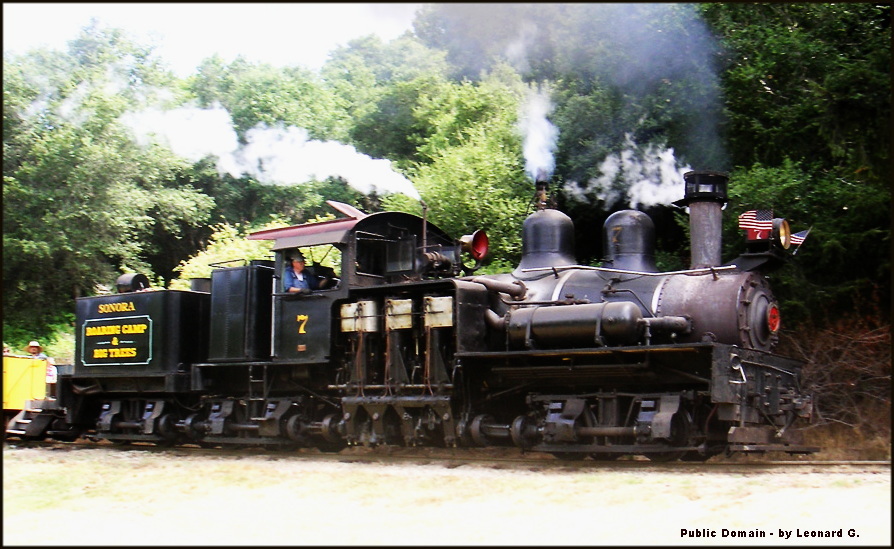
Lima Loco's Shay geared locomotive
Long before the merger with Baldwin, however, Lima Loco, as it was colloquially known, was already famous worldwide, for building some of the world’s finest steam locomotives. Founded in 1869, the firm was known, prior to 1878, as the Lima Machine Works.  But it was in that year that industrialist James Alley contracted Lima Machine to construct an innovative geared steam locomotive, specially designed by Ephraim Shay for the lumber industry.

The first Shay engine was completed in 1880 and became an instant hit throughout the US logging sector.  Over the next decade, Lima Loco would turn out some three hundred such steam engines. The Shay locomotives were low-speed, high-traction steam engines designed to pull heavy loads through mountainous terrain. But by the twentieth century, Lima Locomotive had largely covered that market, and was already turning to “super-power” steam technology.

Shay "Dixiana" logging train

This was a homegrown concept developed by Lima mechanical engineer William Woodward. His development concentrated on maximizing the locomotive’s prime capability—namely the generation and use of steam power. This so vastly increased the power and efficiency of Lima’s steam engines that the New York Central railway ended up buying more than three hundred of the Woodward-technology locomotives. While Lima’s production had earlier concentrated on pulling-capacity, the new locomotives of the nineteen-twenties were built for speed, and it was during that time, when my father was a boy growing up in that town, that Lima Loco became internationally renowned for building some of the world’s fastest steam engines. The maximum expression of this new breed of locomotive was the Berkshire 2-8-4, a powerful iron workhorse with a top speed of seventy miles per hour.

The Berkshire 2-8-4 super-power steam locomotive
In hindsight, the Lima Loco was, quintessentially, a steam locomotive builder, and it was superb at what it did. It was proud of that history and sought to hold onto to it, remaining ever loyal to steam. Seeing the writing on the wall, it was the new partner, Hamilton, that pushed to make the switch to diesel technology. Between 1949 (the year I was born) and 1951, Lima-Hamilton constructed just one hundred seventy-four diesels, making it the smallest diesel builder in the US.  Using Hamilton engine technology, more than three-quarters of the diesel locomotives that Lima-Hamilton built were thousand-horsepower switchers for use in America’s train yards. A rare few are apparently still in service today.

Lima Locomotive Works factory floor
But it was too little too late, and the 1951 merger with Baldwin could do nothing to save it. The firm simply couldn’t compete with big diesel-electric locomotive builders like Electro-Motive Diesel (EMD), Alco, and General Electric Infrastructure (GE). Sadly, in 1956, LBH closed its locomotive operations.

Despite this rich railroading history, what I remember most about growing up in a rural train town like Wapakoneta are the train whistles. Someplace in the back of my mind, from the time of my earliest years, I can still hear the shrill steam whistles. And from my early childhood, I can remember wanting to be at the tracks when the trains passed to see whether they were being pulled by a steam or diesel locomotive.

Lima Loco diesel, still operating freight runs in 2016

I was reminded of this when I was stationed in Germany for more than a year with the Army. I traveled a great deal by train at the time, and it wasn’t unusual then, in the early 1970s, for the German railroads to still use steam for switching and freight operations. It was exciting to see those heavy-breathing steam locomotives chug through, steaming, smoking and pulling with all their might.

But the most vivid memory I have of growing up in a train town is of the mourning doppler howl of the powerful diesels passing through, pulling seemingly never-ending formations of boxcars, flatcars and tankers. It always seemed especially poignant at night, lying in my bed in my parents’ home, and hearing it in the distance, as if in a dream. Or sitting after dark with my friend Mark on the roof of the shelter house in the park, smoking pilfered cigarettes and fantasizing about being on the lam, destination unknown. It was the background tune for our casual discussions of stories like Hemingway’s Nick Adams series or Jack Kerouac’s On the Road.

Now when I go back to Wapakoneta for visits, I stay in a tiny house known as the Moonflower Inn. One of the things I love about the place is that it is close enough to the tracks for me to hear the train whistles at night. It’s nostalgic yet comforting, like being back in my warm bed at my family home.

Indeed, wherever I travel, no matter how far, the sound of a diesel locomotive horn is always sure to carry me away, to take me back home to Wapakoneta.  


Friday, December 15, 2023

A MINIATURE ROAD TRIP

 When I was back in Ohio in November, one of the things I had on my to-do list was a mini road trip I wanted to take. I had never been to Alger, Ohio, and felt it was about time I paid it a visit.

I called up my friend Mary Jo Knoch, who is an incredible photographer, and asked if she wanted to come along and maybe snap some pictures. Mary Jo wasn’t very sure why I, or anyone else, would choose to go to Alger as a tourist destination, but said, “Hey, you know me. I’m always up for a road trip.

A vintage postcard of the Alger of yesteryear

Alger, for any of you who are unfamiliar with it, is a village of fewer than nine hundred souls, located in Marion Township, in Hardin County. It hasn’t always been called Alger. When it was first founded in 1882, it was known as Jagger, named after Elias Jagger, the man who laid out the plans under which the town first took shape. The name was later changed, however, in honor—and don’t ask me why because the village is nowhere near the northern state line—of twentieth Michigan Governor Russell Alger. It was finally officially incorporated in 1892. The town is located on Route 235, a few miles south of Ada, Ohio.  The village covers a surface area of 0.28 square miles. As my mother, Reba Mae, would have said, if you’re driving through, make sure you don’t blink or you’ll miss it.

For every one hundred women over eighteen in Alger, there are only eighty-two men. That might mean that men are in high demand in Alger. Either that or Alger women “order out.”

Ray Brown
Not surprisingly for a small town in rural Ohio, the population is more than ninety-nine percent white. But oddly enough, then, the most famous person ever born in Alger was an African American. I’m talking about Hall of Fame pitcher Ray Brown. Born in Alger in 1908, Brown played for Pittsburgh’s Washington Homestead Grays, a major team in the Negro National League.  Brown led the league in wins eight times between 1931 and 1944 and led it three times in strikeouts in 1931, ’37 and ’38. He was one of five famous black players named by the Pittsburgh Courier, in a 1938 wire to the Major League Pittsburgh Pirates, as being definite major league material. Accompanying him in that sports writers’ assessment were “Cool Papa” Bell, Buck Leonard, Josh Gibson and renowned Hall of Famer Satchel Paige.

Thinking about Ray Brown I can only reflect that it has to have been frustrating for truly great black players to always be relegated to the “semi-pro” Negro League, as if they would never be “good enough” for the majors because they were born with the “wrong color” of skin. Paige, who once played for the Cleveland Cubs Negro League team, provided an inkling of that frustration, saying:  "I'd look over at the Cleveland Indians' stadium, called League Park... All season long it burned me, playing there in the shadow of that stadium. It didn't hurt my pitching, but it sure didn't do me any good."

So anyway, why Alger? Well, whether I’ve ever been aware of it or not, like Ray Brown, there’s Alger in my veins. Let me take a moment to explain.

Murel Newland, my grandfather, didn’t often talk about his childhood. I always got the impression it had been less than fun. But I once heard him say something about “when he was a kid in Alger.”

I recall one story that my grandmother told about how Murel was always brawling. One of the times at school that he got into it with another kid, the teacher couldn’t find out who had started it, so decided to give them both a whipping—and I mean a whipping.  For that purpose, her weapon of choice was the long-strapped buggy whip she used to drive the horse that pulled her cabriolet carriage—this was sometime before 1910, perhaps 1908—the same year Ray Brown was born in Murel’s home town.

Murel was scrappy, if small, and known for being a capable and resilient streetfighter, as was the other boy. Indeed, the fight had been about who could take whom.  They really didn’t have anything major against each other except the need to protect their tough-guy reputations.

So, when it came time for their punishment, they both wanted to go first, to show who was the bravest. The teacher decided for them, taking the other boy by the ear, and leading him to a space open enough for her to get a swing at him with her whip. Murel listened from behind a divider to the repeated slap of the whip. Ten lashes, and the other kid didn’t let a whimper slip from his lips. He came out from behind the divider red-faced but tearless, and murmured, “Your turn Newland.” And then he waited there on the other side of the divider while Murel took his beating.

Murel’s opponent couldn’t have been more surprised when he saw Murel emerge from behind the divider with tears streaming down his face. According to my grandmother, the other kid came forward, put a hand on Murel’s shoulder and said, “Hey Newland, don’t let that ol’ bag see you cryin’. Come on! What’re you bawlin’ about. I’ve hit you a lot harder than that and you just bounced back up and tattooed the hell out of me. What’s the story?”

Murel looked down at his vest that was hanging open and askew in front.  “I’m not cryin’ about the beatin’,” Murel said, “I’m cryin’ ‘cause her goldarn whip cut the buttons off o’ my vest. My mom could barely afford this suit o’ clothes and she’s gonna be furious.”

Murel was, however, incorrigible. One of the other times he felt the lash at school was when he was climbing the stairs behind his teacher and couldn’t resist reaching up under her bustle and goosing her.

The only image I have of
Great-Grandpa Elmer,
accompanied, I believe, 
by Murel's only sister, Mame.
I never saw any pictures of Murel as a boy. In fact, I never saw pictures of anybody in my Grandpa Murel and Grandma Alice’s families until my father’s generation. It wasn’t much of a picture-taking family. I never knew Murel’s father, Elmer, but he appears to have been a rather severe, joyless man. And Murel’s mother, Maude Bowers Newland-Numbers, never struck me as an at all sentimental woman. She outlived two husbands—Elmer, and then Roy Numbers—as well as a “gentleman caller”, by the name of Mr. Hemingway, in between. But she never waited around for a man to provide for her and was always working at one thing or another. This included owning and operating a diner across from the Allen County courthouse in Lima, Ohio, a jail that is most famous for once holding notorious bank robber John Dillinger. Holding him, that is, until two other gangsters, “Handsome Harry” Pierpont and “Fat Charley” Mackley, walked in, shot the sheriff, and broke Dillinger out.

Just as famously—at least in our family—Maude, unbeknownst to her, served the two killers a meal just before they crossed the street and murdered Sheriff Jess Sarber. That was in October of 1933.

Sheriff Sarber

Although Murel lived much of his life in Lima, before moving, in his forties, to Wapakoneta, twelve miles away, he wasn’t, as I say, born there. He was a native of Alger. Elmer made his living as a barber there, and as soon as Murel was big enough to stand on a box and reach the clients in the barber chair, he became Elmer’s apprentice. 

One of the first things Elmer taught him, oddly enough, was one of the hardest: how to give a proper shave with a straight-razor. I can still recall my grandfather using a straight to shave when I was a boy. And he still made a barber’s ritual of it, heating water, soaking a hand-towel in it, and wrapping his lower face and neck in the steaming towel to soften his beard. He would then whip up a froth of shaving soap with his brush in a mug, and lather up slowly and fully with that same brush, before tuning up his fearsome blade on a razor strop, and then carefully scraping off his beard with it. I was in junior high before he deigned to switch to a safety razor in which he always used Wilkinson Sword Steel blades.

Great-Grandma
Maude Numbers
Murel would later—back when Lima, Ohio, was still nicknamed “Little Chicago”— get a job in the city, working in an upscale barbershop in a major Lima hotel. He would then go on to join another barber in opening a barbershop of his own at 38 Public Square, in the heart of downtown Lima.

Although I always enjoyed any stories of the “olden says” that senior members of both my father’s and my mother’s families would tell me, and although I had a more than a passing interest in talking to people from my parents’ and grandparents’ generations from the time I was very young, it has only been in the past decade or so—much too late to matter, perhaps—that I’ve lent even minimal interest to our genealogy. It started with random thoughts about how complicated the spreading branches of a family tree can be. I was considering, despite thinking of myself as a combination of the Newland and Weber clans, how many other families I was blood relation to: the Henrys, the Hamiltons, the Cavinders, the Leningers, the Hatterys, the Bowerses, the Gossards, the Landises, the Kennedys, etc., etc. Who were these people? Where did they come from, and how far back did our mutual roots reach?

However, there always seems to be something more pressing to occupy my time than actually taking a genuine interest in doing a serious genealogical study. Besides, knowing myself and my natural and professional bent for research, taking up a task like that could end up occupying the bulk of my time for the rest of my life.

Murel (wearing tie, standing) in his Lima barbershop
So, making the journey to Alger was a mere gesture, a one-day genealogical fishing expedition, and having an enthusiastic travel partner like Mary Jo along promised to make it fun.  Moreover, once we discussed it, she took a more than pedestrian interest. After all, besides being my long-time friend, she is also an honorary Newland, having been my first cousin Greg Newland’s significant other for forty years before his death.

The thing that had really piqued my interest was that a reader, who had seen a piece I wrote about Murel’s Lima barbershop, in which I mentioned, in passing, his “Algerian” origins, wrote and told me that she was from Alger, and that Newland was a well-known name there. There was even a diner there that was still run by some people named Newland, she said.

It didn’t take much research to find out that my family’s roots in Alger stretched back to at least the time of my great-great grandfather, Abraham Newland. Born in 1812, he was originally from somewhere in Pennsylvania, but had moved, as a young man, to Hardin County, on the site of Alger, in the Ohio Territory. I was excited to find evidence that his mortal remains had been laid to rest, in 1883, at Preston Cemetery in Alger.

Then, as usual, I got sidetracked. Although I made a mental note to visit Alger the next time I was back in the US for a visit, my research stalled at Abe. So when Mary Jo and I agreed on the road trip, it was more of a random long ride in the country with the Newland connection to Alger as an excuse for it.

Google Maps suggested there were several ways to get to Alger from Wapakoneta, where I was staying, but I just clicked START and let the Google lady’s voice guide me along the supposedly fastest route—Wapak to Lima on I-75, exiting at the Hardin Pike, and taking it to Route 235, which runs through the heart of Alger.

After we got off the Interstate, it was a lovely, bucolic journey, through the rural Ohio countryside, on a really gorgeous, crisp, blue-and-golden autumn Saturday. The trip took less than an hour. (There are shorter ways to get there from Wapakoneta, but the Google lady liked I-75, which, I now realize, took us out of our way).

Now, I should note that Mary Jo is a planner, and I could tell that my footloose, no-plan approach to things was making her uneasy.

“What’re we looking for?” she asked as I started coasting around the village at an almost pedestrian pace.

“Damned if I know,” I muttered. “A diner, I guess.”

“Take Lee Street,” she said, “It looks like kind of a main drag.”

We did, but you can’t go very far in Alger before you find yourself out of town again. Eventually, however, we did come across a place that looked as if it was, or had been a diner. But it was closed. Indeed, it looked permanently closed. Then, on Main Street, we came across another place with a big PEPSI sign outside. Mary Jo had a Google Map of Alger open on her phone.

"This appears to be a diner,” she said. “I think it’s the One Fourteen Diner.” But it was apparently closed on Saturday afternoons.

I said, “Okay, let’s try and find the cemetery, then we’ll come back.”


Consulting her phone map again, Mary Jo said, “Okay, turn left…Now turn right. Looks like it’s a couple miles out in the country.”

Shortly, we came to the cemetery entrance. It was a small, typical, rural graveyard, pretty much surrounded by fields, with the exception of a nearby truck repair operation. The internal streets were one-car narrow, and the graves came right up to them, so you couldn’t pull off without parking on somebody.

“If you want to get out,” I said, “I’ll drive to the back and find a place to put the car.”

Mary Jo, amused, glanced around in all directions. There was no one else in the cemetery. No one passing by on the road.

She grinned at me and said, “Doesn’t look like there’s much traffic.”

“Just in case,” I said.

“O-kay,” she shrugged, and got out of the car. I found the only cross-street, which dead-ended at the edge of a field, and left the car there.

"Found it!" cries Mary Jo before I even get started.

“We’re looking for anything that says Newland,” I called to her. “You go that way. I’ll go this way.”

Smart girl, Mary Jo had started perusing the inscriptions on the graves nearest the road. It stood to reason that the ones there would be the oldest graves in the cemetery.

“Found it!” she called before I even had a chance to start looking.

Mary Jo was standing in a section of the graveyard where the tombstones were quite old. So old, in fact, that the inscriptions on most of them were nearly illegible. I kept wishing I had some big sheets of paper and a chunk of charcoal to lift their reliefs. In the midst of all of these old stones, however, was a fairly new, modern headstone with the name Andrew Newland emblazoned on it. He was born in 1838 and died in 1910. I can only guess that there were still members of his immediate family or that he had been a pillar of the community, since his was the only Newland grave with a new headstone.

But what had Andrew been to me and to my cousin Greg. Both Mary Jo and I whipped out our phones and began an immediate, on-the-spot research project.

Andrew's new monument

“Looks like he was Elmer’s brother,” I said. “So our great-great uncle?”

Mary Jo found a site that gave more of the family genealogy and listed Syrus Elmer (strange spelling, but our great-grandfather’s actual first name, which may be why he went by Elmer) and Andrew as siblings.

“But wait a second,” I said, “Andrew was born in 1838, and Elmer wasn’t born until 1874!”  Further and deeper research was apparently going to be necessary.

Right then, and in the coming days, I would find out that Andrew and Elmer were half-brothers. Abe had lived to a ripe old age for those times (seventy-one) and outlived his first wife, Mary Kerns Newland, by twenty years. The couple had six children: Jeremiah, Andrew, William, Rachel, Sanford and Nancy.

Nancy Newland's grave
 in the Hattery plot.
Abraham later remarried, taking Rebecca Hattery, who was thirty-two years his junior, as his bride.  With Rebecca, Abe sired four more children—Melvin (1864-1920), Charles (1867-1943), Mary (1873-1938), and Great-Grandpa Elmer (1874-1932). It was interesting to find out just how closely linked to the history of the Village of Alger my family was. Even up to the time of Elmer and my Grandpa Murel. Of Elmer’s siblings, two, Melvin and Charles, are buried in Preston Cemetery. The body of Elmer’s sister, Mary Newland Shaw, lies in the cemetery in nearby Harrod, probably in her husband’s family plot. Elmer, for his part, is buried next to my Great-Grandma Maude, who lived to be eighty-six, in Memorial Park Cemetery in Lima, where my grandfather and grandmother were also laid to rest.

Of Elmer’s half-siblings, the only one not buried in Preston Cemetery is Jeremiah, a Sergeant in the 82nd Ohio Infantry of the US Army, whose body lies in a cemetery in Cass County, Nebraska. He was twice wounded during the Civil War at Chancellorsville, Virginia, and at Wauhatchie, Tennessee. I can only assume that it was the Indian Wars of the eighteen-sixties and seventies that took him to Nebraska, where he was probably discharged and later died, in 1886, aged fifty-one.  There is no record of the burial of their mother, Mary Kearns Newland, but she is listed as “probably buried in Preston Cemetery.” Nor does Abe have a tombstone any longer—natural wear and tear, vandals? Who knows? But there is indeed a record of his burial there. His second wife, Rebecca Hattery, is also buried at Alger’s Preston Cemetery, and we saw a Hattery monument within the area where the Newlands are buried while we were visiting the graveyard. We also found William’s tombstone, broken off of its base and lying flat in the grass under a walnut tree.

William Newland's stone, broken
off and lying in the grass
Andrew, like Jeremiah, served with the Union Army during the Civil War. He was a corporal, also with the 82nd Ohio Infantry. He was severely wounded at the Gettysburg, during the bloodiest battle of the war, in July of 1863. His wounds were such that he was discharged from further service and returned home to Alger. Despite this, he would live for another forty-seven years.

All of this rich family history, Mary Jo and I were able to glean from clues we found in the little cemetery on the outskirts of the Village of Alger, the town where the Newlands’ Ohio history appears to have begun.

“Let’s go back to town and see if we can find anybody who knows some Newlands that aren’t dead,” I suggested, and Mary Jo concurred.

Easier said than done. It seems Alger pretty much rolls up the sidewalks on Saturday afternoons, so it wasn’t like we had throngs of people on the streets to talk to. But we did find a convenience store open, where people were actually lining up inside to buy this and that.  When there was a lull, I walked up to the young woman behind the counter and said, apropos of nothing, “Hi! Do you know any Newlands here in town?”

Eroded to nearly illegible
She smiled amiably, but looked at me as if I were a lunatic.

“Sorry,” I said, “I’m a Newland. That’s why I’m asking.”

“Newland?”

“Yes.”

“You know, I don’t, but I’ve heard the name.”

“Yes,” I laughed. “Preston Cemetery’s full of them.” And then added, “Are you from here originally.”

“All my life,” she said. She was in, probably, her early twenties, so in all fairness, “all her life” didn’t cover a lot of history. “Maybe check the phone book?” she suggested helpfully, but she didn’t seem to have one.

“Thanks anyway,” I said.

Outside, Mary Jo had struck up a conversation with a guy in a pick-up truck. She introduced me and said he was a local contractor.

“Yeah,” the guy said, “we do just about everything you can think of in building and remodeling.” He handed Mary Jo his card.

“Well listen,” I said, “you must know a lot of people around here. My people are originally from here. Do you happen to know any Newlands?”

“I know there are some around,” he said, “but I don’t know them.”

After he left, I turned to Mary Jo and said, “Okay, I’m googling Newland – Alger, Ohio.”

Right away I got a hit: Newland’s Landing.

“Landing?” I said. “Is there water around here?” Then I saw the marker on the virtual map and calculated that it was nine miles south of Alger and was located on Newland Drive. I clicked START once again and let the Google Lady dictate a few twists and turns, until I realized that we were heading for the backwaters of the sprawling Indian Lake Reservoir. The fact that the Google Lady had taken us to Alger via I-75 North and the Hardin Pike had kept me from realizing that we could have approached from State Route 33, which runs right by the lake through Russells Point and Lakeview. In Alger, we were only a stone’s throw from the lakeshore.

Look more animated...

Shortly, the Google Lady ordered me to turn left onto Newland Drive. As soon as we made the turn, however, Mary Jo said, “Well, we’d better stop and get a few pictures of this.”

“What?”

“The road sign!”

“Oh right!”

So I pulled over onto the grassy berm of the narrow gravel road.

“Go over under the sign,” Mary Jo instructed. I stood there under it, stiff as a cigar store wooden Indian.

I heard Mary Jo go “Ummm…” But she didn’t finish the thought. She said, “Uh, okay,” and shot a couple of frames. I smiled and started to walk back toward the car. “Listen,” she said, “we’ve gotta do something about making you look more animated.”

...like this!
“Animated?”

“Yeah, you know, alive!  Here,” she said, “I’ll pose and you take a picture.”

I got out my phone and looked at the viewfinder as she used the sign post to strike a sort of pole-dancing pose. I took the picture.

Mary Jo said, “See what I mean?”

I went back over, grinned like a self-conscious moron, and pointed up at the sign.

Mary Jo shot a couple more frames, and said, “Well, that was better…” with the unspoken continuation of that phrase going “But, man! You have got to lighten up!”

Um...better.
We then got back into the car and I drove down Newland Drive, which dead-ended in a really lovely little resort. Newland’s Landing, obviously. If you were to look in the dictionary under the term “landing”, there probably would be a picture of this quaint little place.  It was on a picturesque back channel of Indian Lake. It had tidy docks and a boat livery with a concrete slip to launch small-craft off of boat trailers.  The administration was housed in a pretty cottage-style building that fronted on the channel. But most of the boats were covered and everything looked closed for the season. Indeed, although a chained dog was barking at us from a nearby house, the only two human beings stirring in the place were Mary Jo and me.

It was as we were taking a few pictures that I realized we had just debunked a family myth. Back in the day, my grandfather had done a lot of fishing in the Lakeview and Russells Point area. Sometimes he even took me along.

When he found out that there were Newlands in the area, Murel being Murel, he started knocking on their doors. To a man and woman, they said they knew of no connection between the Indian Lake Newlands and the Wapakoneta Newlands.

Now, something you should know about Murel is that for the last twenty-five years before his retirement, he was the quintessential high-pressure life insurance salesman, and his territory included the entire Indian Lake region. I’m quite sure—because he even tried to sell me life insurance—that whatever genealogical inquiries he made, were prefaced by a foot-in-the-door insurance sales pitch. So who, in their right mind, would admit to family ties, when letting this guy in would surely end up in an hours-long pitch designed to make you feel like dirt if you turned him down and refused to “provide for your family’s future?”
Newland's Landing, Indian Lake

The no-link myth was further underscored by Murel’s second wife, Floetta—a tee-totaling Methodist, and my grandmother’s first cousin—who, when my brother and I once mentioned the Indian Lake Newlands, told us, “Oh no, no. They’re no relation. Those are the drinking branch of the Newlands.”

This struck my brother Dennis and me as hilarious, since back then, in our thirties, we mutually prided ourselves on being able to drink each other, and everybody else, under the table. I said, “So, Bro, we’d better go hang out at the lake!” Floetta was not amused.

But now, standing here at Newland’s Landing, on Newland Drive, and with a slew of my Newland ancestors pushing up daisies in a graveyard just nine miles up the road in Alger, I couldn’t help but ask myself if the Indian Lake Newlands and the Lima-Wapakoneta Newlands “not being related,” wasn’t a bit too much of a coincidence to be credible.

Right then, I vowed that the next time I came back home to Ohio, I’d make a point heading for the lake, finding some members of “the drinking branch” of the Newlands, and toasting their good health.