Sunday, December 25, 2022

A TIMELESS MOMENT, OR A MOMENT IN TIME


Sometimes in dreams I will go back to a particular moment in time when the world seemed so perfect and beautiful that it brought a smile to my lips and tears to my eyes. These might be actual dreams, from which I awaken sad to have come out of the trance and desperately wanting to close my eyes and go back. Or they might simply be waking daydreams, where, for a moment I lose track of current reality and time-travel back to that exact instant and place.

What’s important about this is that the moment itself isn’t a dream. It is very real. It existed in real life, and exists still, if only in my mind. I consider myself fortunate that there have been more than one. Although, at the same time, it makes me sad that I haven’t been able to maintain a level of self-awareness that might have provided me with many more of these special moments, which are the only real definition of complete happiness.

These were times when I was momentarily blind to the crime, violence and dirt of the streets, and to the major problems of the world. They were moments in which all I was aware of was myself and my commitment to the path that I was choosing. It still happened to me, very occasionally, in my early years as a journalist, despite my job’s leading me to witness harsh, often even brutal realities on a daily basis. Perhaps back then I was more able to compartmentalize, to keep the reality that I was reporting separate from my own. Maybe it was even a survival mechanism. Who knows?

That’s probably why as I’ve gotten older and, hopefully, world-wiser, these moments have become, sadly, ever more rare. It’s that I no longer seem able to separate myself from the world I live in. And, search for them though I might, those moments of pure joy and self-realization are rendered practically unattainable, or at least they are no longer unadulterated.

I recall these special moments as timeless instances in which there came a sensation that everything around me was mere scenery that could be just as beautiful as I wanted to make it, and that, just beyond it, in a place I couldn’t quite touch or see, only sense, there was something else. Something more.   

Epiphany. I think that’s probably the word for it. A moment of lightning-bolt realization. An instant stripped of doubt, sorrow, regret, rage or cynicism. A moment of simply being, and knowing that that, in itself, is enough. That it’s a miracle. Life is. Being alive, breathing in and out, seeing, smelling, hearing, feeling, loving, that it’s all cause for indescribable joy. For a fleeting moment in time, you might capture it. You hold it in your heart and mind and it fills you. And then it’s gone. But not forgotten. It is branded on your heart and brain and, if you’re lucky, from time to time, it will come back and let you recall it as if it were a snapshot or a video that plays over in your mind, but one that includes more than image. Emotion, feeling, state of mind, all just like they were right then. It’s primitive, unbridled, so simple and pure that it’s an enigma.

Henry Miller - an epiphany
For author Henry Miller, for instance, that sort of moment was eminently literary. In Black Spring, Miller writes:“And then one day, as if suddenly the flesh came undone and  the blood beneath the flesh had coalesced with the air, suddenly the whole world roars again and the very skeleton of the body melts like wax. Such a day it may be when first you encounter Dostoievski. You remember the smell of the tablecloth on which the book rests; you look at the clock and it is only five minutes from eternity, you count the objects on the mantelpiece because the sound of numbers is a totally new sound in your mouth, because everything new and old, or touched and forgotten, is a fire and a mesmerism. Now every door of the cage is open and whichever way you walk is a straight line toward infinity...It was exactly five minutes past seven, at the corner of Broadway and Kosciusko Street, when Dostoievski first flashed across my horizon...”

Harper Lee - a new angle
For Harper Lee, author of To Kill a Mockingbird, that moment of epiphany is experiencing something that causes you to view a world you’ve known all your life from a different angle, and as if seeing it for the first time. She paints that instant through the words of her child protagonist, Scout Finch, when the little girl, as narrator, says, “I turned to go home. Street lights winked down the street all the way to town. I had never seen our neighborhood from this angle. There were Miss Maudie's, Miss Stephanie's—there was our house, I could see the porch swing—Miss Rachel's house was beyond us, plainly visible. I could even see Mrs. Dubose's... Atticus was right. One time he said you never really know a man until you stand in his shoes and walk around in them. Just standing on the Radley porch was enough.”

My moments of wonder have been much more pedestrian, if just as epiphanous. The first one I can recall happened when I was still a boy, an adolescent of sixteen. It was Christmas-time. I was from Wapakoneta, but nearby Lima, Ohio, had become “my town”. In our rural area, Lima was what passed for “the city”, a big industrial town back then, with an urban feel to it.

No one could have told me even a few months earlier that I would be where I was right then. I had been a drummer in a couple of “kid bands” that played in teen centers for a small cut of the meager cover charge. But then I got a part-time job working in Lima’s biggest music store and my whole life changed. Suddenly, I was in daily contact with all of the professional jazz musicians in the area and at sixteen, was playing as a relief drummer every Friday and Saturday night for at least union scale. It was a dream come true to still be in high school and to be working as a professional musician, a percussion instructor and a respected member of the staff at the music store. I knew every bar and nightclub with live music in the area. And I knew all of the best area musicians by name and was treated like one of them. I had my own car. I had my own money. I had my own life, even though I was still in high school.

The old Lima Public Square by night

It was around Christmas-time of that first wonderful year of dreams come true. The changes had opened up a whole new view of the year ahead. I was inspired to not only play every gig I could but also to give free rein to my other artistic endeavor by starting to take my writing seriously. And, therefore, to also take my reading seriously.  By the end of that year, the future I foresaw was as writer by day, musician by night, in a dream world that couldn’t get any better.

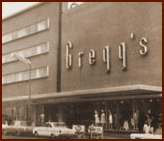
The special moment in time came one night when I was working at the store until nine. I had just been on my supper break. I had walked up Main across the Lima square and half a block up to Gregg’s Department Store, where they had a restaurant I liked on the upper floor. I’d had the ham steak with mashed potatoes with sides of green beans and slaw, washed down with iced tea. And while I ate, I finished reading, for the first time, what was to become one of my favorite short stories of all time—J.D. Salinger’s For Esmé With Love and Squalor.

When I came out, with Salinger’s words still ringing in my ears, the cold had turned sharp as a knife and the sky was mostly clear. Still, snow flurries were falling from some unseen cloud, since, overhead, the sky was infinity-black and dotted with glittering stars. The square was dressed for the holidays, with twinkling colored lights, wreaths, fantasy candy canes and bright red, green and gold ribbons everywhere. And in the middle there was a huge tree with magical lights, silver icicles and oversized ornaments to delight shoppers. Woolworth’s, Penney’s,  Sears, The Leader, Gregg’s and other downtown department stores glistened with holiday cheer, and on the corner, out in front of George Anthony’s Sweetland candy store, coffee shop and restaurant, a group of my newfound colleagues had formed a brass choir and were playing Christmas carols with that sweet, clear, harmonic brass sound that is like no other.

Between tunes they were passing a flask to keep warm and as I went by, one of them called out, “Hey kid!” and held up the flask offering me a snort. I laughed, thanked them and politely refused. And then, as I reached the other side of the square and headed south toward the store, I suddenly felt tears well up in my eyes and the thought that came to me was, “This might well be the happiest moment of my life.”  

As an adult, I remember a New Year’s in Buenos Aires. Virginia and I had invited a number of people to our Mid-town apartment to ring in the New Year. We’d held the celebration at home. I was off from the paper, since the next day was one of only a handful of non-publishing days each year, so I was completely relaxed. Lots of friends and some of Virginia’s relatives showed up, many after they had started bidding the old year farewell elsewhere. There was a surfeit of food and drink and good music on the stereo, and it had been a really fun time, capped by all of us standing together on our eighth-floor terrace, watching a plethora of fireworks burst in dazzling colors above the rooftops.

Then about two or three in the morning, people started peeling off a person or a couple at a time and heading for home. At last, it was just us with a couple with whom we had become intimate friends. They lived upstairs then, and we saw each other several times a week, sometimes daily, and dined together and went out together and took vacations together. We had become like family. Or like something more than family. We truly loved each other.

When everyone else had gone, our friends suggested we go downtown and get a nightcap—champagne, he was buying. So I got my car out of the parking lot around the corner and off we went, east toward the river and downtown along Avenida Corrientes. Partying was still underway in a lot of private homes, but from Mid-town to Downtown, traffic was sparse and many places were already closed, closing or had never opened. It was a rare thing, something almost magical to see the city so abandoned on a warm South American summer’s night.

Fireworks over Buenos Aires...A few hours later the streets
were deserted.

Stranger still was to see the ever busy Avenida Nueve de Julio, the city’s main north-south downtown thoroughfare, practically bereft of traffic. There along that main drag, we found a place that was still open. The refuse of year-end revelers was everywhere, but the fireworks were over with. The place looked jaded and its weary owners less than happy to see us. A little way down the street, a couple were sitting on the pavement, their backs to the front wall of a building, a liter bottle of beer on the sidewalk between them. She was leaning against his shoulder, looking a little the worse for wear, but he was still going strong, strumming the hell out of a box guitar and bellowing out the lyrics of every folk tune he could remember, his voice echoing in the deep canyon of Nueve de Julio where it cleaved a broad swath through the midst of towering buildings. There was no traffic to drown the singer out and he was making the most of this improvised amphitheater.

Inside the bar they were already cleaning up, but our friend talked the owner into letting us sit at one of the tables outside on the sidewalk, and into sending out a bottle of chilled champagne. Suddenly, what might have been the sordid scene of celebration’s end seemed mystical. As if the city were ours alone, with only the scraping guitar and rasping voice to entertain us, as we sipped ice-cold champagne under cones of light from the street lamps, in the grey glint of a sultry summer’s dawn. For perhaps an hour, the four of us sat there joking and laughing and just enjoying being together, putting aside our individual and collective worries and letting trust, love and cold champagne set the mood. By the time we drove back to Mid-town, we had the shimmering streets of Buenos Aires practically to ourselves.

Back home again, I dropped Virginia and our friends at the door of our building. I left the motor running and got out of the car with them. We all hugged and truly meant and felt it, warm as only love can be. Then I went alone to take the car back to the parking lot. It was as I was coming out of the lot that the sun suddenly broke above the horizon and flooded the street around me with the golden-orange first light of a summer day.

I turned to face it, closed my eyes and felt its warmth on my eyelids. My breath caught and a knot formed in my throat. I was completely, unequivocally grateful. It was a new year. I was writing daily for a living, I was married to the woman I loved, I was in the company of friends with whom we shared an almost passionate relationship, and a whole future of promise seemed to be stretching before me. A future that was mine for the taking.

It was a moment of almost uncontainable joy, and one that I would remember forever, even in the hardest of times.

First published in The Southern Yankee in 2019


Thursday, December 15, 2022

WHY I’M NOT HERE

 I’m not here today. I mean, I’m not supposed to be.

Actually I am supposed to be because today’s the fifteenth and the fifteenth is one of the two days a month that I regularly post blogs. But what I mean is, I’m not supposed to be because I’m not really allowed. Not according to my wife and my surgeon who are in cahoots on this.

Post-op portrait
See, two days ago, I had eye surgery. It wouldn’t normally have been a terribly big deal—cataract operation to put in an inter-ocular lens. But it was the second eye operation—same eye—this year. The first was in mid-February to remove a fibrous membrane that had developed on my retina, deforming it and eventually distorting the vision in that eye (the left) to the point where I couldn’t really see out of it any more.

I had to travel for that one, because they don’t do that highly complex operation here—here being the Patagonia ski resort near where I live. I had to take a seven-hour bus trip through the wilds of Patagonia to the next piece of civilization two hundred-fifty miles from here, a fruit-growing and oil city in the Río Negro Valley called General Roca. I stayed for a week in Roca, which is a pleasant town, and was operated on by an ophthalmological genius, whose excellent work saved me from losing the sight in that eye.

When the operation was over, however, the genius, Dr. Mancini, told me that my sight would very gradually return to normal, but that the retina surgery would almost necessarily cause the eye to form a rapid-growth cataract. So just as I started seeing well again, in five months or so, my sight would again be impaired by the cataract. But that, he said, I could take care of in Bariloche, where I live.

Now, that placed my need for cataract surgery at right around June-July. That’s mid-winter here in Patagonia. So I had an appointment to see an ophthalmologist at the eye clinic that had sent me to see Mancini in late June. But on that date there was a heavy snow and I couldn’t get out to drive the twelve miles from home to Bariloche. I had to cancel.

They gave me a new appointment for mid-July. But, just when the date rolled around, I got snowed in again and had to cancel. You would think living here, the folks at the eye clinic would understand about snow days. But they all live in town, I assume, and can walk to work if need be, so, no, they didn’t get it.

So, they kept putting me off after that until I was again nearly blind in that eye. And still they were telling me, “No, nothing available. Call us back next week and see if anything has opened up.”

Vindictive, I thought.

Finally, I decided to take the bull by the horns, went to see my medical insurance provider and asked them to recommend some other ophthalmologist. They did, and, as luck would have it, he, Dr. González Valdez, was a former colleague of Dr. Mancini’s. I got hold of Mancini to ask about his fellow doctor, and he told me that the man was a highly capable surgeon. Mancini highly recommended him.

I got in to see him pretty much right away. He assessed the situation and scheduled me for surgery right away. When he completed the procedure two days ago, he said it had gone very well and that I should go see him the next day. When I did, he said that while the operation had gone quite well, the retina operation made it more complex as did the fact that the cataract had grown quite tough, so getting the crystalline lens out to replace it with the artificial lens had caused some swelling in the cornea and had broken a blood vessel in the eyeball. But he said that the prognosis was excellent.

No hat? Like telling me to go naked!
Now he has me putting two kinds of drops in my eye every three hours day and night, and another kind of drops every eight hours. I can’t bend or lift or strain, can’t wear a mask, and can’t wear a hat or cap (that’s like telling me I have to go naked). He’s going to keep a close eye on me until I’m fully recovered.

Me, I’m really grateful to both surgeons. Although my vision is still somewhat blurred in that eye because of the swelling and hemorrhage, I am amazed at what I can see already! That was always—since childhood—my “bad eye” (the worst of the two, neither of which was ever perfect without glasses). I’m convinced that, once I’m fully cured, that’s going to be my good eye. And the light that comes into the eye now is nothing short of incredible to someone whose vision has been impaired for some time now.

Thing is, though, I’m sneaking this blog entry in, because, like I said at the beginning, I’m not supposed to be here!

So if you happen to bump into my wife or my doctor…sssshhh! You never saw me, okay?

Talk to you again soon.


Wednesday, November 30, 2022

EXERCISE ONE: SOME UNLIKELY PROMPTS WOULD-BE WRITERS ARE ASKED TO WRITE ABOUT

 There’s an exercise tool called “a prompt” used in a lot of creative writing courses. Personally, I’ve always thought real writers formulated their own prompts, which guys like me call “memories” or “topics”, but which trade fiction writers will usually just call “ideas”. Some will come from the odd offbeat item in a newspaper or magazine that sets a creative mind thinking. Others will form around some event or personality in history. Still others might grow around a psychological term—I just finished reading a book that was about a woman with “dissociative fugue”, for example. That’s a psychiatric term I had no idea existed before reading the novel. Nor did the author, apparently, since, in an interview, she talked about having read the term in a news article and having become so enthralled that she decided to write a story about a victim of it. In case you’re intrigued, the book is Love Water Memory, by my Facebook friend and fellow-writer, Jennie Shortridge.

Anyway, there are all sorts of writing courses, online and off, that promise to make writer wannabes into bestsellers, or mediocre writers into good ones, or to teach you the writing secrets of the truly talented—or, more importantly, of the commercially successful. But from my own experience in talking to other writers, I’ve usually found that the successful ones, if they’re honest, have little or no idea how they got there, and some very good ones indeed, who never meet with anything like conventional “success”, are just as baffled by their fate (and usually blame themselves). All of them, to a man and woman, however, say that none of these things should ever be a writer’s primary concern. The focus, they say, should always be on the writing, and it should always be about producing the very best possible writing of which you are capable. 

But, back to prompts. Although all of the writing I do either springs directly from my mind or from my constant research, I’ve always liked a challenge. That’s why, whenever I have a few minutes I can spare, I’m always curious about online quizzes. Not all online quizzes, but at least the ones that test areas of knowledge the answers to which any international journalist worth his salt should know: history, current events, geography, prominent personalities, etc. They’re a readily available way to exercise memory, which gets more and more important with age. I usually score high on them—many are too easy to waste any time on and I’m not kidding myself that any of them are anything more than click bait—and that makes me feel good, as Jack Nicholson says in As Good As It Gets, about me.

I mention this because something similar happens when I see grammar challenges or writing tools. And one of my favorite classes when I was studying public translation at the Argentine business university UADE in Buenos Aires was based on a book called For and Against in which students were given pictorial prompts that they were asked to write about. That’s why I can hardly pass up the opportunity to read a set of prompts. 

I have to admit, however, that they are usually disappointing, and highly unlikely, when not utterly outlandish. But just for fun, indulge me while I tackle a few.

Name the most terrifying moment of your life so far.  

I could probably say, quite credibly, that this was when I had a life-threatening accident and was bleeding out internally and, in the ambulance I heard the assistant tell the driver he couldn’t find a pulse any more. Oddly enough, however, I didn’t find that moment terrifying at all. On the contrary, right at that instant, in a physical state of suspension in which I felt no pain or urgency, when it was sort of like I no longer had a body to worry about, I felt incredibly calm. All I wanted to do was sleep, and I heard a voice in my head that said, “This is a lot easier than I thought it would be. You just close your eyes and let go.”

Fortunately, my life depended not on my own volition but on the stubborn persistence of emergency and hospital personnel. Which is why I’m still here writing this today.

I’ve had a few experiences in my work as a journalist that should have been terrifying, perhaps, but journalism’s a lot like the work of firefighters or law enforcement in that. When everybody else is running away from a dangerous event, you need to be running toward it. In those moments, you’re the job, so you aren’t usually concentrating on how scared you are.

Maybe the most terrified I’ve ever been, however, was during my first couple of days in the Army. Mostly because it was like being snatched out of everything I’d ever known and the soft existence of small-town life, only to be dropped into the midst of what seemed like a nightmare. A place stripped of comfort, where everything was very hostile, and where the job of the DI’s was to scare the bejesus out of the recruits, to take everything away from you and give you back only what they wanted you to have and be.

I’m sure for guys with tough upbringings in hostile environments it was a lot easier, because they had the tools to deal with it. But for guys like me, and for guys who were even more naïve and protected than I was, the first couple of weeks were a living hell, which was about how long it took to realize that your old life no longer existed and that you were a soldier now.

What famous person do other people tell you that you most resemble?

Papa...
This is an easy one. Hemingway. For those of you who say, “Yeah, but you don’t look anything like Hemingway,” all I can say is that I agree with you completely. But there you have it. People see a paunchy heavyweight with a white beard and steel-rimmed glasses, and the image is immediate: Hemingway.

As I writer, I only wish I could have that kind of recognizability and writerly fame. Alas…

I always spend some time in Miami when I’m back in the States and I never make a trip there that somebody doesn’t say, “Did anyone ever tell you that you look just like Papa Hemingway?” And every time, I say, “Personally, I don’t see it, but thanks.” And I mean it, because if I actually did look like Hemingway, well, there are a lot worse people to look like. I mean, imagine if they told you that you looked like Charles Laughton, or Peter Lorre. I mean what do you say? “Um, thanks?”

...and Dan...Who''s who?
Last guy who said it was a bartender last May in Downtown Miami. I sat down at the bar, ordered a beer, and the guy says, “Hey, did you ever compete in the Hemingway Look-Alike Contest down at Sloppy Joe’s.”

“Nope,” I said.

“You should, man. You’d win.”

“Only problem is,” I told him, “by the time Papa was my age, he’d been dead eleven years.”

Took him a minute to figure that one out. He went over and served a few drinks elsewhere then came back. “So how old are you?”

“Seventy-two.”

“Damn, you sure don’t look that old.”

“How about another beer?” I said. “And one for you on me.”

What is the strangest thing you’ve ever eaten?

People who aren’t from Argentina or Uruguay would think a lot of the things included in the typical asado criollo were quite strange. Everything from sweetbreads, to kidneys, to blood sausage, to chinchulines (crisp-barbecued beef or sheep small intestines) besides abundant beef cuts. But I was always partial to asado and there was never anything in it that I didn’t thoroughly enjoy—with the exception of only very occasionally included udder, which I always found rubbery and tasteless.

I recall when Whitie, my dad, came down to visit and my brother-in-law put on a big cook-out to honor him and Reba Mae, my mother. Reba Mae was always a good eater and dutifully tried, and liked, almost everything. Whitie, however, was suspicious of everything, as if these damned foreigners were out to poison him. He picked at the asado, said the meat was tough, didn’t want salad because there was no French dressing, and so on. So I sat by him and cut small pieces of things and put them like samples on his plate, which he politely nibbled at. But he finally put his foot down when I sliced him a crispy taste treat, put it on his plate and said, “Now this one’s called chinchulín.”

He pushed the plate a few inches away and said, “That’s called intestine and I ain’t eatin’ it!” He was right, but he had no idea what a tasty delicacy he was missing out on.

The strangest thing I ever ate, however, according to my taste at least, was when a fellow correspondent and his wife invited my wife and me to dinner one night in Buenos Aires. She had previously been married to a Japanese national and had lived a number of years in Tokyo. So she was the one who called the restaurant, inviting us to go to the city’s only authentic Japanese eatery.

I’d been saving up appetite for supper and, typically, we’d had a load of cocktails at their place downtown before going to the restaurant, so I was starving. I said that since she knew the place and the cuisine, perhaps she should order for all of us. 

Now, I’ve always been good about trying new things, but when the dishes started arriving, I was appalled. It was the first (and, I might add, last) time I’d ever seen sushi and I wasn’t even sure how to approach it. I was kind of waiting for a little charcoal stove to arrive at the table because this looked like something that might involve do-it-yourself cooking. But no, Emily, the hostess said cheerily, “Well, dig in!” and started transferring strands of seaweed and hunks of bait to her plate.

Virginia, my wife, who was at least as hungry as I was, looked like she was about to stab somebody with her fork and glanced at me like, “Are you kidding me?” But I didn’t want to offend our hosts so, little by little started working my way through some of the little seaweed and raw fish bonbons on the serving plates. I had thought it might end up being a nice surprise and that I’d find I loved it. It wasn’t and I didn’t and I swore this was the last time I’d be dining on baitfish chum and marine algae. I found it utterly revolting, and couldn’t help thinking I might end up with a tapeworm long enough to tie up the kitchen staff before I set the place on fire.

To make matters worse, the whole time I was nibbling on raw everything, I was catching wonderful whiffs of the most delightful barbecued beef smells, which, on our arrival, I could have sworn were wafting from the kitchen. When Emily said, “Now we should try some so-and-so,” I said, “Not for me, thanks. I’m stuffed.” And rose to go find the restroom.

A waiter pointed me in the direction of the men’s room, back by the kitchen. Along the way, I had to pass by a little private alcove where the presumed owner and his family were dining. To my chagrin, and feeling I’d just been had, I saw that they were contentedly chowing down, not on sushi, but on the most delectable Argentine beef you could ever want, and washing it down with a good Mendoza cabernet.

Do you believe honesty is the best policy?

This should have a yes-or-no answer, I suppose, but it doesn’t. Not for me at least. If the honesty we’re talking about has to do with our everyday dealings and transactions with other people, then yes, I do. It may sound old fashioned, but I think a person is only as good as his or her word and that there’s only one chance to prove it. Cheat me once, shame on you. Cheat me twice, shame on me. Once a person lies, cheats, or reneges on a deal or a promise, there’s no going back. Their word is no longer their bond and there can be no believing them in the future.

This extends to professional pursuits. That said, there are jobs in which honesty is difficult if not impossible. Advertising and publicity, for instance. I recall an advertising executive who was introduced to me as a possible contact for industry stories when I was writing for McGraw-Hill’s World News service. He handed me his card and said, “I’m general manager of this advertising agency. I’ve done dirtier things in my life, I suppose, but I can’t think of any off hand.” 

Another such job is being a spokesperson for a multinational, a billionaire magnate, or a politician. Those are jobs that intrinsically involve lying or altering facts to fit a narrative. Journalism is not supposed to be like that and in the best publications, it isn’t. Stories and facts are meticulously checked and rechecked and updated as new data becomes available in order to make every attempt to write the truest version possible of any given story. And reporters who don’t adhere to those rules end up getting caught out and fired, and will have a hard time finding a job in any serious medium after that.

But ever since the advent of “infotainment” (the combination of information and entertainment that has become a popular branding device in certain cable “news” operations geared to “spinning” the news rather than reporting it), what sometimes passes for journalism isn’t. And consumers get confused, because, unfortunately, there are apparently no laws that require infotainment to be identified as such.

In my own case, I never worked for a publication that spun the news, nor would I have. In fact, I was once offered a free-lance opportunity to work for the infamous National Enquirer as one of their correspondents in South America and turned it down flat, even though their pay rates were two to five times higher than those of any of the other publications I was working for. When the editor who contacted me asked why I wouldn’t take the job, I told him thanks a lot for the offer but if I ever decided to write fantasy, I’d become a sci-fi novelist.

Speaking of which, the term fiction is generally a misnomer. I remember bumping into an old newspaper colleague once who had recently decided to take a year or so off and write a novel. I asked him how it was going and he said, “It’s hard. After so many years of being a newsman and having to write the truth, it’s hard to write fiction and lie.”

I think my jaw literally must have dropped, because he looked at me for a second and then said, “What?”

“Well,” I said, “we may have a different idea of what we refer to as fiction, but to my mind, fiction should be the truest thing you’ll ever write. And what it certainly isn’t is lying.”

All of this aside, however, honesty is not always the best policy, at least to my mind. We all lie in one way or another. Even those who say they never do—that’s a lie right there, it almost can’t help but be.

I’ve frequently found that the people who pride themselves on “always telling the truth” either have a very subjective idea of what the truth is, or they fancy that what they “believe” and what they “think” is the truth and that everyone else is living in Fantasy Land. In other words, they’ve declared themselves Owner Of The Truth. That seems to go with an obsessively blunt personality. That is, they think that they are obliged to “tell the truth” whether anyone else wants to hear it or not. So if you ask them questions like, “Does this outfit make me look fat, or does this haircut make me look old?” they will answer “honestly” that, “Yes, you look fat as a pig and it’s not just the clothes!” or “Yes, you look older with that haircut; in fact, you look ancient!” You would have to be a masochist to be grateful to them for their response.

Furthermore, what does anyone gain by that sort of “honesty”? I suppose a coldly objective person might be able to see an upside, even if it escapes my comprehension. I mean, I recall a girl in high school who was a couple of years older than I was and about whom my sister told me a story that, at the time, made my blood boil. The girl in question (Sue, we’ll call her) had a shy, sweet personality and a kind, pretty face. She was what I might have referred to as “pleasingly plump”, but the fact that she didn’t fit the accepted standard of what the “cool girls” in school looked like, meant she wasn’t all that popular.

It seems she once confided to a friend that there was a boy on the football team whom she had loved from afar since grade school. Back then, before puberty and incipient sex started getting in the way, they had been friends and playmates, but since junior high, he hadn’t given her the time of day. The friend whom she’d confided all this to was indeed one of the popular girls, and knew the guy in question. So she decided to help her shy friend out and told the guy that Sue was crazy about him and asked why he didn’t ask her out.

The guy laughed derisively and said, “Well, if I could fit her through my car door, I might!”

Now this would have been no big deal if Sue were none the wiser. Her friend could have written the guy off as a jerk and never said anything to Sue about it. But this friend of Sue’s was one of those “honesty’s the best policy” people who felt obliged to tell her friend what a cretin the guy was to keep her from pining after him anymore. So she could think of nothing better to do than to tell Sue what the guy had said. Honesty, clearly, but, the best policy? To my mind, it was just unnecessarily cruel and subjective, and who’d asked her, anyway?

Some would say the story had a “happy ending”, since, because of that incident, Sue went on a diet, started working out, learned all about how to use make-up and clothes and, before graduation, had become one of the most popular girls in school, a girl who could pick and choose whom she wanted to go out with.

But my question always was, how much did she have to suffer to make those changes, and at what cost to her personality, happiness and self-esteem? More importantly, what does it say that the reason she made all those self-improvements didn’t spring from her desire to mold her own destiny, but from attempting to make somebody else eat his words and see what he was missing? Seems to me the football jerk was being given way too much importance, but I guess only Sue would be able to say whether she was grateful for her friend’s “honesty” or not.

And finally…   

If you joined the circus, what act would you most want to perform?

Saved this one for last because it’s the most typical of the typically outrageous things these self-help writing courses include. But never mind, I actually have an answer on the tip of my tongue.

When I was sixteen, I started working for the then-biggest music store in Lima, Ohio. I sold musical instruments, took inventory and did just about anything else around the store that my boss, Bruce Sims, asked me to do. But I also gave rudimental drumming lessons—meaning, beginning, intermediate and advanced snare drum lessons based on the twenty-six rudiments that every percussionist needs to know.

Now the store was near the main square in downtown Lima and was a veritable hub for musicians from all over the area, that covered at least three West-Central Ohio counties. So, working there, you were bound to meet every major musician, band and orchestra director, and private music teacher in the region. And you also made contact with a lot of people associated with music, entertainment and musical instrument manufacturing. For an ambitious teen musician, it was an exciting place to work, a place where you could feel at home.

But—as usual—I digress. Manager Bruce Sims knew just about everybody there was to know in the business in Ohio and elsewhere, and some of the most unlikely people you can imagine would drop by to say hello to him whenever they were in town. One early summer day, half a year before I would turn eighteen, I was standing behind the counter and Bruce was at his desk on the sales floor when this big guy walks in the front door and Bruce says, loud enough for him to hear, “Oh-oh, here comes trouble.” Then they both laughed, exchanged hearty handshakes, and sat down at Bruce’s desk to talk.
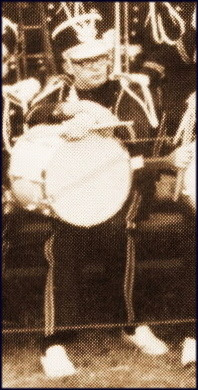
Dan - Drummer
I went about my business while they chatted, sold a girl some reeds for her clarinet and a guy a pair of drumsticks. But just then I overheard Bruce say, “Yeah, I’ve got one standing at the counter over there.” When I looked up from whatever it was I was doing, I see both Bruce and the guy looking my way, Bruce with his usual wry grin.

“One what?” I said. And Bruce, turning to the guy, said, “Best rudimental drummer money can buy.”

“Okay if I borrow him for a minute?” the guy says, and Bruce nods and says, “Sure.”

So the guy comes over to where I’m standing, introduces himself, shakes hands with me and says, “I used to be a musician here in Lima. That’s how I know Bruce.”

“Used to be?”

“Yeah, played a little trumpet,” he says. “Never much good, strictly a hack. But I like to stay close to it.”

“What can I do for you?” I ask.

“Well, for a number of years now, I’ve been a talent agent for a traveling circus.”

“Really? Interesting job. Never met anybody from the circus before.”

The guy smiled and nodded. Then he said, “Anyway, we’ve got a little brass band that travels with us and our snare drummer’s retiring.”

That was back before the Cirque du Soleil with its distinctive avant garde music. Back then, circus was all about Sousa marches and can-can burlesque. So rudimental drummers, parade drummers, were what a circus band would be looking for.

“They asked if I knew anybody,” the guy went on. “I said I did and dropped by to see Bruce. I know if Bruce says you’re the guy, his word’s good as gold. Interested?”

“Interested in what?”

“In playing with the circus.”

“Wow,” I said, stupidly, “Uh, well…”

“Pays ninety-five bucks clear a week and the circus pays all room, board and travel while you’re on the road.” Back in those days, the mid-sixties, that sounded like good money, considering that it was clear and all expenses paid.

I said, “I guess I should tell you that I’m still in high school.”

“No problem. You can do the summer tour with us and see if you like it and if we like you. The rest we can work out later. Get us a letter with your parents’ permission and we’re cool.”

“Can I think it over?”

“Sure, but not indefinitely. I’ll be back this way in a couple of days.”

By the time I was driving home to nearby Wapakoneta, I was feeling really excited. Playing with a circus band! You didn’t get an opportunity like that dropped in your lap every day.

Reba Mae had other ideas though. What about college, my mother wanted to know? And the circus! Did I have any idea the class of people that were in the circus? And what about the draft? It was the height of the Vietnam War, and if you weren’t in school after graduation, Uncle Sam would make sure you were in the Army. Did I think the Army would let me just keep traveling around with the circus after high school?

Whitie, for his part, heard me say I might join the circus and said, laconically, “Do whatever the hell you want, Dan. You always do anyway.”

But Reba Mae eventually wore me down and the circus became a could-have-been fantasy.

Years later, working in a newspaper in Buenos Aires, I had a colleague who, when things got chaotic, would always say, “I shoulda taken that job in the bank.”

And I’d respond, “I shoulda been a drummer in the circus.”

Prompts. Toss a writer a few and, no matter how unlikely they are, he’ll tell you stories all day.


Tuesday, November 15, 2022

ONCE A BARBER…

 My grandfather was a barber. I’m talking about Whitie’s dad, my Grandpa Murel Newland. A lot of people never knew him as a barber, because he did a lot of other things in his life. But he never forgot having been a barber—kept the tools of his trade all his life, razors, scissors, hand and electric clippers, barber combs and neck brushes. Kind of like someday he might just take it up again.

My Grandma Alice—she was a Henry before she married my grandfather, and her people were from Paulding, Ohio, her father a teamster when teamsters still drove horse-drawn wagons, the Henries on one side and the Hamiltons on the other—used to let me get the barbering tools out and look at them when Grandpa wasn’t home, because she knew I’d be very careful, whereas she never would have trusted my brother or cousins with them, especially the razors! But she realized somehow that I took these things as a curiosity, that my interest was almost “scientific”, that all I wanted to do was hold them and look at them and be able to picture them in my head, and picture Grandpa using them.

She did the same thing with a single-shot 20-gauge shotgun that my youngest uncle had left behind when he went into the Methodist seminary, and with the compact little Puma .22-caliber six-shooter that Grandpa kept under the front seat of his Studebaker for a lot of the years that he was a life insurance salesman in a few dicey neighborhoods. That was back when a lot of people still paid cash, and he would travel around his “debit”—which is what insurance men of those days called their sales territory—collecting premiums when they came due.

Sometimes I would ask her to tell me about when Grandpa was a barber. Grandma never had a problem telling you a story over and over. It was one of the things my mother, Reba Mae, criticized about her. “God!” she would tell my dad, “If I have to hear your mother tell the same stories over that I’ve heard a million times this Thanksgiving, I’m going to lose my mind!”

But I was only too glad to hear the stories again and again and sometimes she added some new detail that I’d never heard before. When I asked about Grandpa’s barbering years, she would go all the way back to when he was a little boy in the early nineteen-hundreds, living in Alger, Ohio, over in Hardin County. The village, which even today has a population that doesn’t reach nine hundred, back then was quite new. It had only been incorporated in 1896 and Murel was born in 1898. Murel’s father, Elmer Newland—his mother was the former Maude Bower—was the barber in town, and as such also, as barbers were back then, a sort of minor surgeon for every sort of wart, mole, cyst or small tumor, since to handle things like that in those days all you had to be was good with a razor. He also was the ad hoc dentist. Not that he could do bridgework, or fill molars or make dentures, but if a client was suffering and didn’t mind having a tooth pulled with a pair of fairly clean pliers, Elmer was your man.

Murel had been Elmer’s apprentice from the time he was still too small to reach the client without a stool to stand on. But the first thing Elmer taught him to use was a straight-razor, and the boy quickly became proficient at it.

When he was old enough, Murel would leave Alger and move to the “big city”. Indeed, the industrial town of Lima back them had a big-city feel. According to Grandma Alice, he first barbered in a major hotel—probably the posh Hotel Argonne, which now is an historical site, but which back then was a beautiful new piece of Lima architecture, constructed on downtown Elizabeth Street right after World War I, opening its doors to the public in 1919. But ever hot-headed and ready to fight at the drop of a hat, Murel couldn’t get along with the other barber who had also managed to get a chair in that fine establishment.

Alice always described the other barber as “a wop”. I had no idea what that meant, but I could tell by how she said it that she intended disdain. Later, I would retell the story to Reba Mae, and, following Grandma’s lead, would describe the barber in question as a wop. My mother stopped me mid-story and told me that just because Grandma Alice said things like that, it didn’t mean I should. I asked her what it meant and she explained that wop meant “without papers” and that it was a nasty term for Italian immigrants. She assured me that Italians were very nice people and asked me to think how I’d feel if I was an Italian and some little snotnose called me that.

I decided to eschew the word from my lexicon, and later consulted with Reba Mae whenever my grandmother used such other dubious terms as kraut, kike, wet-back, mick and spic. I didn’t think any less of Grandma Alice for it. I just figured she didn’t know any better, and that perhaps Reba Mae was the wiser of the two. Hers, then, was the lead I’d follow.

It seems that the enmity between the two barbers eventually boiled over and Murel ended up clocking the other man. Now, Murel never weighed more than a hundred and fifty pounds soaking wet, but he was absolutely lethal—as would be my Uncle Red after him—with his fists. Each blow arrived on target with every one of those hundred and fifty pounds behind it. In this case, it was an uppercut to the ear, that ripped the lobe loose from the other barber’s head and a right cross to the jaw that knocked him out.

Cook & Newland Barbershop, Lima, Ohio, 1925
After that incident, Murel was invited to give up his chair at the hotel and at some point after that, he opened up the new place in the basement of the pharmacy on the Public Square with a partner with whom he apparently got along famously. The Italian barber, for his part, started a rumor that when the doctor had sewn his ear back fast to his head, he’d told him that Murel couldn’t have done that with his fist, that he must have slashed the other man with his razor.

One day Murel took time out from work to drop by the hotel again. He walked into the barbershop and said to the other barber, who went pale when he saw him, “I hear you been a-talkin’ a lot o’ hooey about how I cut you with a razor. Tell you what, keep on a-runnin’ your damn mouth and I’ll be back to knock your other ear loose too."

The rumor dissipated and died.      

Anyhow, when I visited Grandma’s house, which I often did, I was allowed to get out all of those things—the barbering tools and the guns—and lay them out on the bed in the guest room or on the floor in front of the hall closet, where they were all kept, even while I was still in grade school. There was only one time when I proved unworthy of that kind of trust. But it didn’t happen at their house. It happened once while we—my family and Grandma and Grandpa—were on vacation together in the Upper Peninsula. We were staying, as usual, in one of the cabins at the Buckeye Rustic Resort, on Lake Manistee, which belonged to Murel’s old insurance partner, Morris Butcher. I must have been about six at the time. And I loved being there with Whitie and Grandpa Murel and Morris. I watched Grandpa’s every move, whether he was fishing or organizing his tackle, or going through his morning ablutions at the galvanized metal kitchen sink in that cabin that was basically one huge room, a small screened-in front porch, a utilitarian privy—just a rudimentary toilet—off of the porch and three bedrooms off of the big main room, the central feature of which was a large potbellied woodstove, and which served as kitchen, dining room, living room and extra sleeping room provided by a fairly comfy couch and a small, dusty, sleeping loft to which access was gained via a steep barn-ladder.

On the morning in question, I’d been watching Grandpa shave, while Grandma Alice and my mother, Reba Mae, were busy preparing a breakfast of eggs, bacon, toast and pancakes on the wood-burning cook-stove. It was, for me at least, a fascinating process, because Murel wouldn’t have thought of using a Schick electric shaver like Whitie did. And back then, he still even refused to use a safety razor—he wouldn’t do that until the advent of Wilkinson Sword Steel razorblades, which were the only ones, according to him, that could rival a straight-razor. He still shaved the way he’d been taught as a barber: standing in from of a little piece of mirror above the sink in his trousers and undervest, soaking his face first with a scalding hot towel over which he’d poured water directly from the teakettle, then lathering up with thick foam that he’d whipped up thoroughly by vigorously beating a bar of Williams Shaving Soap in a mug with his long-bristled shaving brush. It was a veritable morning ritual the climax of which was when, with long, clean, careful strokes of a gleaming razor that he had conscientiously stropped, before the whole process began, he would give himself the cleanest shave ever.

Then he’d say, “Feel that, Danny, what do you think?” And I’d run my hand across his jaw and say, “Smooth, Grandpa!” And then he’d say, “Smoothest shave you can get. There’s nothing like a straight-razor.”

On this particular morning, when Murel finished his shave and I didn’t miss a beat of the whole process, I waited until he’d wiped the remaining traces of foam from his face and razor with a hand towel and slapped on his Rexall Bay Rum cologne and expected to see him carefully put the slim razor away in his dop kit before going to the table for breakfast. But just then I heard Whitie call, “Hey Dad, come here a sec and look at this,” from out on the porch, and Grandpa left everything on the drain board and went out.

There was nobody right there. Whitie and Grandpa were out on the porch, Grandma and Reba Mae were busy with breakfast preparation, my brother was just a baby and still fast asleep and my big sister hadn’t gotten up yet either. I figured this was my chance. I whipped up the soap in the shaving mug with Grandpa’s brush and liberally soaped up my face and chin and throat, as I’d so often watched Grandpa do. Then I unfolded the gleaming blade. Grandpa had made it look so easy. So I imitated the way he held the razor to the best of my ability and scraped foam from one cheek with a long stroke, and then started to pull it down the opposite cheek. This time I felt a white-hot burn, and razor and foam came away scarlet. It was just then that I heard my grandfather shout, “What in tarnation are you doing you little dickens!”

And then he was there, snatching the razor out of my hand and quickly lifting me up under his arm to stick my face under the tap, before running icy well water on the wound to try and stop the bleeding. My mother, who heard the commotion, came running over and I heard her exclaim, “Oh my god!”

Murel said, “He’s okay, I’m just a-washin’ it off. Then I’ll put some styptic on that and he’ll be good as new.”

“Stypic!” my mother shouted.

“Just go on back over there and let me handle this,” Murel scolded, and, incredibly, she went.

Expert barber, he had the bleeding stopped in no time and sat me on the edge of the drain board and daubed the cut with a styptic pencil that burned like fire, but closed the wound up so that by later that day it was just a scratch. Reba Mae was furious with me and barely spoke to me the rest of the day. Whitie wasn’t even aware anything had happened. After lunch my Grandma Alice, who always amazed me with her sensible approach and with her unshakable calm in the midst of everyday emergencies walked up to me on the boat dock where I sat, rather dejectedly at having screwed up and been such an idiot, pretending to fish.

“Hey bub,” she said. “Whatcha doing?”

“Fishing, Grandma,” I said laconically.

“Catchin’ anything?”

I shook my head without turning around.

“Hey, look here a second,” she said. I put my fishing rod down, swiveled around on the rough planks and stood up.

She patted my head affectionately with one hand. The other one she was holding behind her back. “Tell you what,” she said, “Next time you feel like you ‘need a shave’, use this.” She brought the hand around from behind her back and handed me something. I took it and saw that it was a very old-fashioned Gillette safety razor with no blade in it. She realized all I wanted to do was imitate Murel and she couldn’t see the harm in it. She even gave me my very own can of Foamy shaving cream and I would enjoy standing by Grandpa applying foam to my face and scraping it off with the bladeless razor whenever we were together and it was time for him to shave.

I kept that old safety razor, and started using it with a real Gillette Blue Blade in it when I was thirteen and first started shaving. And I kept using it until I went into the Army at age twenty, long after Grandma Alice had passed away from cancer and Grandpa Murel had remarried to her first cousin, Floetta, who’d had a crush on him since she was a preteen.  

I was remembering all this because I recently came across a picture of Murel, before he was anybody’s grandpa, in his barber shop on the Square in downtown Lima, Ohio. It was an antique picture that somebody had posted on the memory site of my hometown, Wapakoneta. The back of the photo had an inscription in careful cursive that identified it as a picture of Bob Cook and Murel Newland’s barbershop under Thompson’s drug store in Lima. It also identified Murel as the father of Norm Newland, Whitie’s given name. It said that the photo had been taken circa 1925-26.

For the first time in my life, my grandfather’s barbering days were no longer just invented snapshots in my childhood imagination, the product of Alice’s tales of their youth. I now could see Murel, the twenty-seven-year-old, father of two boys, Whitie and his brother Red, who still couldn’t know that he would be the father of four boys and grandfather to twelve grandkids, a slight, cocky young man in an impeccable white shirt and tie, standing next to his barber’s chair in the shop he shared with his erstwhile partner. Suddenly, it was no longer family folklore, but documented history and it was as if I could embrace my grandfather’s youth as a fond memory of my own.